It is sweeter than any other melon we have tasted, which is why it has become a favorite among chefs. Gonis Melon, grown by Antonis Gonis, is one of those Greek agricultural products that makes us proud.
Antonis Gonis comes from Gargalianoi in Messenia, southwestern Greece, an area whose name has been closely associated with melon cultivation for decades. After finishing school, he left for Athens to study, but eventually decided to return home. Not long afterwards, he took over his father’s fields and set about developing them.
Today, his name is attached to one of Greece’s most recognizable melons, sought out by fine-dining restaurants. Gonis is a determined farmer, and we wanted to understand more about his relationship with the land, his extraordinary persistence and his devotion to the fields—a relationship that goes far beyond anything we had previously imagined.
Ask him about his product and he will tell you about the countless hours he spends walking through the fields. He will explain why he sometimes has to get up at two in the morning to irrigate them. He will describe how the soil, and even the leaves of the plants, are constantly giving him clues about what the crop needs.
And he is not saying any of this to create a romantic mythology around his work. This is simply how he understands his relationship with the land.
That helps explain how he took the 10 acres of melon fields his father, George, had cultivated with the same love and turned them into an organized business with a distribution network reaching both Athens and Thessaloniki.
None of this was what Antonis had imagined for himself when he left school. Yet he had always been fascinated by the way friends and fellow villagers celebrated his family’s melons. That was where his own story began.
“I realized there was something more than a simple crop”
You had built a successful career in sound engineering before deciding to return to Gargalianoi. How did that decision come about? Was it a spur-of-the-moment impulse or was there a strategy behind it?
It was something I felt had to happen. When you live in Athens, work in a field you love and things are going well, it is not easy to leave everything behind.
At the same time, I never wanted to sever my ties with my hometown. I kept going back. Whenever I took time off, I would be in the fields with my father. It was something that made me happy.
So, as the years went by, I realized that what I missed most was the lifestyle of the countryside. I began thinking that, by constantly postponing my return, I risked staying in the city forever.
Even then, though, I had never considered working the land.
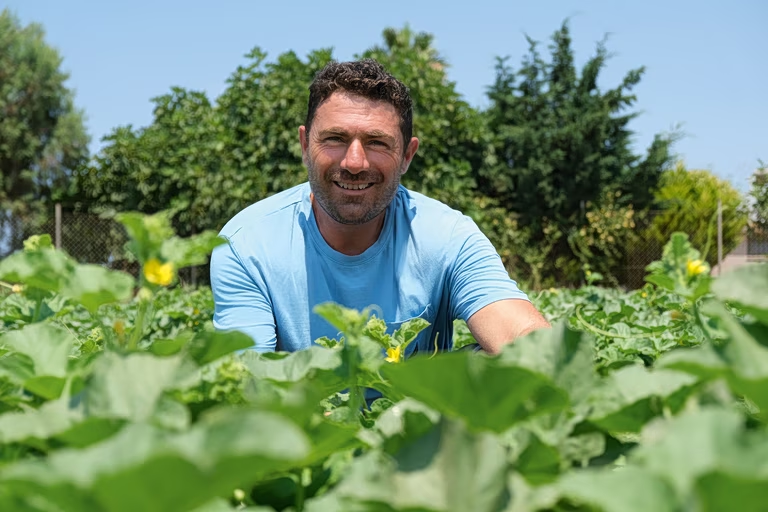
Antonis lived in Athens, where he worked as a sound engineer. Yet he always returned to Gargalianoi and the fields with his father. He soon realized that this was where he truly belonged. Photo: Lavrentis Choritais
What do you think was the biggest trigger that eventually made you decide to take over the family business?
When I returned to Messenia, I initially went into music. I was a DJ at clubs and had even opened a beach bar.
But I kept seeing people’s reactions to my father’s melons, and I began to realize that there was something more there than a simple crop.
Imagine that people leaving the village would take our melons with them to give as gifts. Or that we would get calls from Athens asking us to send them melons by transport company—something that, of course, made absolutely no financial sense for them.
I realized, then, that my father had created a crop that deserved more than simply having a good presence at the farmers’ markets in Gargalianoi or Kalamata.
I wanted to make our melon known beyond our region.
From the beginning, though, I was determined to try to do this without changing anything about the way we cultivated it, so that neither its quality nor its flavor would be put at risk.
“I read their needs by looking at the leaves”
You walk through your fields every day. What do you observe in the melons that helps you make the right decisions?
I can’t answer that precisely. It is something I have developed over the years.
By now, I understand the melons in the same way I would understand a person I had known for years. Just as that person would not need to speak for me to sense that something was wrong, I can sense it in them.
I know exactly when they are doing well and when they are lacking something.
The melon needs specific nutrients, such as magnesium, potassium and calcium. Its needs change depending on the temperature, humidity and condition of the soil.
I “read” those needs, usually simply by looking at the leaves. That tells me whether it needs more water, different fertilization or some other intervention.
In this work, it is important to know when to give the plant something and not to overdo it. By monitoring it day after day, I can intervene subtly and successfully.
So cultivation requires your presence every day?
Exactly.
Fertilization is not something you do only at the beginning of the growing season. You constantly monitor the plant, the soil and the weather. Every day is different.
Of course, that doesn’t mean you always get it right. There are years when extreme temperatures overwhelm you. Even two days of a heatwave can make a difference.
Nature always has the final say.
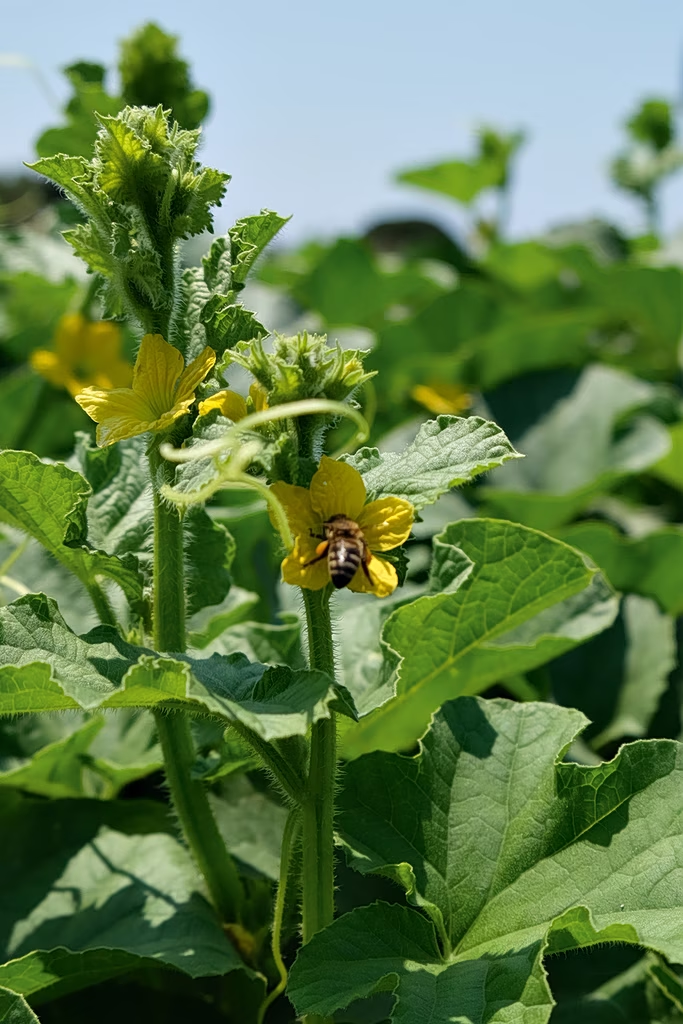
The plant requires constant monitoring, and working the fields is exceptionally demanding. Photo: Lavrentis Choritais
“It’s never been about quantity”
How many acres are you cultivating now? Are you planning to expand?
We have reached 40 acres, and I consider that more than enough because this is a demanding crop.
The truth is that I have always been interested not in quantity but in quality.
Of course, even with 40 acres there are ways to increase production. But many times that comes at the expense of flavor, and I would never enter into that process for any reason.
I don’t want to do anything that could threaten the character of our melon.
You are not a certified organic farmer, but you use practices that are very close to that philosophy, don’t you?
Exactly.
I am not certified, but the products I use are those approved for organic farming.
To deal with insects and diseases, I prefer alternative solutions. I use beneficial insects and other microorganisms that act naturally against pathogenic fungi.
All of this significantly increases the cost of cultivation, but in the end it rewards the quality of the product.
From Gargalianoi to Michelin-starred restaurants
Today your melon appears on the menus of important restaurants and has even reached a Michelin-starred restaurant abroad. When did you realize that what you had started had gone beyond the boundaries of a local crop?
Perhaps when chefs themselves began looking for me—and even chefs from restaurants abroad.
I remember when the French chef Bruno Verjus happened to taste my melon at a restaurant in Kalamata and asked to meet me. He actually came to the field to find me and see how the crop was grown.
We spent a long time talking exclusively about my work. That is how our collaboration began.
The same thing happened with important Greek chefs such as Tasos Mantis and Adam Kontovas.
These collaborations are another reward for my work and an incentive to continue with even greater enthusiasm.
As the product becomes more recognizable, does the responsibility increase too?
Very much.
When you know that a restaurant has created a dish based exclusively on your melon and has put your name on the menu, you don’t want to disappoint anyone.
A melon is not like a dish that you cook and can taste along the way. You can adjust the salt, add a spice, improve it until the very last moment.
Here, the rules are different.
My “dish” takes three months to prepare. During that time, I obviously can’t lift the lid of the “pot”, taste it and see what is happening inside.
And in this particular “cooking” process, someone else is constantly changing the heat—the weather itself, with its fluctuations—so things are even more demanding and unpredictable.
Farming in a changing climate
Has climate change altered the way you farm?
I adapt every year.
I am constantly testing new varieties that are better able to withstand high temperatures and sudden changes in the weather. I even use shade nets to reduce the temperature around the plants.
That is also why part of my production is always experimental. I sacrifice a section of the field to experiment with new varieties and discover what might work better in the years ahead.
A few days ago, in fact, I was talking with a Spanish representative of a seed company about the new varieties we are testing.
That is what interests me more than anything else: constantly learning and evolving.
Of course, things are not easy.
Most consumers, as well as greengrocers, are interested in melons that look better and last longer on the shelf. That is completely at odds with the flavor and quality of the fruit.
I insist that we need to focus on varieties that deliver flavor.
It is a battle I am constantly fighting.
It is important to convince the people developing hybrids that they should not be so focused on so-called “long shelf life” fruit.
Do you often travel to keep up with developments in the fruit industry?
Yes, and every trip is an opportunity to learn something new.
I attend international trade fairs, such as Fruit Logistica in Berlin. But even when I travel on holiday, I will definitely go into a greengrocer’s shop.
I will buy melons, watermelons and anything else I can find, simply to see what they grow and what their products taste like.
I never stop observing.
For me, that is perhaps the most important aspect of the job.
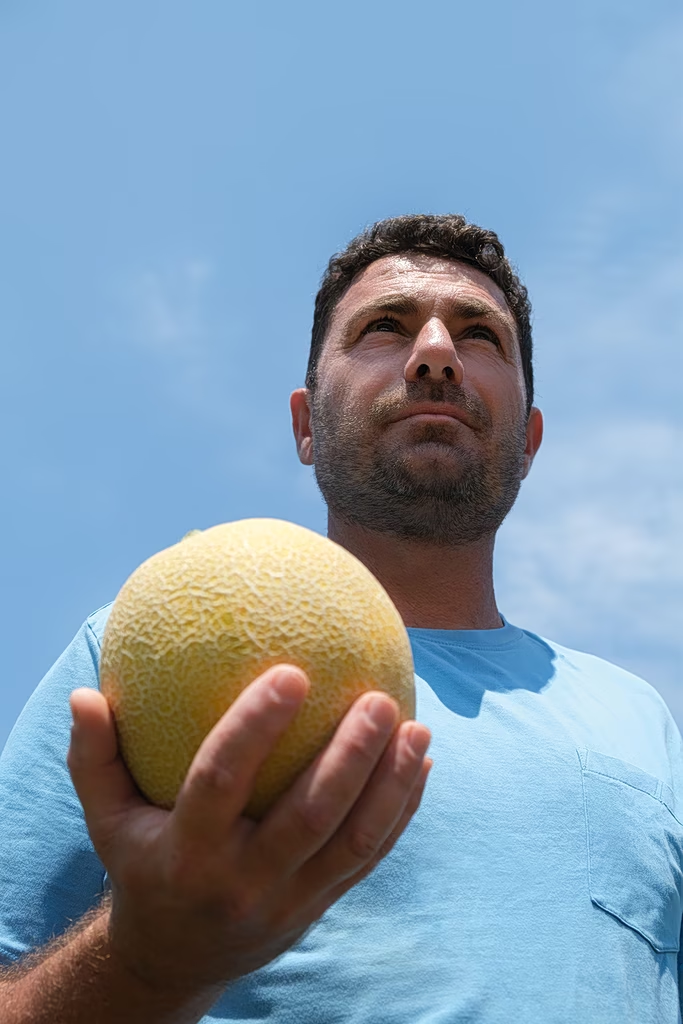
Antonis’ melons are exceptionally sweet—and there is proof: they have reached 18 degrees Brix, the unit used to measure the natural sugars in fruit. Photo: Lavrentis Choritais
The 18-Brix melon
You often mention Brix levels. What exactly do they measure, and how important are they for a truly good melon?
It is the unit used to measure the natural sugars in fruit.
When I started taking cultivation more seriously, I read that this particular Galia variety could reach up to 13 degrees Brix, and I assumed that was the upper limit.
At some point I decided to buy a refractometer to measure my own melons. I wanted to know what I was actually producing and not rely on assumptions.
When I measured them, they reached 18 degrees Brix.
That was when I realized we had achieved something truly special.
Of course, Brix is not the only criterion. It indicates sweetness, but the flavor of a melon also depends on its aromas, texture, balance and the way it has ripened.
Could Greek melon conquer Japan?
You have mentioned Japan several times, a country where melon is regarded almost as a luxury product. Is that a market that interests you?
Very much, because the Japanese treat melon with enormous respect.
I often watch documentaries and see how they evaluate their fruit. They measure Brix levels too, pay attention to every detail and genuinely pay for quality.
Years ago, I tried to send melons to Japan. I even made special wooden packaging.
But at the time I was disappointed by the process. Instead of explaining how I could make a small-scale export, they presented me with a mountain of bureaucracy and investment that was impossible for me to cover on my own.
Later, I learned that there were much simpler ways of doing it, but by then I had already abandoned the effort.
Even so, I have never stopped believing that such a good Greek melon could one day find its way into that market.
“It’s better to do one thing exceptionally well”
Why do you insist exclusively on melons when you could expand into other crops?
Many people ask me why I don’t plant watermelons or other products as well.
The answer is simple.
I believe it is better to do one thing as well as you possibly can than to do many things moderately well.
Growing melons is so demanding that it leaves me neither the time nor the inclination to seriously take on something else.
If I am going to do something, I want to do it properly.
The work never really stops
You are at the peak of your workload at this time of year. Does everything calm down from September onwards?
Not really.
People only see the harvest, but preparation begins in February, when the first plants go into the field.
Harvesting starts in May and continues gradually until the end of August or the beginning of September, depending on weather conditions.
After that, the fields are cleared and prepared again, ploughed, and essentially the preparation for the following year begins.
In other words, cultivation never stops.
There are simply periods of even greater intensity, such as summer.
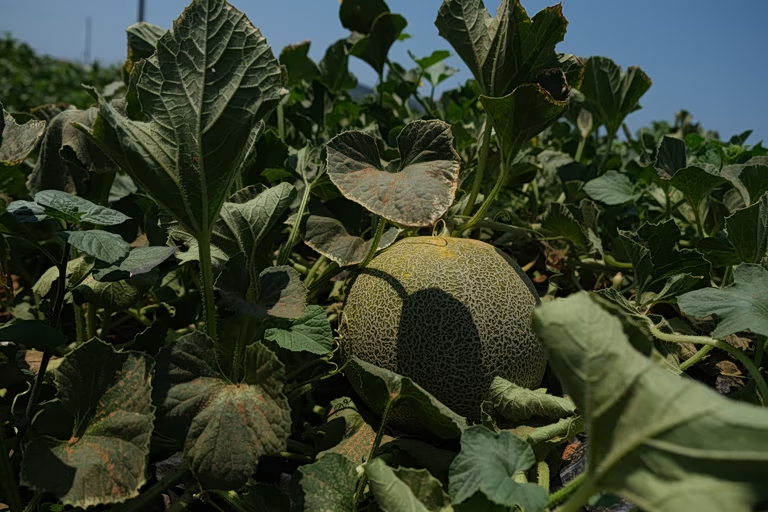
The cultivation never stops. Melon harvesting begins in May and continues until early September. Afterwards, the fields are prepared for the next planting season. Photo: Lavrentis Choritais
“The field needs stubbornness—and sometimes a little madness”
In recent years, there has been growing talk of encouraging more young people to return to the countryside and work the land. Do you think they could cope with such demanding work?
They might be able to, but before deciding, they need to understand the reality.
Working in the fields is much harder than most people imagine.
If they think they can operate like businesspeople and simply hire workers, they probably won’t achieve much.
The field requires stubbornness, persistence, personal presence and, sometimes, a little madness.
If you don’t genuinely love what you are doing, it is difficult to endure.
So what is ultimately the greatest reward?
I could consider it a reward that I have managed to sell my melon for much more than the average market price.
But that would be a mistake.
Certainly, I feel that all this work should be compensated accordingly, but much of the additional money goes straight back into the field.
So I have concluded that the greatest satisfaction I get is people’s trust.
And I earn that trust every day. I never take it for granted.
If someone tells me that a melon wasn’t as it should have been, I will go back and find out what happened.
I won’t brush it aside.
I want the consumer to taste the same excellent melon every time.
Only then can I sleep peacefully.