 Μake us preferred on Google
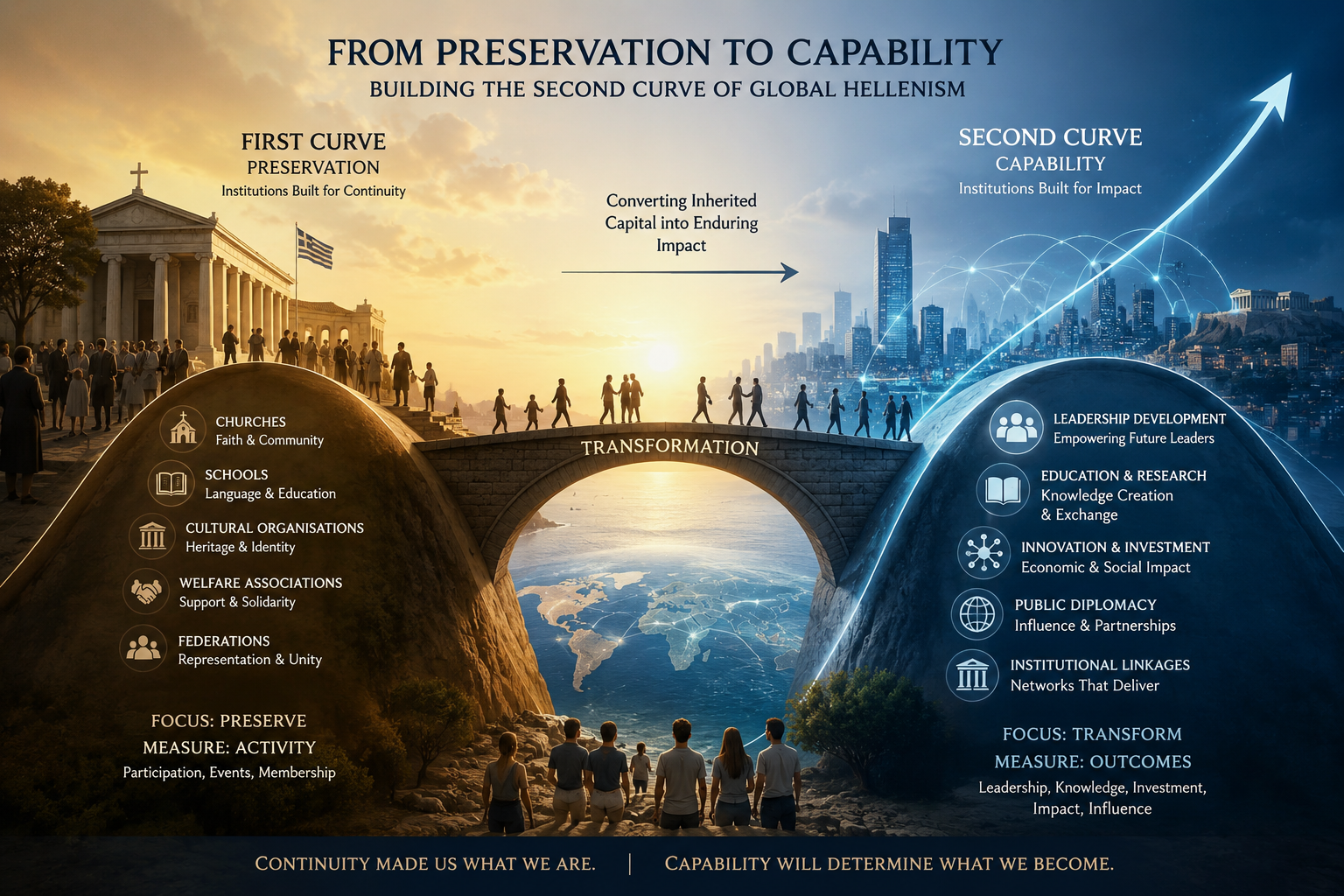
 Every successful institutional order eventually reaches what Charles Handy called the “second curve”: the point at which the structures that enabled past success begin to constrain future adaptation. The central question at that stage is whether dispersed knowledge, capital, and capability can be re-coordinated into new forms of effectiveness, or whether they drift into fragmentation and inertia as the original model loses relevance.
For global Hellenism, this question is no longer cultural alone. It is increasingly a problem of capital coordination under conditions of institutional dispersion.
Across Australia, North America, Europe, and beyond, the Greek diaspora has built churches, schools, philanthropic foundations, and community organisations that have preserved language, identity, and social cohesion across generations. These institutions solved a historically specific problem: the preservation of cultural capital under migration and geographic separation. While the argument is global, the Australian case is particularly instructive, given the depth and maturity of its diaspora institutional ecosystem.
Yet what succeeded as a mechanism of preservation is less suited to the next phase: coordination within an increasingly complex global environment.
From Cultural Preservation to Capital Misallocation
The underlying issue is not identity but the dispersion of knowledge and capability across weakly connected systems.
In complex societies, value depends on the coordination of dispersed information through institutional signals. Markets perform this function through prices, firms through hierarchy, and states through policy frameworks. Diaspora institutions occupy an intermediate space—neither market-driven nor fully hierarchical, and primarily oriented toward continuity rather than allocation.
As a result, global Hellenism contains substantial but only partially integrated forms of capital:
Financial capital accumulated through philanthropy and community assets;
Human capital embedded in highly skilled diaspora professionals;
Social capital expressed through dense transnational networks;
Cultural capital rooted in identity and shared heritage.
However, these forms of capital are not consistently translated into prioritisation, investment, or deployment.
The outcome is a structural inefficiency: significant latent value, but weak conversion into coordinated outcomes.
The Absence of Coordinating Mechanisms
In efficient systems, intermediaries aggregate dispersed signals and direct resources toward higher-value uses. In global Hellenism, such mechanisms remain fragmented.
Community organisations and diaspora bodies are typically designed for representation and cultural continuity rather than allocation. Their institutional logic is custodial rather than coordinative.
This creates a structural gap: there is no consistent mechanism that performs for diaspora capital what modern economic systems perform for financial and human capital—continuous evaluation, prioritisation, and reallocation.
The consequences follow predictably. Talent remains geographically dispersed. Networks exist but are under-leveraged. Assets accumulate but are rarely deployed at scale. Opportunities emerge in isolation rather than as coordinated portfolios.
The constraint is not a lack of resources but a lack of synthesis: dispersed actors hold partial knowledge, but no structure converts it into coherent system-wide decisions.
Diaspora Systems in Comparative Perspective
Comparative cases such as Ireland, Israel, and India illustrate alternative institutional approaches. Each has developed structured mechanisms linking diaspora expertise, investment, and institutional capacity with national development priorities.
These systems do not eliminate dispersion; they reduce coordination frictions across distance, sector, and generation. They provide partial answers to the problem of how to transform scattered capability into strategic national or transnational advantage.
By contrast, global Hellenism remains a fragmented system of loosely connected actors. It is rich in endowments but comparatively weak in mechanisms that align them with strategic priorities.
The reported sale of Hellenic Village in Sydney—valued at approximately $119.5 million—illustrates this tension. Its original conception extended beyond property development toward a multi-use institutional platform integrating education, welfare, and cultural infrastructure. Whatever view one takes of the transaction, it raises a broader question: why do diaspora assets so rarely evolve into scalable institutional platforms?
The issue is not intent but architecture.
Brain Drain as Structural Signal
A similar dynamic is visible within Greece itself.
Brain drain is often framed in demographic or cultural terms, but it is better understood as a mismatch between human capital and institutional absorption capacity. Skilled individuals exit when domestic systems fail to provide reliable pathways for productive deployment.
This reflects friction in the allocation of talent: capability exists, but institutions do not consistently convert it into opportunity.
Within the diaspora, a parallel dynamic emerges through generational disengagement. Younger cohorts are deeply embedded in global professional networks while remaining loosely connected to inherited organisational structures.
These are not separate phenomena. They are parallel expressions of the same structural condition: institutions built for preservation operating in an environment that now demands mobilisation.
In both cases, the underlying issue is alignment failure between available capability and the mechanisms required to organise it.
Toward a Diaspora Capital Architecture
The central question is therefore not cultural preservation but institutional design: what would a more coherent architecture for global Hellenism look like under conditions of dispersion?
At minimum, it would require functional equivalents of coordination infrastructure:
Platforms that map and connect diaspora expertise across sectors and regions;
Institutions that prioritise initiatives through transparent criteria;
Financial vehicles that convert philanthropic capital into structured investment outcomes;
Systems that match knowledge, opportunity, and funding across jurisdictions in real time.
These are not traditional cultural bodies. They are coordination infrastructures designed to reduce fragmentation and improve the alignment of dispersed resources.
From Cultural Stock to Coordinated Flow
The evolution of global Hellenism can be described in structural terms. The first phase built a durable stock of cultural capital: identity, continuity, and institutional presence sustained across generations and geographies. The second phase requires the development of flow—the continuous mobilisation of dispersed resources into coordinated, high-value outcomes.
The challenge is no longer preservation. It is whether existing assets can be connected, evaluated, and deployed at scale.
Without stronger coordination mechanisms, diaspora capital remains substantial but underutilised: rich in potential, weak in conversion. With them, it becomes a distributed system capable of sustained impact across borders and generations.
The underlying tension is therefore not between continuity and loss, but between fragmentation and coordination. In that sense, global Hellenism is not only a cultural inheritance, but an unresolved problem of system design.
Dr. Steve Bakalis is an economist and has worked with La Trobe University, The University of Melbourne, Victoria University, and universities across the Asia-Pacific and Gulf Region.