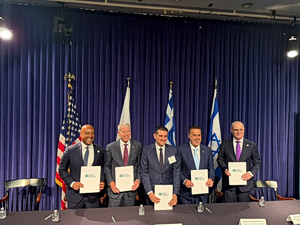
By the time the East Med Energy Center was inaugurated in Houston, Texas, Joshua Volz had already become the American official most closely identified with a project that began as a congressional idea and grew, for a time, into something far more complicated.
The center was created to give structure to energy cooperation among the United States, Greece, Cyprus and Israel, a partnership that had gained momentum in Washington after the passage of the East Med Act in 2019.
But according to people familiar with the planning, the project’s path from legislation to launch was marked by delays, shifting designs, uneven coordination with Capitol Hill and confusion among some pro-Israel stakeholders who had originally the center as a practical way to reinforce the growing partnership among the United States, Greece, Cyprus and Israel.
The center did eventually open. But the route it took revealed how a project conceived as a geopolitical instrument can lose clarity once it moves through Washington’s bureaucracy.
When Congress approved the East Med Act, several people involved in the issue expected the center to be developed through the State Department’s Bureau of Energy Resources.
That office had already served as the main diplomatic channel for American energy engagement in the Eastern Mediterranean. Francis Fannon, who led the bureau during the first Trump administration, had built relationships across the region. Geoffrey R. Pyatt, who later succeeded him as assistant secretary for energy resources after serving as ambassador to Greece, carried that work forward from Athens and then Washington.
In that context, the East Med Energy Center was not understood simply as a research project. It was part of a wider diplomatic design: to use energy cooperation, infrastructure and regional partnerships to deepen the American role in the Eastern Mediterranean at a time when Greece, Cyprus and Israel were drawing closer together and Turkey remained outside the arrangement.
In practice, however, the project moved to the Department of Energy and became associated with Mr. Volz, the special envoy for energy integration. Under his stewardship, according to people familiar with the discussions, the early concept took on a more elaborate shape than the version ultimately presented in Houston.
One proposal reviewed in the early stages would have assigned different parts of the East Med Energy Center to three universities in the United States and three universities abroad. The idea suggested ambition, but it also raised immediate concerns among people involved in the process.
The available funding, they said, did not appear to support a structure of that scale. Nor was it clear that a six-university model would be easy to manage for a center whose political purpose was already delicate.
The experience of the U.S. Israel Energy Center in Louisiana was also cited by people familiar with the discussions as a cautionary example. A narrower bilateral center required disciplined management, a clearly defined mission and sufficient resources.
That raised an obvious question about the early East Med proposal. How could a broader regional project begin with a six-university plan and no simple explanation of its purpose?
At different moments, it appeared to be a diplomatic platform, a technical research body, a university consortium and a policy hub. The lack of a simple answer, according to people familiar with the planning, contributed to delays and to uncertainty around the project’s identity.
The problems were not limited to the design.
On Capitol Hill, people familiar with the original legislation said that congressional offices that had supported the East Med Act were not always kept closely informed as the center evolved.
That mattered because the project had not emerged from a narrow bureaucratic initiative. It had been part of a broader political effort to anchor the relationship among the United States, Greece, Cyprus and Israel.
The center had drawn support from American Jewish organizations, including the American Jewish Committee, and from lawmakers associated with the Congressional Hellenic Israel Alliance. For those constituencies, the project was meant to reinforce the partnership between the Hellenic and pro-Israel communities in Washington.
Instead, according to people briefed on the discussions, the way the project was presented created confusion in some pro-Israel circles. Some lawmakers and aides wondered whether the East Med Energy Center would overlap with, or even compete against, the U.S. Israel Energy Center.