Forty years after she first visited Athens and, as she puts it, “fell in love” with the city and its history, Hughes returns to it through a new international documentary about the world’s most important cities. Athens is the first city in the series. As she explains, the producers considered this an obvious choice, since it is a foundational city, one that played a decisive role in helping us understand who we are and what Europe is.
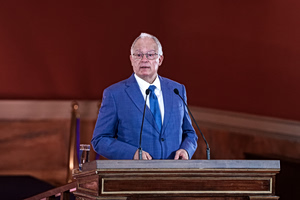
As part of ΤΟ ΒΗΜΑ’s two-day conference “Dialogues for Athens: From Myth to the Modern City,” British historian Bettany Hughes joined Odin Linardatou, editor-in-chief of ΤΟ ΒΗΜΑ International Edition, for a conversation titled “Athens Through the Eyes of Others.”
The British historian spoke about a city with a history of roughly 6,000 years, about the power of memory and heritage, and about what ancient Athens can teach today’s society: the value of cooperation, harmony, and questioning, the dangers of fame and persuasion, and above all the need for a city to constantly ask itself questions.
For Hughes, a strong city is not one that looks for easy and rigid answers, but one that has the courage to question, think, and reexamine itself. And perhaps this is the most modern image of Athens to emerge from the conversation: a city that inherits not only monuments but also ideas, and that must decide which of them it will leave as a legacy for future generations.
What still makes Athens recognizable and influential far beyond its borders? How does its ancient heritage translate into the modern world, and what does Athens mean to those who view it from a different geographic and cultural starting point?
With the perspective of a historian who has dedicated much of her work to the ancient Greek world, Hughes set out to trace this legacy around the world, shedding light on an Athens that does not belong only to the past but continues to speak to the present.
The City That Made a Historian
“I am the ultimate embodiment of the benefits of xenia,” Hughes said as she opened the conversation, referring to Greek hospitality. Her first visit to Athens, forty years ago, was what led her to decide to become a historian. “I owe this city so much.”
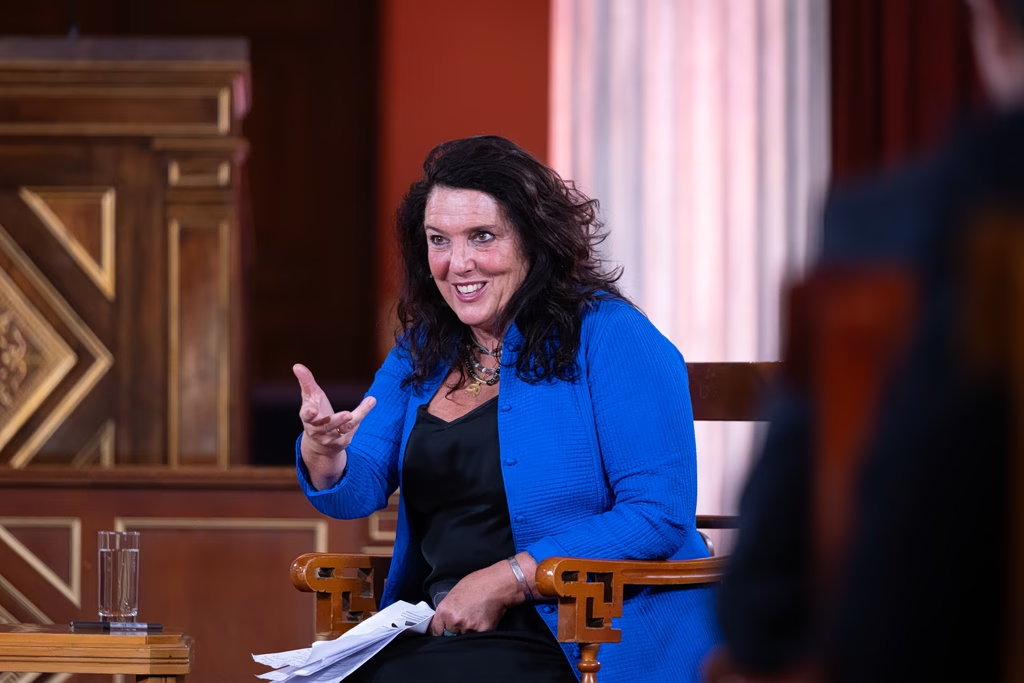
The Historian Bettany Hughes
That debt is currently being repaid, with the new documentary series about the world’s greatest cities, with Athens in the first episode. It will premiere in the United States in January, in Britain in February, and internationally early in the new year. Hughes also revealed that her next book, due out in four years, will be a biography of Athens.
“The Asty”: A City That Knew How to Promote Itself
“Why, has Athens held such a strong place in the world’s collective imagination?” Odin Linardatou.
Hughes started with the word itself. “From antiquity onward, the city simply called itself ‘the asty,’ the town. It didn’t even need a name.”
She followed with a remark that drew smiles from the audience: “Athens has always been, and I have to give credit to you and your ancestors, very good at public relations. It always knew it had to promote itself to the world. Sometimes with complete honesty, sometimes with a slight ‘massaging’ of the truth.” The Parthenon played a decisive role in this, a symbol that, as she noted, Paris, London, or New York acquired much later. That is why, in her view, Athens has an unusually strong visual presence in the world’s collective imagination.
Beyond the “Golden Age”
The filming experience itself reminded her of something we often forget. When she posted material on social media about the medieval graffiti on the Parthenon and about the route through the Roman aqueduct, which is now being restored and waters the city’s parks, two users politely reminded her that Athens is an “ancient Greek city,” not a medieval or Roman one.
“It’s important to remind people that this is a city with a very long life, around 6,000 years,” she said, “and to talk beyond the golden age of the Greek miracle.”
From the same documentary series, she offered an example directly relevant to Athens. “In Sofia, the way they have embraced the underground city is incredible. People now go there to see the Roman and late antique finds beneath the city. It’s something Athens could perhaps continue to do.”
Living With the Past
The Athens of Pericles, Hughes argued, is visible not only in its monuments but also in how we think. We are creatures of memory, and we cannot think about the future without drawing on something we remember. “We should never live in the past,” she said, “but we are foolish if we don’t admit that we live with it.”
This value becomes clearest in difficult moments. “In times of crisis, in a natural disaster, in the pandemic, or in wartime, people turn desperately to heritage buildings, because they know a collective experience exists there.”
Her love for the city does not cast her in the role of a hagiographer, however. When Odin Linardatou asked whether the ancient Athenians had warned us about dangers, Hughes, who introduced herself as a “great philhellene,” replied that “there is a real danger in wearing rose-tinted glasses when we think about the city, its past, its present, and its future.”
Harmony, Fame, Persuasion
The first lesson concerns the difficulty of living together. “A city is a difficult thing,” she observed. “It is hard to live in harmony with all these complex ideas, competing ideologies, individual egos. The ancient Greeks understood this completely.” That is why, she recalled, the Athenians worshipped Aphrodite as both Harmonia and Homonoia, and knew that cooperation among citizens required rituals that fostered unity.

The second lesson concerns words. “Fame originally did not mean glory or celebrity. It meant gossip, rumor, slander.” It is no coincidence, she added, that there was a sanctuary of Peitho, the goddess of persuasion, on the ascent to the Acropolis: the Athenians understood both the power and the dangers of persuasion, which can turn into slander.
Socrates, she concluded, had warned about something else as well. “He scorned writing because, as he said, the written word is always an orphan; it never has its father to protect it. Today we all know that a careless email or a social media post can cause enormous, real damage.”
What Makes a City Great
“A city is a place of specialization and, therefore, a place of hyper-cooperation,” Hughes said when asked what makes a city great. “It only works if we cooperate, both within its limits and beyond them.” She focused on the word “techne,” which in ancient Greek did not simply mean technology but an attitude toward life. Etymologically, it is related to weaving, to the idea that different people weave something shared together.
But if the ancient Athenians could see the city today, what would surprise them most? “They would ask: where did all the rivers go? What have you done with our water?” Hughes replied. She added, smiling, that they would also wonder why we all wear so many clothes. Their most important question, however, would be whether we still follow the path of wisdom in the city of Athena.
Monuments and Ideas
Closing the conversation, Hughes spoke from the perspective of a historian, which, as she said, has the advantage of a long horizon. “Every generation that has recorded anything has asked: are we destroying our world? Will we be able to survive? We are sometimes a foolish species, but if we use wisdom, we can always find solutions.”
For her, the solution lies in a city’s ability to question itself. “A strong city can ask itself questions. A weak city, a weak body of citizens, wants only easy and rigid answers.” The danger today, she warned, is that the world is hardening: “from a place where ideas are valued, it is becoming a place where ideologies are valued.”
She ended with a line that seemed addressed directly to Athens: “Powerful civilizations leave behind great monuments. Great civilizations and great cities leave behind powerful ideas.”