India is rapidly becoming a central pillar of Greek foreign policy — and Artificial Intelligence is the vehicle driving that shift.
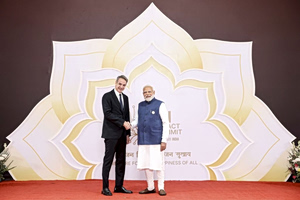
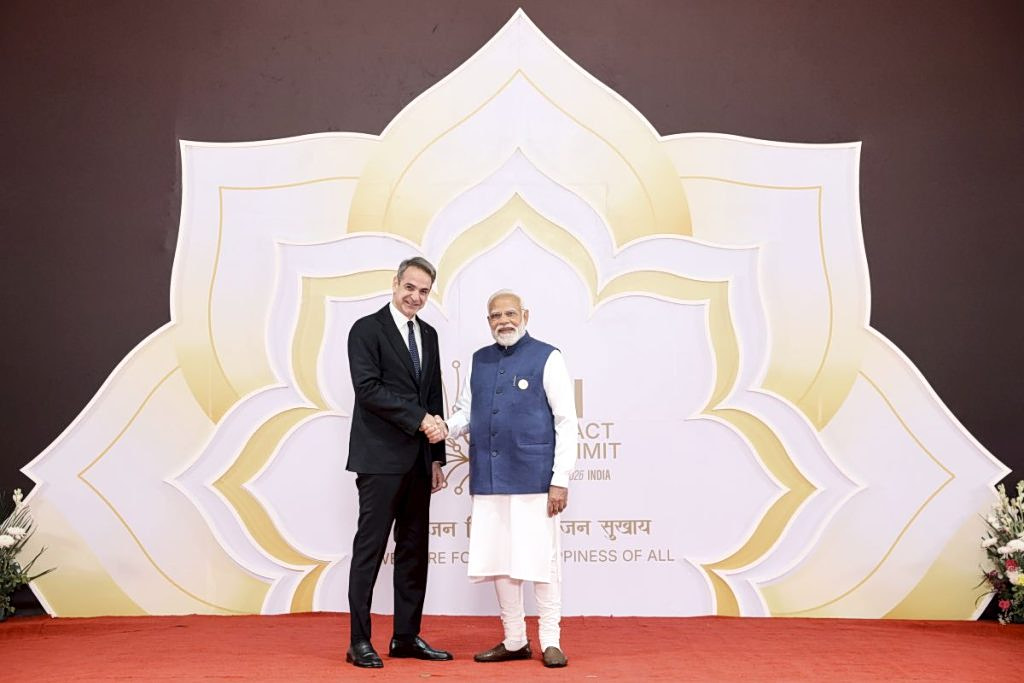
Greek Prime Minister Kyriakos Mitsotakis is in New Delhi to attend the India AI Impact Summit 2026, hosted at the Bharat Mandapam International Exhibition Centre. The summit is widely seen as a flagship global initiative aimed at shaping an international policy framework for Artificial Intelligence, with a strong emphasis on measurable social and developmental impact under the banner “People–Planet–Progress.”
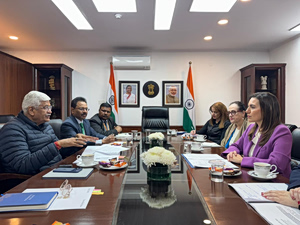
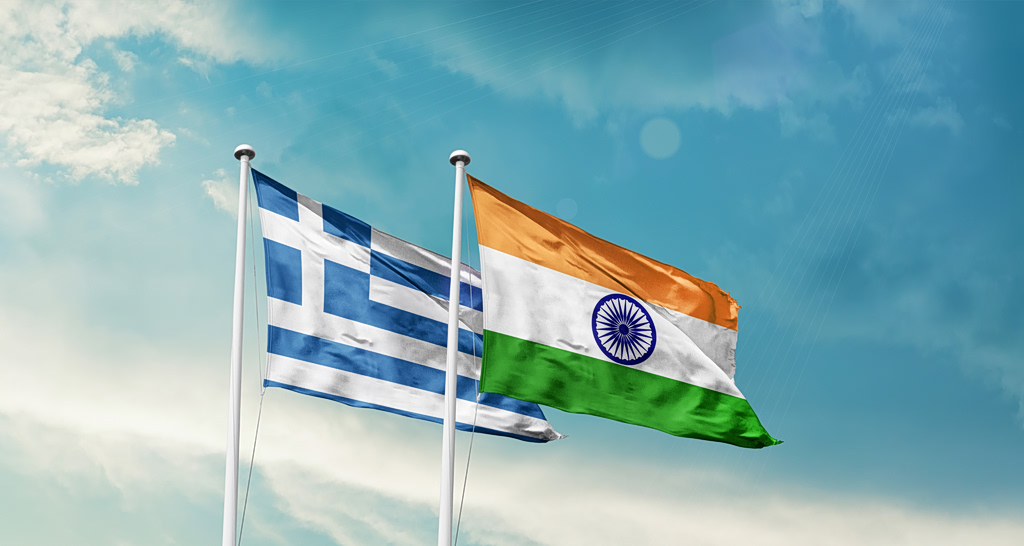
At 1 p.m. Greek time, Mitsotakis is scheduled to meet Indian Prime Minister Narendra Modi. This will mark their third meeting since 2023, when Greece and India agreed to upgrade bilateral relations to the level of a strategic partnership — a significant diplomatic step that signaled closer cooperation in defense, trade and geopolitics.
Beyond high-level diplomacy, the Greek premier is also holding meetings with leading figures in global technology, including OpenAI CEO Sam Altman, Google DeepMind CEO Demis Hassabis, and Microsoft Vice Chair and President Brad Smith.
A strategic choice with geopolitical weight
For the Greek government — often referred to domestically as “Maximos” after the Prime Minister’s office — Mitsotakis’ participation in the summit is described as a strategic decision of high political and geo-economic importance.
India’s ambition is clear: to shift the global AI conversation away from abstract declarations and toward tangible results, scalable applications and concrete partnerships. By attending, Greece aims to position itself at the heart of that transition — strengthening its role in the global AI dialogue while presenting itself as a bridge between Europe and the Global South.
As part of this broader diplomatic push, Greece is expanding its footprint in India with the opening of two new consulates, in Mumbai and Bangalore — the latter widely regarded as India’s technology capital.
Greece’s “opening” to India
Athens sees an opportunity to redefine its geopolitical role. Greece positions itself as Europe’s strategic, geopolitical and commercial gateway to the Indo-Pacific. It also aims to become a key node in the India–Middle East–Europe Economic Corridor (IMEC), a major connectivity project linking India to Europe through the Middle East.
Located at the crossroads of three continents, Greece argues that it offers an ideal bridge to Europe and the Eastern Mediterranean — and is seeking closer cooperation with all countries participating in the IMEC initiative.
At the same time, cooperation between Greece and India is expanding across multiple sectors: security and defense, investment and trade, science and technology, education, culture, tourism and agriculture.
Negotiations toward a broader EU–India trade agreement are also redefining the bilateral framework, potentially strengthening trade and investment flows while opening new access opportunities for European products and businesses in India’s vast market.
“Significant synergies” between Athens and New Delhi
In an interview with Indian television network Times Now and journalist Srinjoy Chowdhury, Mitsotakis underlined the importance he attaches to strengthening the strategic partnership.
“I am pleased to report that we are certainly moving in the right direction,” he said. “There are obvious and significant synergies between our two countries that go far beyond our very close cultural ties.”
The Greek prime minister stressed that Greece is the closest continental European country to India. Referring to the IMEC project, which he described as highly significant, he noted that multiple connectivity initiatives could benefit both countries.
He highlighted shipping, foreign direct investment by Greek companies in India and Indian companies in Greece, and pointed specifically to India’s GMR Group. “As we speak — I visited the construction site just a few weeks ago — GMR is building the second-largest airport in Greece,” he said.
Tourism is another priority. “We want to become the destination of choice for Indian tourists in Europe,” Mitsotakis said, noting that direct flights between the two countries are now operating and are expected to increase significantly — a development he believes will provide an additional boost to travel from India to Greece.
AI ambition — and caution
On Artificial Intelligence, Mitsotakis emphasized that Greece has its own ambitious national AI strategy. But he also acknowledged the risks.
“We fully recognize that there are serious risks that need to be addressed,” he said, citing concerns about the mental health of children and adolescents, the programming of large language models to ensure they align with what societies consider responsible behavior, and the protection of democratic systems from AI-amplified disinformation.
Speaking about the summit in India, he added that the concentration of power in the hands of a few global technology companies should be a cause for reflection.
“I believe we must engage with major global leaders and the large tech companies developing these cutting-edge models,” he said. “We need an honest discussion — and that is what we will have tomorrow.”
With AI governance, global connectivity projects and expanding trade ties converging, Greece’s outreach to India signals more than diplomatic symbolism. It reflects a calculated repositioning — one that aims to anchor Athens at the crossroads of Europe, the Indo-Pacific and the emerging architecture of global Artificial Intelligence governance.