Greek Foreign Minister George Gerapetritis has warned that tensions with Turkey could escalate depending on the content of a reported legislative initiative linked to the “Blue Homeland” doctrine, while stressing that no official announcement has yet been made by Ankara.
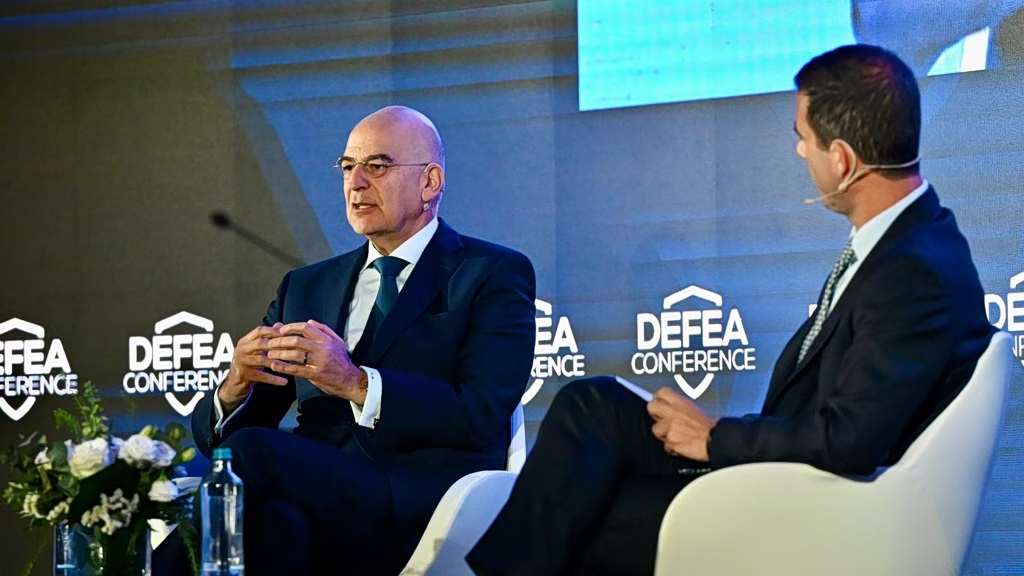
Speaking at a conference on national strategy under conditions of global uncertainty, Gerapetritis described Greek-Turkish relations as being at a “significant crossroads” three years after the two countries resumed efforts to rebuild dialogue in 2023.
The minister cautioned against drawing conclusions from media reports and leaks alone, noting that Turkey has not formally presented its plans. However, he said that if a legislative measure is eventually introduced, its substance will determine whether tensions rise between the neighboring countries.
According to Gerapetritis, any unilateral action by Turkey would have no legal effect under international law. Nevertheless, he acknowledged that an attempt to advance such a move could generate renewed friction in the region.
He emphasized that Greece has prepared for all possible scenarios and possesses the means to respond both preventively and reactively if necessary.
Defending the Policy of Dialogue
Responding to criticism that recent developments undermine the policy of maintaining calmer relations with Turkey, Gerapetritis argued that the approach has strengthened Greece’s position internationally.
He pointed to progress in areas such as maritime spatial planning, marine parks, responses to demilitarization claims, and the expansion of strategic partnerships with countries including the United States, Israel, Gulf states and India.
“The footprint of Greece is greater than ever,” he said, adding that calm relations are not an end in themselves but a tool for strengthening the country’s geopolitical standing.
The foreign minister also stressed that maintaining communication channels with Ankara over the past three years has produced tangible results, including fewer airspace violations, reduced migration flows, increased tourism activity and stronger trade relations.
Maritime Dispute Remains Unresolved
Despite those gains, Gerapetritis said lasting peace cannot be achieved while the core dispute between the two countries remains unresolved. He identified the delimitation of the continental shelf and exclusive economic zones as the central issue dividing Athens and Ankara.
At the same time, he argued that Greece has significantly enhanced its geopolitical influence through stronger international partnerships and strategic alliances.
Armed Sea Drone Incident Still Under Investigation
Gerapetritis also addressed the recent discovery of an armed maritime drone off the Greek coast, describing the incident as “extremely serious” and insisting that the matter remains open.
He said it was inconceivable for such an object to be found on Greek shores and warned of potential implications for security, economic activity and the environment. The minister added that the Mediterranean must not become a new theater of military operations.
The government is awaiting the final findings of the armed forces before deciding on further action, both through bilateral channels and international organizations.
Reaffirming Greece’s support for Ukraine, Gerapetritis described it as a strategic national choice rooted in the country’s longstanding commitment to international law and opposition to territorial revisionism.
He concluded by stressing that Greece would not allow the conflict to spill into the Mediterranean, arguing that wars are not resolved through expansion but instead become even more difficult to contain.