 Μake us preferred on Google
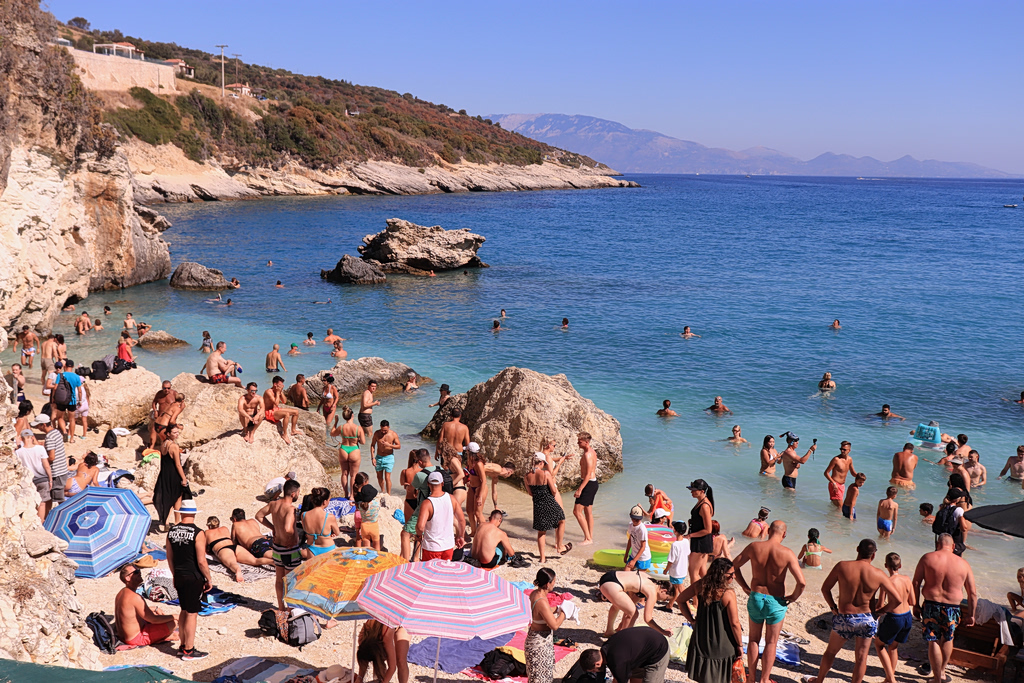
 A long-unanswered question has resurfaced with the publication of the new Special Spatial Planning Framework (SSPF) for Tourism by the Ministry of Environment and Energy: how can development be balanced with the limits and capacities of each location? There is no easy answer, and all stakeholders agree on that.
There is also broad agreement that the country needs clear rules, effective oversight, and modern planning based on real data. There is similarly a shared recognition of the need for serious carrying-capacity studies that take into account, beyond hotel beds, the rapid expansion of Airbnb-type rentals and the adequacy of infrastructure in water supply, sewage, waste management, transport, healthcare, worker housing, and environmental resilience. Beyond that point, however, opinions diverge regarding the development model that should be followed.
Social consensus
“For an activity with the economic and social weight of tourism, the existence of a modern SSPF is not simply necessary but imperative,” notes Efthymia Sarantakou, associate professor at the University of West Attica specializing in spatial tourism planning. She stresses that tourism requires legal certainty and social consensus, the absence of which led to the annulment of previous spatial planning frameworks.
She describes it as a “missed opportunity” that the period since the first public consultation in 2024 was not used by the relevant ministries for substantial and open dialogue with social partners and professional bodies.
As she points out, the new plan also ignores feedback emerging from consultations on the Local Urban Plans currently under development, during which the majority of stakeholders explicitly opposed strategic investments on saturated tourist islands and demanded restrictions. The professor also focuses on the introduction of an additional special levy on tourism activities in saturated, developed, and developing areas.
“It comes on top of the existing resilience tax, which for 2026 is estimated at €597 million. These resources flow into the coffers of the central state rather than local government, as they should, for the implementation of compensatory policies. Yet it is the municipalities that are called upon to manage the cost of overconcentration: the housing crisis, water and waste management, and the strain on health and transport infrastructure,” she notes.
The question
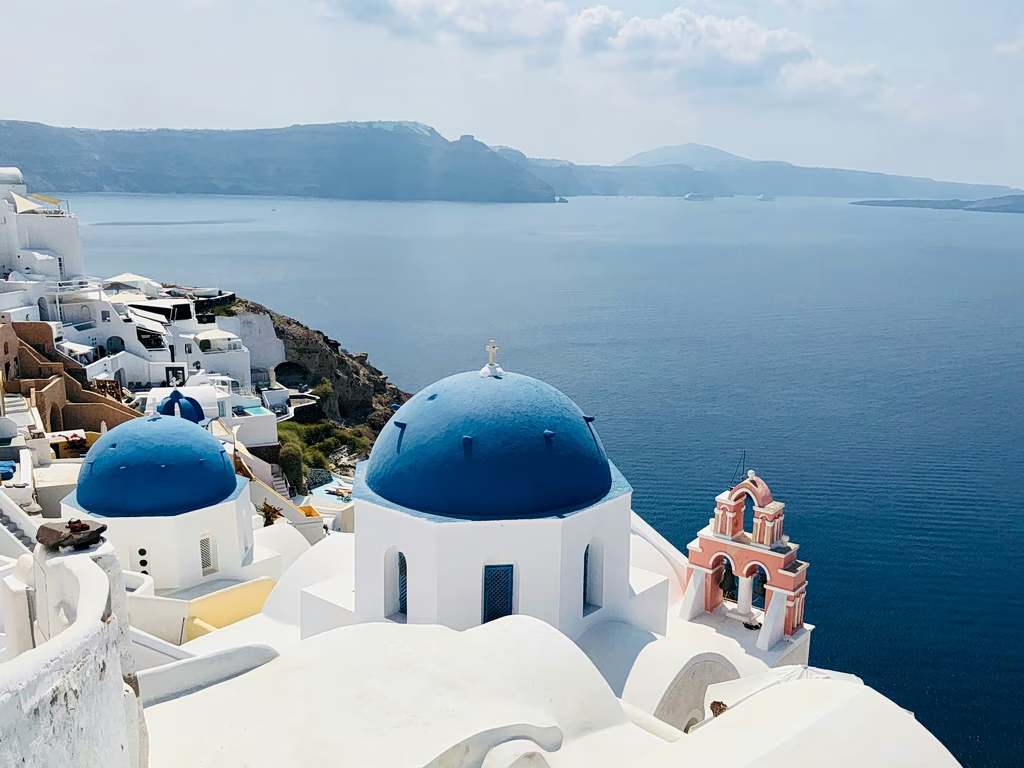
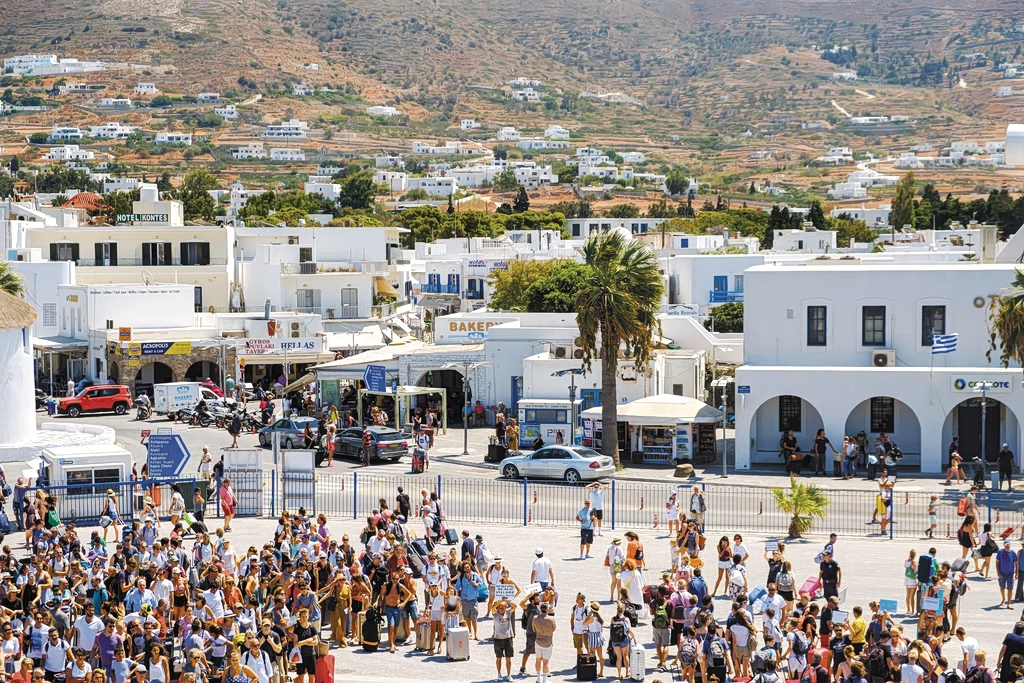
At the center of criticism is also the “cap” of 100 beds in saturated or developed areas, with objections coming from different sides and for different reasons. Local authorities and scientific bodies believe that saturated or developed islands such as Mykonos, Santorini, and Paros cannot sustain additional beds, while tourism representatives argue that destinations such as Rhodes still have development potential.
However, both sides converge on the assessment that the limit will not substantially prevent large-scale projects, since an investor can develop multiple smaller units of 50 rooms each on neighboring plots of land.
The question raised is whether this fragmentation is ultimately more environmentally friendly.
This issue is also highlighted by the president of the Hellenic Hoteliers Federation, Giannis Hatzis, who stresses that “Greek tourism cannot be designed with simplistic lines drawn across a map.”
He criticizes the horizontal restrictions introduced by the new SSPF. As he notes, the limit of 100 beds for the majority of islands and mature destinations does not constitute serious spatial planning but rather “a mechanistic prohibition that will trap the country for decades, in an era of disruption and uncertainty, depriving the state of revenues, investments, and jobs that could support local communities and public infrastructure.”
Needs and infrastructure
Hatzis insists that every destination has different environmental needs and infrastructure, a different economic base, and a different development history. For this reason, he says, critical decisions regulating what each place can and should do over the coming decades cannot be made horizontally, but through Local Urban Plans based on real data for each destination.
He argues that carrying capacity cannot be treated as an arbitrary number or a static quantity, citing the example of Malta, an island of similar size to Kos that hosts fifteen times the population. According to him, the discussion should shift away from general prohibitions and toward infrastructure needs in water supply, sewage, transport, public health, waste management, and similar sectors.
“Greece needs a spatial plan that organizes development, not one that freezes it.”
A similar position is expressed by Konstantina Svinou, vice president of the Kos Hoteliers Association, who points out that the South Aegean is the only region in the country with positive demographic growth, “a development directly linked to tourism growth.” In her view, the problem lies in the inability of public infrastructure to keep pace with private investment activity, rather than in development itself.
A different voice from the tourism sector
A different perspective from within the tourism industry is expressed by Mania Abatzi, president of the Paros–Antiparos Hoteliers Association, representing what she describes as a mature destination.
The island is classified as a developed area, with the new SSPF allowing the construction of new hotels of up to 100 beds (up from 80) and reducing the minimum land requirement for out-of-plan construction to 12 stremmas from 15.
As Ms Abatzi notes, the proposed framework therefore appears more favorable toward tourism development than the existing regime, even though the island needs strict rules in order to preserve its identity in the face of intense development pressures, mainly from tourist residences.
At the same time, she expresses opposition to the possibility of locating strategic investments on islands such as Paros, arguing that these are out-of-scale interventions that place additional strain on destinations.
She also raises objections over the absence of special provisions for agritourism and the lack of meaningful tools to protect agricultural land from tourism expansion.
Out-of-scale investments
On the other hand, the president of the Association of Greek Urban and Regional Planners and assistant professor at the Aristotle University of Thessaloniki, Loukas Triantis, is particularly critical of the philosophy behind the new framework.
As he notes, the plan continues to favor large organized forms of tourism development almost everywhere, including sensitive areas, without sufficiently taking into account the carrying capacity of locations and the environmental pressures such developments create.
“Even the supposedly ‘mild’ versions of organized tourism developments are not mild in practice,” he says, explaining that concentrating large-scale construction within limited sections of land can create severe pressure, especially on small islands or protected areas.
According to him, such investments are linked to heavy infrastructure requirements and increased demand for water and energy, while the new framework does not adequately assess their environmental footprint.
He also objects to the institutionalization of glamping (luxury camping) on small islands and rocky islets.
As he stresses, “it is presented as a mild, almost temporary form of tourism, but in reality it involves permanent facilities with infrastructure, water and energy consumption, and high service demands. It is a way to bypass reservations about construction in areas that should remain undeveloped and protected.”