 Μake us preferred on Google
 Pope Leo XIV is re-establishing the Catholic Church as a loud voice in world affairs, challenging President Trump over the war in Iran and decrying the rule of tyrants during a trip to Africa.
The question is how much difference the pronouncements of a priest can make in a world of brute force and fraying rules.
According to Winston Churchill, Soviet dictator Joseph Stalin once sarcastically asked a French diplomat: “The pope! How many divisions has he got?” The papacy had the last laugh when St. John Paul II’s moral influence in his native Poland helped bring down Communism.
The pope is arguably the ultimate global influencer. He speaks to the world’s 1.4 billion Catholic faithful, but the impact of his words can go beyond that, as the wide resonance of the Vatican’s clash with the White House is showing.
The first American pontiff is now using his pulpit to oppose the use of military force by the U.S. and others—emerging as the most prominent defender of a rules-based international order built after World War II that Trump and other leaders are rapidly dismantling.
The growing world disorder is part of what makes a morally clear voice appealing, said the Rev. Robert Sirico, co-founder and president emeritus of the Acton Institute for the Study of Religion and Liberty, a think tank in Grand Rapids, Mich. “There is a vacuum here and people know it,” he said.
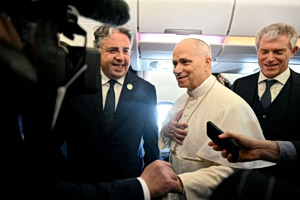
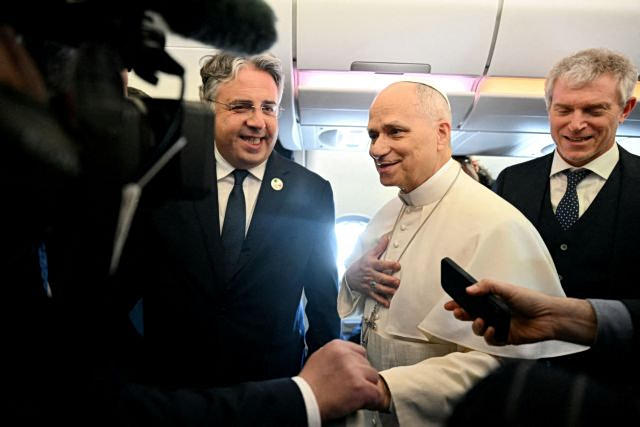
The pope on Thursday urged Iran and the U.S. to resume peace talks. Speaking to reporters, he revealed that he carries with him a photo of a Muslim child who greeted him in Lebanon last year, and who was killed in the most recent war there.
“As a pastor, I cannot be in favor of war,” said Leo.
The church is the clearest example of what theorists of geopolitics call “soft power,” said Massimo Faggioli , a church historian and professor at Trinity College Dublin. “It’s a moral authority that speaks clearly from the point of view of the Catholic faith, but it is not speaking on behalf or for the sake of Catholics only,” he said.
One arena where the Catholic Church can tangibly affect events is U.S. domestic politics . There are roughly 53 million adult American Catholics. Trump won about 56% of the Catholic vote in the 2024 election. Recent surveys show a significant drop in approval and pro-Trump Catholic activists fear a drop in support in this November’s midterm elections.
“There’s definitely an inflection point now. The Catholic vote is going back to 50/50,” said Ryan Burge , a political and religious data expert at Washington University, St. Louis.
Last year, U.S. bishops forcefully rejected Trump’s anti-immigration tactics, including threats to raid churches, hospitals and schools and what they described as a “climate of fear” it was creating among immigrants. The raids by U.S. Immigration and Customs Enforcement have particularly affected Hispanic Catholics.
Now, with unusual directness, Leo has appealed to Catholics and other U.S. citizens to press their representatives in Congress to end the Iran war. “Ask them, tell them to work for peace and to reject war, always,” he said.
Trump responded with a broadside against Leo on Truth Social, accusing him of “catering to the Radical Left.” The attack on the pope triggered widespread criticism from Catholics, including many conservatives.
Trump’s posting of an image depicting himself as a Christ-like figure went down worse still with Catholics and other Christians. “The image is blasphemous, and we condemn it,” said CatholicVote, a political advocacy group that backed Trump for president. Its co-founder, Brian Burch , is the serving U.S. Ambassador to the Holy See. Trump, who later deleted the image, said it showed him as a doctor, not as Jesus.
Criticism of Trump’s attack on the pope also came from the Knights of Columbus, a nonpartisan lay Catholic organization with far-reaching influence in parishes across the U.S.
Vice President JD Vance accused the pope of ignoring the Catholic tradition of just war theory, which senior Catholic clergy denied. Millions of U.S. Catholics still support the president. There are risks for Leo if he becomes seen as a political figure closer to Democrats than Republicans—a perception that Leo has been at pains to avoid.
The Chicago-born pontiff “reached out to conservative Catholics early on, and that makes it harder to brush him aside: He can’t be dismissed as an outsider or as a progressive,” said Rev. Antonio Spadaro , a Vatican official and author of a book on papal diplomacy. “Trump’s attack had the effect of uniting the Catholic world behind the pope in a way that would have been hard to imagine until recently.”
Leo has found new fans among non-Catholics too, on both sides of the Atlantic. Filmmaker Spike Lee was seen sporting a “Pope Leo” jersey at a recent New York Knicks game.
Although the pope has tried hard to stay out of partisan debates, U.S. congressional leaders including Sen. Bernie Sanders (I., Vt.) have praised and quoted him.
Leo is someone that “Europeans of all faiths—and none—listen to, appreciate and respect,” said Roberta Metsola, head of the European Union’s legislature.
Vatican officials stress that Catholic teaching—ranging from opposition to abortion, same-sex marriage and divorce to advocacy for the poor and marginalized—doesn’t fit neatly with either progressive or conservative politics and can be challenging for politicians of all stripes.
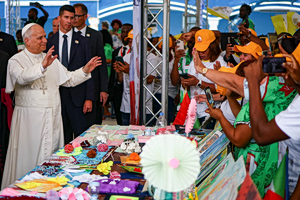
Beyond its historical heartlands, the church wants to be a strong voice in the global South, where most of the world’s Catholics live. On Thursday, Leo concluded an 11-day trip to Africa, a continent of growing importance for the church.
Through the many speeches and Masses delivered in multiple languages during his trip—which took him to Algeria, Cameroon, Angola and Equatorial Guinea—Leo made passionate appeals against violence, authoritarianism and social injustice.
In Cameroon, he denounced the “chains of corruption” that stand in the way of peace and justice, and accused a “handful of tyrants” of ravaging the world. “We can see today how the hope of many people is frustrated by violence, exploited by the powerful and defrauded by the rich,” he said days later in Angola.
It remains to be seen what impact his appeals might have. Some observers expressed concern that his visit could potentially also legitimize the dictatorial regime in Equatorial Guinea that hosted him.
The most famous modern example of a pope swaying the course of history remains St. John Paul’s 1979 trip to Poland, where his message “Be not afraid” helped spark the rise of the Solidarity labor movement that eventually brought down the Communist regime—with a domino effect across the Soviet bloc.
“People listened, and the nation responded,” said Rocco Buttiglione , a former Italian politician and close personal friend of the late pope. “The second most powerful power in the world collapsed in front of moral, cultural and religious opposition. And it was led by John Paul II.”
More recently, the Vatican played a pivotal role in brokering a diplomatic thaw between the U.S. and Cuba in 2014. It was an example of how popes and their envoys have tried to play a behind-the-scenes role as a trusted mediator between governments.
Such attempts haven’t always succeeded. Last December, the Vatican tried to mediate between the Trump administration and Venezuela’s strongman leader Nicolás Maduro , encouraging them to consider exile in Russia for Maduro to avoid a military clash. Trump ignored the proposal and ordered U.S. forces to seize Maduro.
Cuba could be the next test case for the Vatican’s diplomatic role. Leo’s aides are trying hard to mediate between Washington and Havana, urging both sides to defuse their tensions and the U.S. not to use force, as Trump has threatened.
“We do what we can as a tiny state, mostly off camera and with great discretion,” said Cardinal Michael Czerny , a senior Vatican official. “The conditions don’t look favorable. But when you’re inside it, you always see opportunities—to build bridges, to help people to listen to each other,” he said. “We’re as busy as ever.”
Write to Margherita Stancati at margherita.stancati@wsj.com