More than a week has passed since the Prime Minister Kyriakos Mitsotakis addressed the Thessaloniki International Fair (TIF) and the mood inside his office has soured. Aides had spent weeks priming expectations that his September 5 speech would help break New Democracy out of a stagnant polling rut. Instead, the measures landed with a shrug, and the government is now recalibrating its approach.
People close to the prime minister’s office, acknowledge that objections and pushback from several social groups, business representatives chief among them, largely overshadowed the measures once they were announced. Officials are now arguing that the government’s standing can still recover, provided the measures are delivered quickly.
That rollout is expected to move fast, with officials saying all the measures announced at TIF will be legislated as soon as possible. Some are already coming into effect: two months of rent support owed to teachers and health workers stationed outside major urban centers is due to be paid in September, and a 400 euro additional yearly stipend for all pensioners over 65 is set to go out in November. “Some may think it is a lot, others may think it is too little, but no one can deny that we are using up the fiscal space available and returning to society as much as our economy can bear” is how those close to the PM are describing the situation.
At the same time, in an effort to stem the loss of voters left unsatisfied by the measures, the government has gone on the attack against opposition leaders, accusing Tsipras of keeping “double books” on his promises and accusing Androulakis of effectively admitting that his program aligns with Tsipras’s own.
Mitsotakis set that tone himself from Thessaloniki, criticizing the leaderships of both the Greek Left Alliance (EL.A.S.), Alexis Tsipras’ new party founded earlier this year, and PASOK, and going even further after Samaras and his plans for a new party.
According to people familiar with internal discussions, second thoughts inside Mitsotakis’ office have since prompted officials to dial back the intensity of the attacks on Antonis Samaras, until he formally announces his new party. Government leadership concluded that a fight with the former New Democracy lawmaker and PM does not serve the interests of the party at this stage.
The front against Tsipras
The government’s strategy toward Tsipras is built on a simple bet: that voters who lived through his first stint in power already know him well enough not to be swayed by a fresh round of promises, however polished the pitch. Mitsotakis leaned into that argument himself in Thessaloniki, and will continue to do so, as the perception within the PM’s circle is that a strategy of direct confrontation with the former SYRIZA leader will only help rally voters back to New Democracy.
This approach rests on an internal analysis that has shown a correlation between EL.A.S.’s standing in the polls and how unified New Democracy’s own voter base can become. Officials point to a small bump in New Democracy’s numbers last May, when Tsipras formally launched his party, which they attributed to former New Democracy voters rallying back reflexively. Over the summer, as EL.A.S.’s appeal stagnated, that same consolidation among New Democracy voters appeared to weaken. Officials take this as evidence that although New Democracy and EL.A.S. do not compete for the same voters, one party’s standing in the polls affects the other’s, if only marginally.
It is against that backdrop, that government spokesman Pavlos Marinakis launched a pointed attack the day after Tsipras held his press conference at TIF. Marinakis accused the former prime minister of “audacity” and “unbelievable lies,” saying Tsipras “has a unique ability to tell a lie without any shame.”
Marinakis, who was reportedly following the line given to him by the PM’s office, went on to call the program “a manual for political fraud.” The government spokesman argued that Tsipras’s program was more damaging than the exaggerated campaign promises of the past precisely because it was disguised and presented as fully costed.
According to those familiar with New Democracy’s communication strategy, the attacks on Tsipras will keep running along these lines in the weeks and months ahead. The government also intends to insist for the program to be referred to the independent Fiscal Council, betting that an official cost analysis would show the real price tag is far higher than what Tsipras has promised.
Androulakis in the crosshairs of Mitsotakis
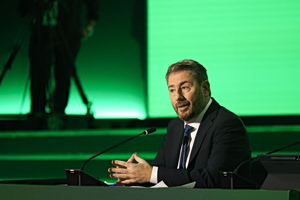
PASOK and its leader, Nikos Androulakis, occupy a different but no less prominent place on the government’s list of targets, part of an offensive that has already begun and is expected to intensify. Mitsotakis set the tone during his appearances in Thessaloniki where he criticized PASOK officials who traveled to Crete for the anniversary of the party’s founding declaration and took aim at a statement from some PASOK lawmakers ouncing on claims from some PASOK lawmakers that 80 percent of Tsipras’s program was lifted from PASOK’s own.
The prime minister’s view, according to people close to the discussions, is that PASOK’s copying claim will backfire on Androulakis. By making the comparison, officials argue, PASOK hands Tsipras credibility, effectively vouching for 80 percent of his program, while tying itself to his politics. The message it sends to voters, according to New Democracy, is that PASOK and EL.A.S. are close enough, with only a fifth of their platforms setting them apart, opening plausibly a path towards governing together after the next election. That undercuts PASOK’s own argument that it offers a distinct alternative to Tsipras.
Government officials plan to sharpen this line of attack, according to people familiar with the party’s thinking, pointing to internal polling they say shows a significant share of the centrist voters PASOK attracts are wary of anything reminiscent of the 2015 to 2019 period, when Tsipras previously governed, and would react negatively if PASOK’s leadership continued to be cast as aligned with him.
Although not stated publicly, the prevailing view among senior New Democracy figures is that winning a third term depends in part on peeling away PASOK voters who prioritize government stability. People familiar with internal discussions say the party’s own polling suggests roughly half of PASOK’s voters want stability and disagree with the resolution passed at PASOK’s last congress ruling out future cooperation with New Democracy.
A pause, rather than peace, with Samaras
The government has also decided to change tack with Samaras following the developments of recent weeks, according to people familiar with internal deliberations around the PM. After Mitsotakis’s appearance at TIF, government officials decided to hold off on further public confrontation with the former PM, at least until Samaras formally announces his new party.
This new approach does not signify a shift in how those close to Kyriakos Mitsotakis view Samaras. Officials still describe him as squarely opposed to the government and say he can no longer be treated with the courtesy once extended to him. The assessment that ultimately prevailed was that the confrontation with the former prime minister had escalated beyond what served New Democracy’s interests, drawing more public attention to Samaras rather than starving his effort of momentum. It also lend an unwarranted air of seriousness to a political project that, in their assessment, does not merit it.