 Μake us preferred on Google
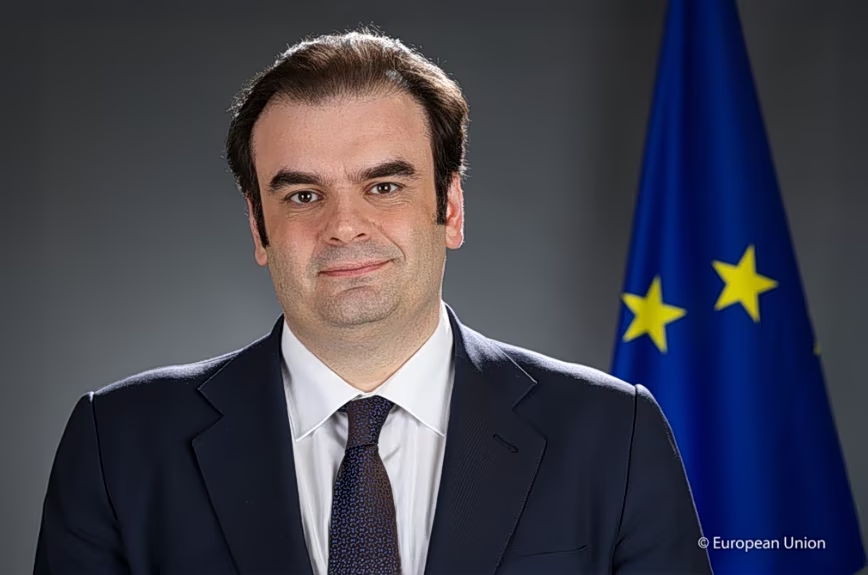
 Greece’s Minister of National Economy and Finance and President of the Eurogroup, Kyriakos Pierrakakis, has warned that the European Union risks missing a major opportunity if member states fail to align on economic, defense and technology policy.
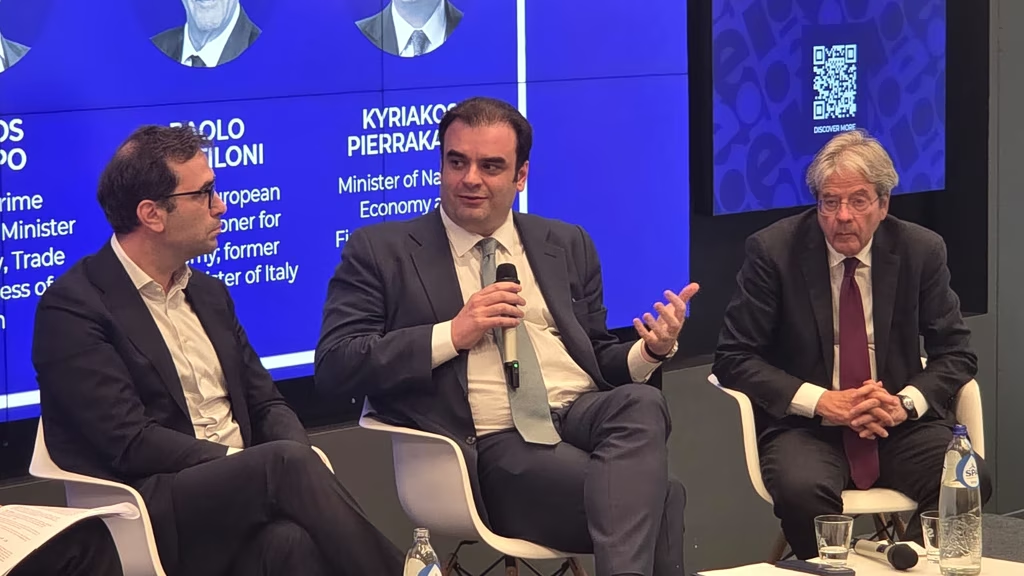
Speaking at the IE Competitiveness Hub during a discussion on Europe’s long-term competitiveness, Pierrakakis highlighted the importance of coordinated action on initiatives such as the Savings and Investment Union (SIU), digital finance and the development of a digital euro.
The panel, moderated by Financial Times journalist Paola Tamma, also included former Italian prime minister and former EU economy commissioner Paolo Gentiloni and Spain’s Economy Minister Carlos Cuerpo.
Call for implementation over consensus alone
Pierrakakis stressed that while there is broad agreement on the direction of EU reforms, the main challenge lies in implementation.
He referred to major European policy reports by Enrico and Mario as guiding frameworks, but noted that progress depends on finance ministers turning strategy into action.
“The challenge is implementation,” he said, adding that while European institutions are working effectively, member states must develop stronger internal mechanisms to deliver agreed reforms.
He also emphasized the need to communicate EU initiatives more clearly to citizens, using familiar references such as Erasmus or roaming-free travel as examples of successful European policies that are widely understood.
By contrast, he said, initiatives like the Savings and Investment Union remain abstract for many Europeans and need clearer explanation through practical examples, such as enabling startups to scale within Europe instead of relocating abroad for funding.
National interests vs European ambition
A recurring theme in his intervention was the tension between national priorities and collective European goals.
Pierrakakis argued that while countries often support EU-level reforms in principle, national concerns frequently slow progress. He warned that Europe must recognize the “opportunity cost” of delayed action, especially in areas such as financial integration and technological development.
He also linked this challenge to broader geopolitical shifts, noting that recent global events have underscored the need for Europe to strengthen its strategic autonomy in both defense and technology.
According to Pierrakakis, Europe must move beyond being simply a single market and instead develop deeper integration supported by a shared technological and defense doctrine.
Technology, AI and global competition
The minister also pointed to rapid developments in artificial intelligence and digital technologies, arguing that Europe risks underestimating the speed of change.
He referenced discussions around major AI models and the evolving global tech landscape, warning that innovation cycles are now measured in weeks rather than years.
Pierrakakis questioned whether European policymakers share a common understanding of “technological sovereignty” and whether the EU is aiming to create its own large-scale technology champions or remaining fragmented along national lines.
He cautioned that failing to resolve this question could lead Europe to miss a significant strategic opportunity.
Digital euro and financial sovereignty
A key part of the discussion focused on the future of digital finance and the proposed digital euro.
Pierrakakis described digital finance as a major opportunity for Europe, noting global differences in approach: the United States relies heavily on private-sector innovation around dollar-based digital assets, while China is pursuing a fully state-controlled digital currency model.
Europe, he said, is developing its own regulatory framework but still faces a major imbalance, with the vast majority of stable coins linked to the US dollar and only a small fraction linked to the euro.
He argued that the digital euro could become a cornerstone of Europe’s financial strategy, supporting public payment infrastructure and strengthening the continent’s monetary position.
While acknowledging that legislative timelines may extend into the coming years, he warned that technological innovation is already happening rapidly and that delays risk lost opportunities.
A race against time
Throughout his remarks, Pierrakakis returned to a central message: Europe is operating in an environment where technological and economic change is accelerating, and hesitation carries real costs.
He concluded that Europe’s ability to act collectively—particularly in finance, technology and defense—will determine whether it can seize emerging opportunities or fall behind in global competition.