 Μake us preferred on Google
 The Greek government is moving to impose its toughest regulations yet on electric scooters, proposing a ban on riders under 17, mandatory third-party liability insurance and substantially higher fines as authorities seek to curb a growing number of traffic accidents involving the increasingly popular two-wheelers – or two “little wheelers”, to be more precise.
The measures are contained in draft legislation released for public consultation by the ministry of social cohesion and family, which also includes transport provisions prepared by the ministry of infrastructure and transport. Officials note that the reforms are intended to close long-standing regulatory gaps as e-scooters become a common feature of urban mobility across urban areas in the eastern Mediterranean country.
The proposed legislation follows months of debate over road safety after a series of serious accidents involving electric scooters, several of them involving minors. Over the past year, the government has gradually tightened its approach to micromobility, as municipalities have struggled with illegal parking, unsafe riding and the rapid expansion of rental scooter fleets in Athens, Thessaloniki and other cities.
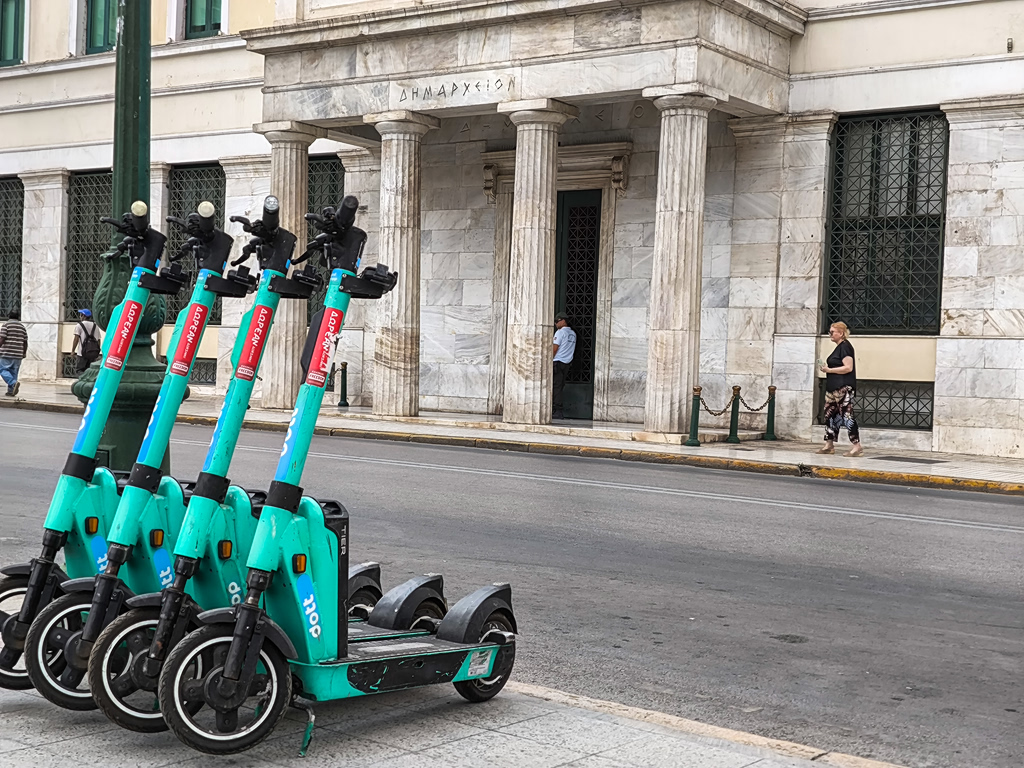
File photo: Shared electric scooters in Athens, Friday, July 18, 2025. (GIORGOS KONTARINIS/EUROKINISSI)
Authorities have argued that existing rules no longer adequately reflect the scale of scooter use or the risks posed to riders, pedestrians and motorists.
The most significant change would prohibit anyone under the age of 17 from operating an electric scooter on public roads, except for specially adapted electric mobility vehicles intended for people with disabilities. Violators would face an administrative fine of 150 euro.
The bill also dramatically increases penalties for riding e-scooters on roads with speed limits exceeding 50 kilometers per hour, where officials say the speed differential with motor vehicles significantly raises the likelihood of severe or fatal crashes. The fine would rise to 350 euros, compared with the current 30-euro penalty.
For the first time, owners would also be required to carry third-party liability insurance covering injuries or property damage caused while operating a scooter. Riding without insurance would carry a 250-euro administrative fine.
The legislation would further require riders to carry valid identification and proof of insurance whenever using an electric scooter, facilitating roadside checks by police and other enforcement authorities.
The proposals also shift greater responsibility onto businesses selling or renting electric scooters. Companies would be prohibited from selling, leasing or otherwise providing scooters to anyone under 17 and would be required to verify customers’ age through official identification before completing a transaction. Businesses violating the rule would face fines of 1,000 euros.
If approved after the public consultation process, the legislation would establish Greece’s most comprehensive regulatory framework for electric scooters to date, introducing mandatory insurance, age restrictions, stricter operating rules and expanded obligations for both riders and micromobility operators.
The proposed overhaul forms part of a broader government effort over the past year to modernize the traffic code and strengthen road safety enforcement, as Greece seeks to reduce one of the European Union’s highest rates of traffic fatalities while adapting regulations to new forms of urban transportation.