 Μake us preferred on Google
 Greece has managed to improve its overall position in global gender equality rankings, but continues to face significant gaps in women’s economic participation and opportunity. The country ranked 75th out of 145 countries in the World Economic Forum’s (WEF) Global Gender Gap Report 2026, released this week. Greece closed 71.4% of its gender gap above the global average but remained 4.3 percentage points below the European average.
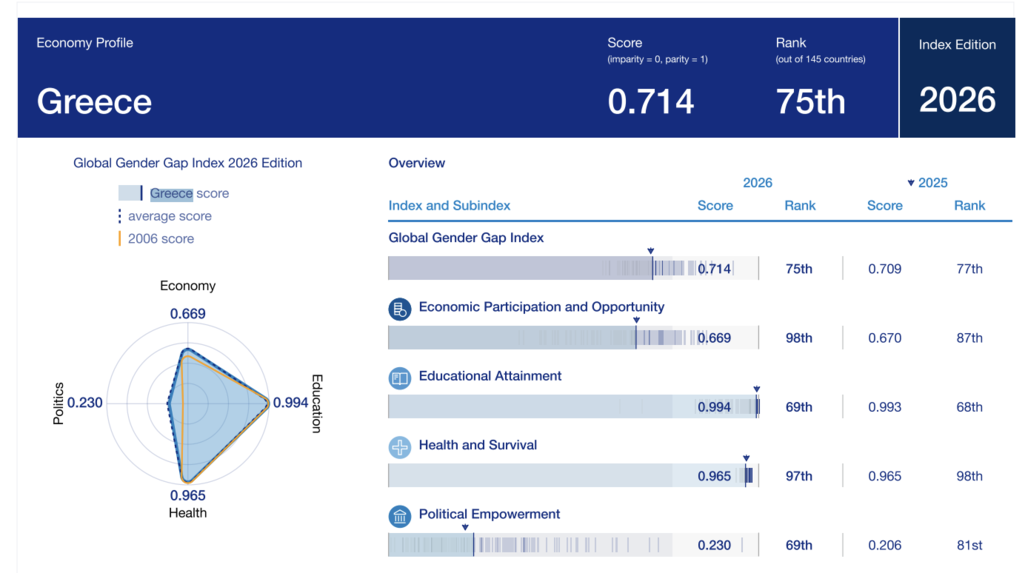
Greece moved up two places compared with 2025, although its performance varied across the four areas measured by the index. Its ranking for economic participation and opportunity fell from 87th to 98th, while educational attainment slipped from 68th to 69th.
In contrast, Greece improved in health and survival, moving from 98th to 97th, and recorded its largest improvement in political empowerment, rising from 81st to 69th. The gains in these areas contributed to its overall rise to 75th place.
Global Progress Slow
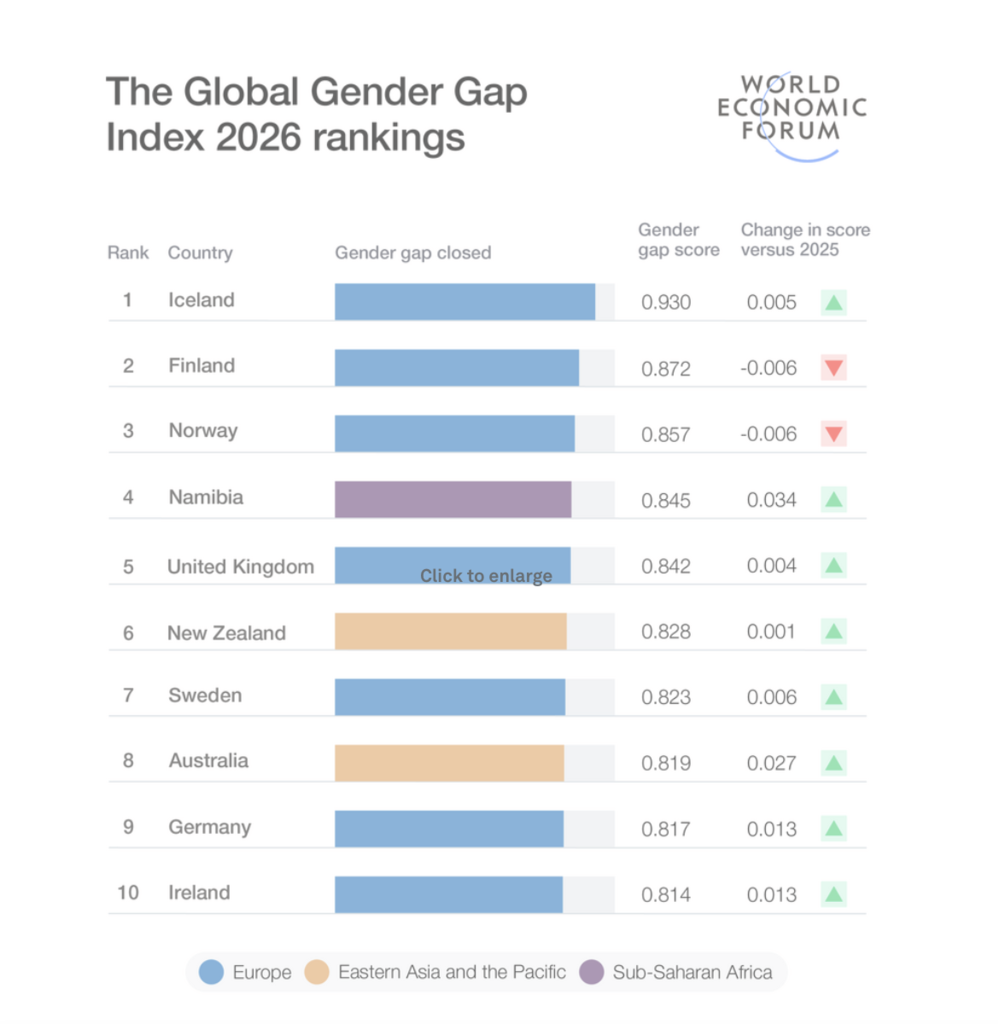
Infograph: World Economic Forum
Worldwide, gender parity reached 69.2%, the highest level since the index was launched in 2006. However, the WEF estimates that, at the current pace of progress, full gender parity could still take 120 years.
Women remain significantly underrepresented in positions of power, while economic participation continues to be a major area of inequality. Education has made greater progress globally with the gender gap in educational attainment now close to being fully closed.
Iceland leads the rankings, having closed 93% of its gender gap, followed by Finland, Norway, Namibia and the United Kingdom.