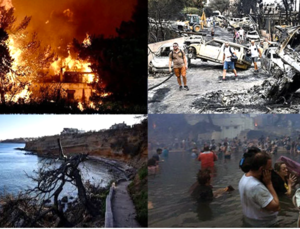
Relatives of those killed in the 2018 Mati wildfire are turning to Greece’s Supreme Court, demanding a full investigation into a mass grave at the Nea Makri cemetery and the broader handling of victims’ remains.
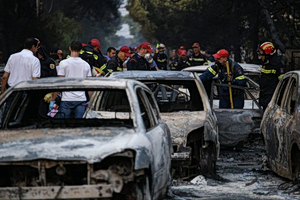
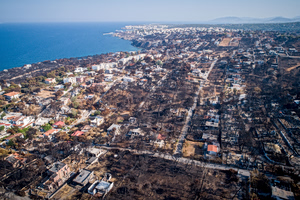
The move comes days before the eighth anniversary of the fire, which tore through the seaside settlement of Mati in eastern Attica on July 23, 2018, claiming 104 lives. The Association of Relatives of the Deceased and Burn Victims of July 23, 2018 in Eastern Attica, which is behind the legal initiative, says its report to the court is accompanied by a file of official documents and other evidence, and raises a series of questions about how victims were recorded, identified and laid to rest.
According to the association’s announcement, the report asks judicial authorities to examine evidence concerning a mass burial site at the Nea Makri cemetery where, it alleges, unidentified human remains were interred alongside what may be remains of already identified victims, as well as animal remains and other objects.
The families are also seeking answers about the case of a woman whose body was recovered from the sea after the fire, transferred to the Schisto morgue and buried only after a significant lapse of time. They want authorities to establish whether all required identification procedures were followed.
The report also calls for renewed scrutiny of the procedures under which bodies were identified and released to relatives, citing cases that emerged during the criminal proceedings in which remains were delivered to the wrong families. In addition, it requests that prosecutors locate and assess any digital evidence, together with any other material capable of clarifying the case.
“With the report we are filing, we are asking for a full investigation of facts and evidence that, in our view, demand further scrutiny,” said Kalli Anagnostou, the association’s president. “The families of all the victims have the right to know that their loved ones, and any human remains, were treated with the respect the law requires, and that every critical piece of evidence was evaluated. For us, a full accounting of what happened is the least we owe the dead. For the state, it is the least it owes the victims, their families and justice itself”.
The association is also seeking a preliminary inquiry into whether anyone bears criminal or other liability, leaving it to prosecutors to decide what investigative steps are warranted. It has pledged to hand over all the evidence it holds to assist the investigation.