 Μake us preferred on Google
“At Sinai, the rocks are bare. There is nowhere to hide from yourself. Or from God, who once walked these mountains. Here, you have no choice but to be truthful.”
The monk serving as the guestmaster— traditionally responsible for welcoming and caring for pilgrims and visitors — takes a sip of Arabic coffee and continues in the same aphoristic vein.
“It is not right to say that we are guarding Thermopylae. The truth is that the Thermopylae are guarding us. Saint Catherine holds us in her embrace. This place changes us. It guards us so that we can guard it.”
The monks are few, and they share a certain distrust of human endeavors, the other side of which is their trust in God to preserve both a place and a way of life.
“The monastery has survived many empires,” the guestmaster continues. “The Prophet Muhammad and Napoleon passed through here, as did Christian emperors and Muslim caliphs. After every ordeal, the monastery emerges stronger. We fear nothing for the monastery. What we fear is whether each one of us will preserve his polity, his ‘life and conduct.’ That is, the way of life handed down to us and our communal organization. Because the monastery will remain, but each of us must take care not to lose himself.”
The conversation is occasionally interrupted by a ginger cat attempting to infiltrate the monastery’s traditional reception room for guests, in pursuit of a share of the meatless mushroom pie prepared by the Arab cook.
When we ask whether the remaining monks fear the monastery becoming overly commercialized by tourism or turned into a museum, the monk replies: “Those who have experienced God face the world with irony, with a kind of holy lightness. They become serious only in the face of other people’s suffering.”
“During a difficult period, when there was no money for food or medicine for the Bedouins, a wealthy man suddenly appeared whose child had cancer. As soon as the child saw the late Elder Pavlos, he was struck by the light in his face and asked to stay beside him. The child later died, but his father supported Sinai. That is how the monastery survives.”
Jebeliya Bedouins Are Considered Descendants of Justinian’s ‘Romans’
The relationship between the monks and the Bedouins is marked by a particular tenderness. The Jebeliya tribe — whose name means “mountain people” — are considered descendants of the 200 families of; Eastern Roman soldiers, whom Byzantine Emperor Justinian brought from the Black Sea region to protect the monastery.
Even after the spread of Islam, the Jebeliya have retained a sense of gratitude toward the monastery, which provides them with means of employment and subsistence.
Bedouin customary law is based on collective responsibility. Stories circulate of vigilante justice and even “divine judgment,” in which whether a person survives a punishment is taken as a measure of whether they were in the right.
Such practices exist in tension with Egypt’s official authorities on a heavily militarized peninsula. Often, however, the desert has a different view.
The monks have great affection for the Bedouins.
“They are authentic people. They are not pretentious intellectuals,” the guestmaster says. “Our relations with them have been forged over centuries. Wherever we Greeks go, we become part of society; we do not form ghettos. We do not go to conquer, but to create. They appreciate that.”
A ‘Guarding of the Senses’ in the Sinai Desert
The guestmaster recalls his former life.
“My father had farms in Crete. But he also had clubs, cafés, pool halls and tavernas. It was a life of smoking and alcohol. But from an early age, I was interested in the truth. The more I searched for it, the more a path began to take shape.”
“I went through Marxism-Communism, but I saw that it was an external approach. Then I turned East. I encountered Buddhism in Chania in 1978-1980, before it became fashionable. At the same time, I was reading Galen.”
“I was influenced by the story of Alexander the Great, who, when he conquered Persepolis, would not even turn to look at the women of the captive royal family, so that the conqueror would not himself be conquered by their beauty. In spiritual life, this is called the ‘guarding of the senses.’”
At Sinai, the Cretan monk found a respite for the senses among the jagged rocks, which leave no room for hypocrisy or affectation.
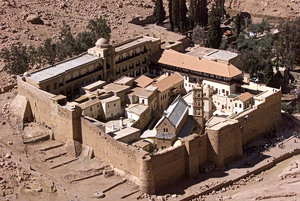
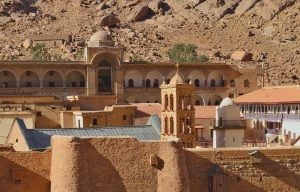
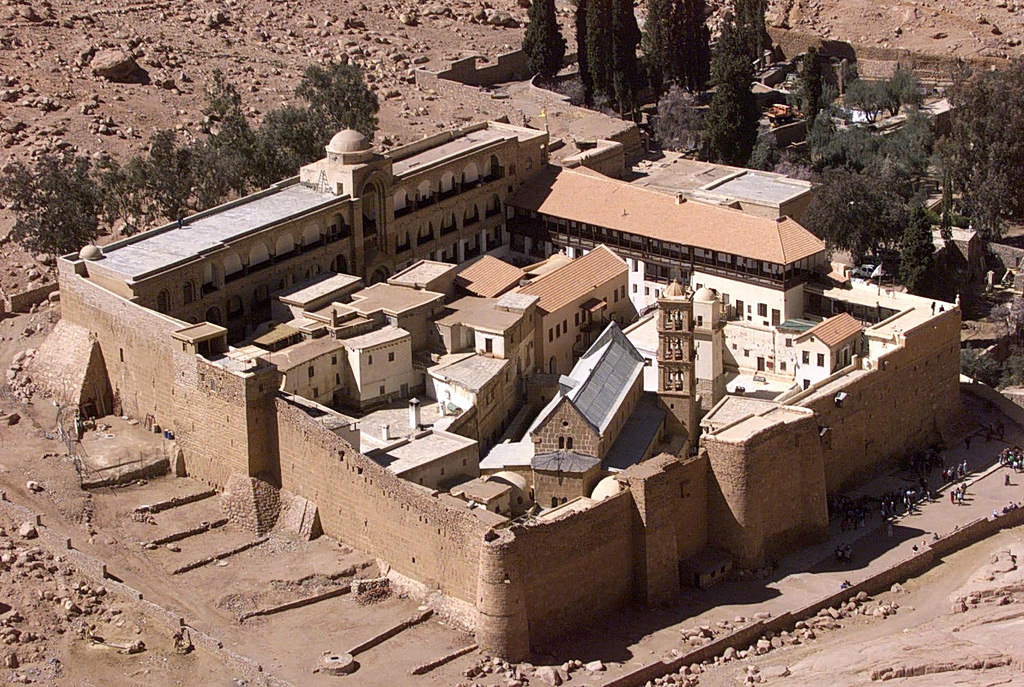
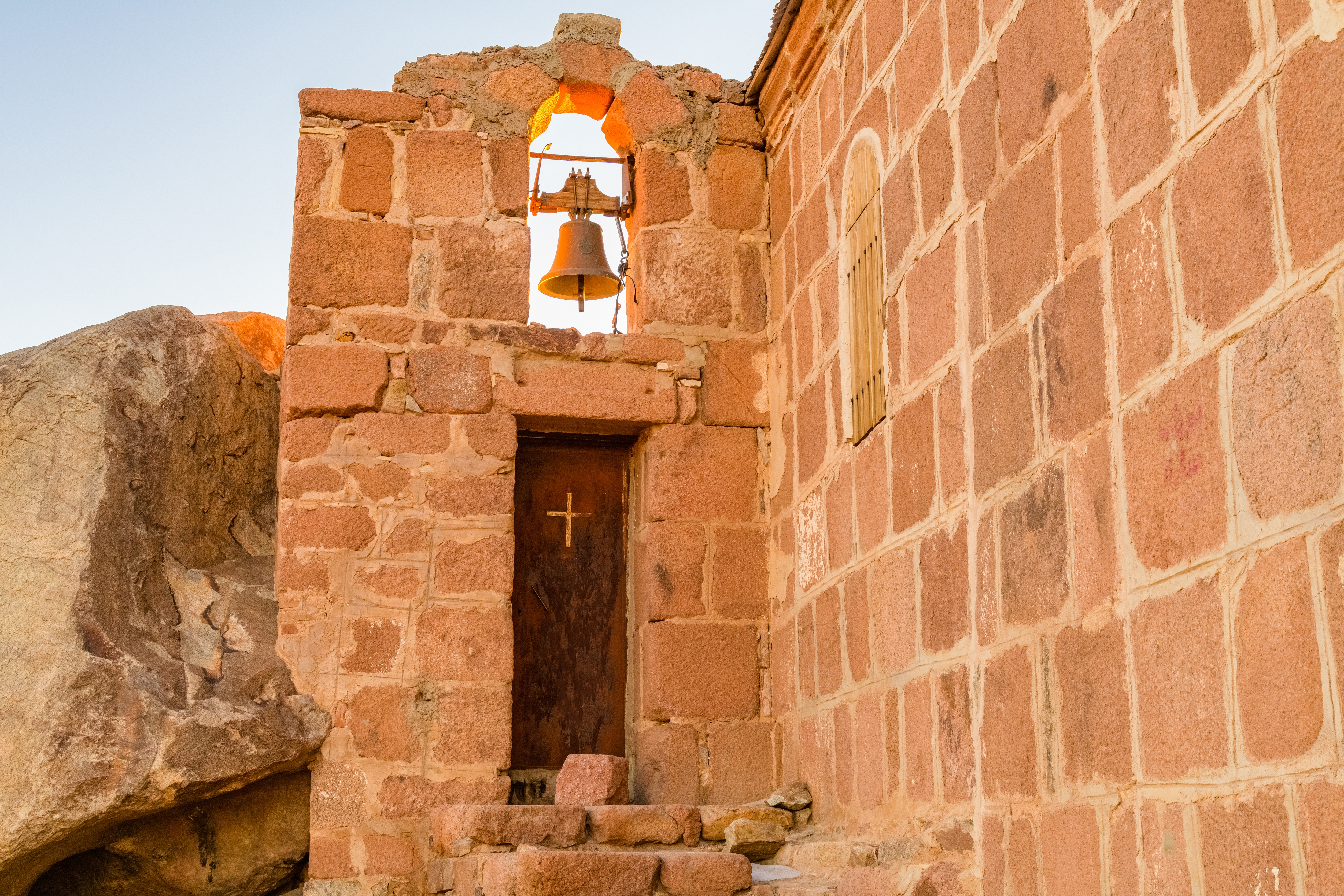
Inside the monastery stands a minaret dating to 1106, topped with the crescent, directly beside a bell tower bearing a large cross.
Legend links it to a Muslim ruler who approached the monastery with hostile intentions. The monks managed, using whatever resources they had available, to construct a minaret with a crescent and an arch facing east. When the ruler arrived and saw the minaret, he bowed in reverence and departed peacefully.
The historical reality underlying the legend is the necessity of coexistence and mutual respect.
The Significance of the Ossuary
The other side of the longevity of the world’s oldest continuously operating monastery is the monks’ profound awareness of the mortality of each individual brother.
The monk guiding visitors through the ossuary points to the countless stacked bones and skulls of those who lived as monks here, as bare as the dusty rocks themselves.
Saint Stephen stands apart, his largely preserved remains fixed in the posture of prayer in which he died in the sixth century.
The monks’ greatest fear is that, for some reason, they might leave the monastery and not be granted the privilege of being buried alongside those who came before them.
Conversely, they consider it the greatest blessing to be granted a lifelong stay on the mountain where God is believed to have walked — a stay extended into eternity in the monastery’s ossuary.
Kazantzidis’ Voice Echoes Through the Desert
From the battlements of Justinian’s walls, it is no longer threatening invaders that come into view, but vast tourism developments capitalizing on their proximity to the monastery as a major visitor attraction.
The hospitable monks, accustomed to centuries of coexistence with Bedouin tribes, do not fear the tribes of tourists.
Tourism, after all, is a field in which Greeks have traditionally been particularly active. In the resort town of Dahab — whose name means “Gold” and which is renowned for its underwater scenery and coral reefs — there is a “Greek Club.” When they are not diving, tourists can hear the voice of legendary Greek singer Stelios Kazantzidis echoing across the desert.
The “Greek Center,” headed by businessman Antonis Kazamias, is set to open four new branches: in Saint Catherine, in Taba on the border with Israel, in Raitho, the capital of South Sinai, and in Sharm el-Sheikh.
The centers will expand Greek-language instruction for Egyptians and Arabic-language instruction for Greeks.
Their activities also include the establishment of three newspapers covering news from the Greek community and the monastery’s activities, as well as extensive charitable work.
There is also an unconventional form of women’s empowerment. At the Greek Club in Dahab, a Bedouin woman holds a leadership role. She is the first woman to work in defiance of her tribe’s customs and has even taken a leading role in efforts to improve labor relations.
It is one of the discontinuities within the continuity of a peninsula marked by both harshness and holiness.