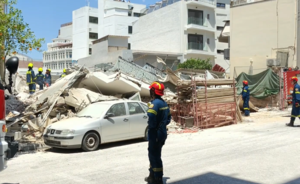
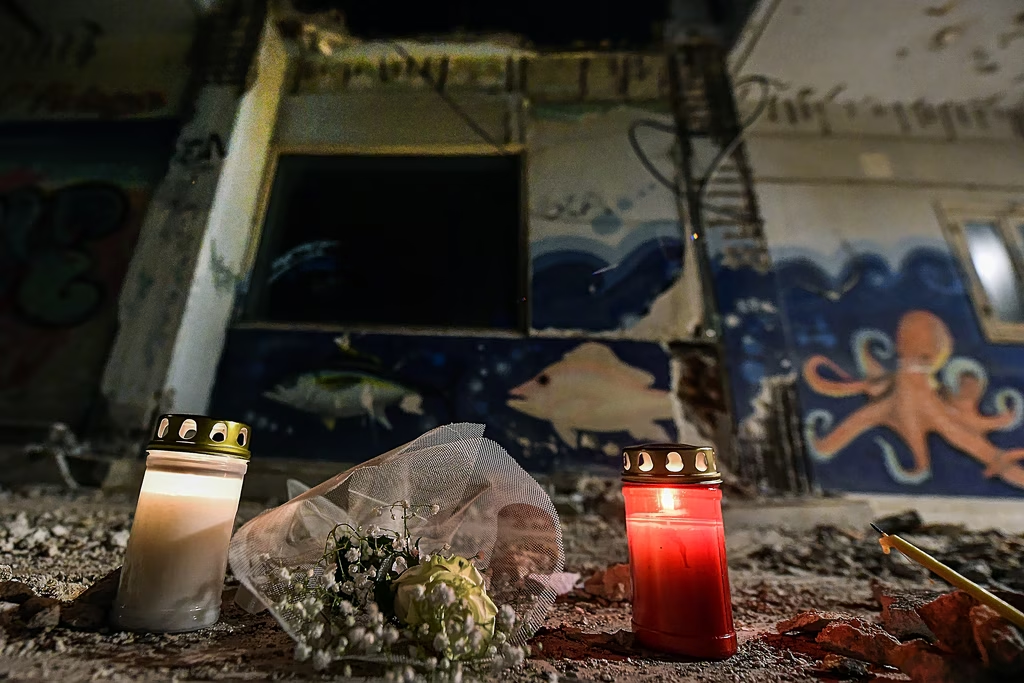
A wave of questions has emerged over what caused the collapse of an apartment building at 22 Alkminis Street in Petralona, which came down while construction work was underway on the lot next door. Structural engineers who spoke to tanea.gr describe it as an unprecedented case, one that “doesn’t happen every day, just like that,” and expect investigators to focus first on the required engineering studies and then on whether they were actually followed on site.
A prosecutor has ordered a preliminary investigation to determine whether zoning or building code violations occurred. Following that development, all five people who had been detained were released pending the outcome of the probe.
Why the building fell like a house of cards
How does an entire apartment building in central Athens collapse like a paper tower? Do city residents live under the illusion that their buildings are safe? Vasilis Bardakis, president of the Association of Civil Engineers of Greece, explains that every building under construction requires an excavation plan, a study detailing exactly how the digging will be carried out. He noted that when excavations go deeper, especially near adjacent buildings and below their foundations, ground failure becomes a real risk, which is why a dedicated shoring study and corresponding safety measures are required. In his view, that step appears to have been skipped in this case.
The same logic applies during demolition: if a wall is providing any kind of support, measures still need to be taken. Bardakis said it looks like neither shoring measures nor proper demolition precautions were in place, which is exactly why incidents like this are so rare.
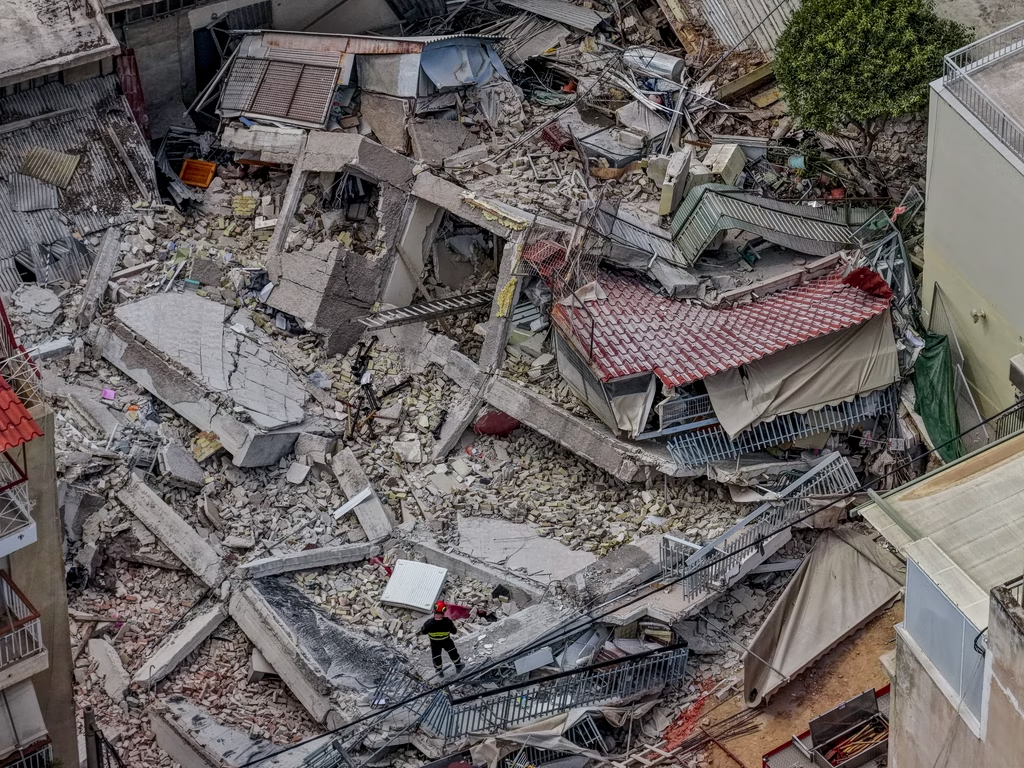
The collapsed building in Petralona on Alcminis road. Tuesday 30 June, 2026
A chain of failures
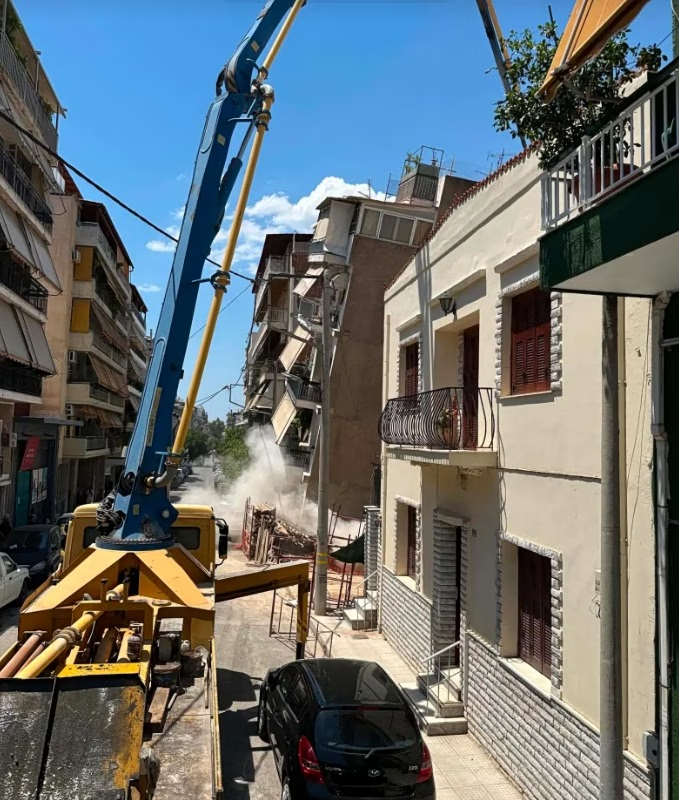
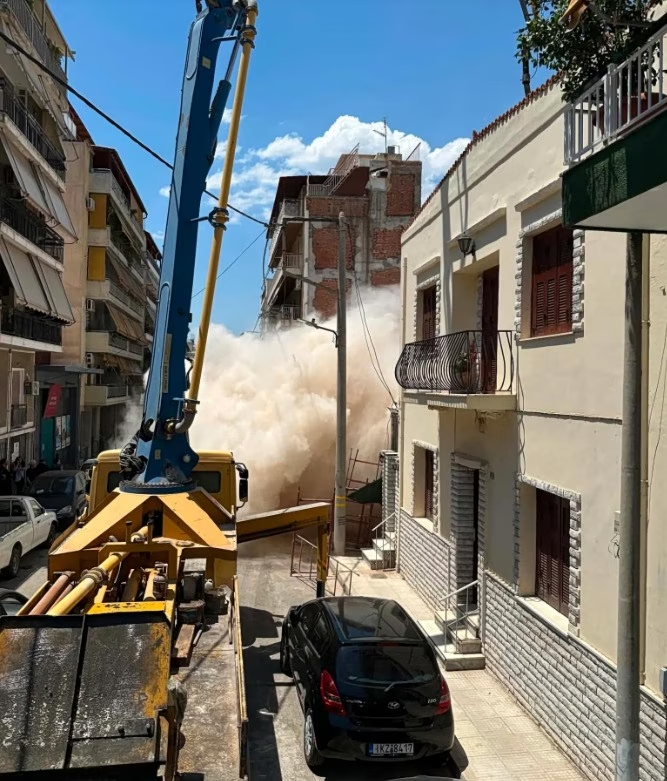
Tanea.gr visited Alkminis Street on Tuesday afternoon (June 30) and gathered accounts from neighborhood residents and tenants of the building that collapsed. Several said they had noticed the building leaning to the right beforehand, with some reporting a visible crack. One resident’s daughter recalled that an engineer had remarked, “It’s leaning like the Tower of Pisa but it hasn’t fallen,” only for the building to come down about ten minutes later.
Bardakis added that if proper measures had been taken, there would have been no visible tilt at all. He believes the failure mechanism originated in the ground: excavation work removed material near the foundations, causing them to settle, which triggered the tilt. From there, he suspects a chain of failures built on one another until the entire structure gave way.
He also stressed that all of this should have been assessed before demolition even began. Depending on the level of risk, he said, larger excavation and demolition jobs call for dedicated shoring studies and corresponding structural work. A geotechnical study isn’t legally mandatory in every case, he noted, but it’s a separate matter from the new building’s foundation study. Even where a geotechnical study exists, he said, a shoring study and the resulting safety measures should still follow.
“The studies and how they were applied need to be checked”
Manos Kranidis, a civil engineer and press representative for POMIDA (the Greek property owners’ association), called it a complex case that will take time to fully unpack, adding that he has never encountered a situation quite like it.
He said investigators should first determine whether the existing building had any known structural issues before it collapsed. He assumes a valid building permit and the legally required studies were in place, since a permit can’t be issued otherwise, but stressed that authorities will need to verify both whether those studies were sound and how they were actually carried out on site, which he called critical.
Put simply: was the work done properly? Kranidis said that’s the question authorities need to answer, through a review of the studies themselves and how they were implemented. He noted the studies should lay out the full logic behind the building’s foundation work, and that something clearly went wrong once excavation began, based on the tilt the building reportedly developed. He estimated a full forensic assessment could take months to pin down exactly what went wrong.
The demolition report
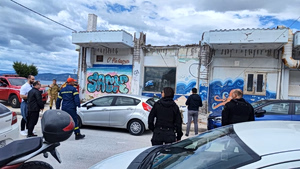
Tanea.gr has obtained the demolition report for the two-story building at 20 Alkminis Street, which included a ground-floor shop and storage space. The report states that no shoring of neighboring buildings was required beyond standard regulatory safety measures.
The document, signed by an architectural engineer and dated November 20, 2024, states that there was no visible damage and that the building could not be classified as dangerously dilapidated, and that it was structurally independent from the adjacent buildings.
Demolition and building permits for the neighboring lot
As tanea.gr reported yesterday, the process to demolish the building at 20 Alkminis (originally built under a 1956 permit) began in 2024. The demolition permit was issued on November 19, after the Architecture Council of the Central Athens Regional Unit approved it that June.
The project description covers demolition of a two-story building with a ground-floor shop and storage unit, on a lot listed at 213 square meters, though the site coverage plan lists the lot at 150 square meters.
On July 23, 2025, the demolition permit was updated due to a change of ownership. On September 18, preliminary approval was granted for a new five-story building with a basement, attic, and ground-floor pilotis, along with a permit to remove one tree from the lot.
On March 24, 2026, the building permit was formally issued so construction could begin. By then, the file also included sign-off from the relevant authority on modern monuments and technical works (November 2025), an approved gas fuel study (December 2025), and clearance from the department of prehistoric and classical antiquities (March 2026).
Deputy Mayor for Technical Services, Municipal Property and Digital Governance Panagiotis-Paris Charlaftis said that in an initial check with the city planning office, there was no on-site inspection report, whether for structural risk or for unauthorized construction, on file for either building.
He noted that the second property, at number 20, had both a demolition permit and, later, a construction permit. Some kind of failure occurred during the basement excavation work, he said, and that led to the collapse. The property had been bought by a company, and its owners are themselves engineers.
A luxury five-story building was planned
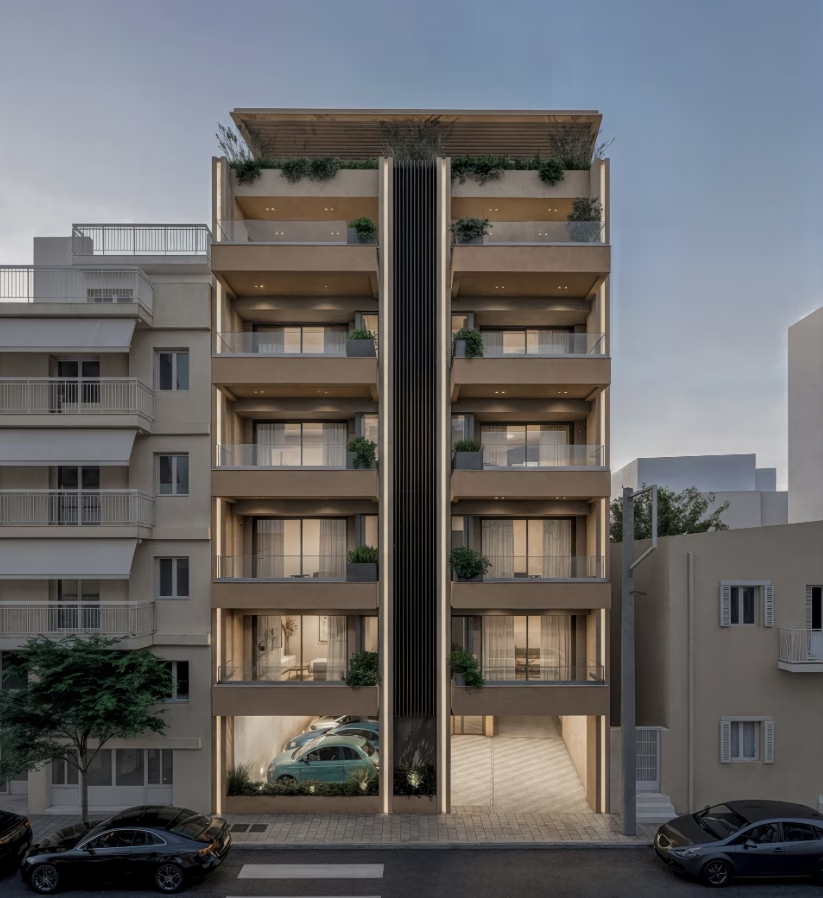
Next to the four-story building that collapsed on Tuesday afternoon, a luxury five-story residential complex had been planned, complete with a basement, attic and ground-floor pilotis. Photorealistic 3D renderings of the project even show the building that would later collapse standing beside it.
According to the project’s own marketing material, the complex was pitched as ideally located at the crossroads of Kerameikos, Petralona and Thiseio, close to the Filopappou hill, the Acropolis, and three metro stations, blending the city’s ancient heritage with modern urban living. Social media posts for the project promoted homes with clean design, natural light, and a strong connection to the city.
The official project description also promised uncompromising safety alongside high-end aesthetics, with particular emphasis on maximum earthquake resistance and top-tier Class A energy efficiency.