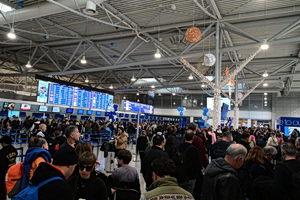

Five full days after the unprecedented blackout at the Athens–Macedonia Area Control Center (KEPATHM), which on Sunday morning caused eight hours of chaos in the country’s air transport, the official cause of this serious incident has still not been determined.
The “explanation,” it seems, will come from the investigations and reports of the expert committees that have taken charge of examining the unprecedented event, particularly the Committee led by the Head of the Civil Aviation Authority (CAA), Christos Tsitouras. Members include: the Head of the National Cybersecurity Authority (EAC) Michael Bletsas, the Communications Engineer of the Hellenic Armed Forces General Staff Colonel Dimitrios Zampakolas, the Deputy Director of Spectrum Supervision of the Hellenic Telecommunications and Post Commission (EETT) Nikos Igoumenidis, and a EUROCONTROL representative.
The Committee meets daily and will likely soon be joined by a specialist from the European Union Aviation Safety Agency (EASA).
What Is Being Investigated
The experts are focusing on two main scenarios: a complete “collapse” of the KEPATHM radio-telephony communications and a failure in the digital remote control of the Ymittos transmitter, which is supported by the Geraneia radar systems.
Specifically, they are examining a possible “stalling” of the VAR system (Voice communication system – Ancillaries – Remote control system), the main KEPATHM radio communications system, which according to staff “collapsed” along with all its frequencies, both primary and backup.
All air traffic controller reports from KEPATHM on Sunday morning converged on the point that “nothing related to communications was functioning.” Only radar screens worked, and the last-resort wireless system had very limited range. Controllers could see the aircraft on screens but could not communicate with the pilots.
The VAR System
The VAR system, provided by Thomson, is very old (dating back to 1991, with some intermediate upgrades). It includes all primary and backup radio-telephony communications, the hazard and aeronautical information display system (Information Display System – IDS), and the Remote Control System (RCS), which manages the remote operation of stations located on various mountains such as Ymittos and Geraneia.
According to preliminary assessments, due to the serious VAR issue, the Ymittos transmitter appears to have been activated via digital remote control. The transmitter, due to a malfunction in its remote control, began emitting strong pulses. It is believed that this excitation occurred automatically, without human intervention.
In any case, these assessments remain to be confirmed through field investigations. Experts will examine the proper functioning of the VAR/VCS remote control system and whether the Ymittos transmitter was continuously activated last Sunday, as reported by staff who conducted an on-site inspection.
New System
It is noted that the new VCS/RCS system for KEPATHM, contracted to SPACE HELLAS at a cost of €4.7 million, is already in the Civil Aviation Authority (CAA) warehouses. However, it has not yet been installed at KEPATHM due to known bureaucratic delays in the Greek public sector. Specifically, a decision from the Court of Audit to modify the contract with the contractor has been long awaited. According to the CAA, this decision is expected next week, on 13-01-2026.
Additionally, a total of 495 new VHF VoIP transceivers are being procured from ROHDE & SCHWARZ HELLAS AE at a cost of €4.2 million. The project was contracted on 20-10-2025, and the first systems are expected to be delivered and installed by CAA electronics engineers within the first two months of 2026.