
 Μake us preferred on Google
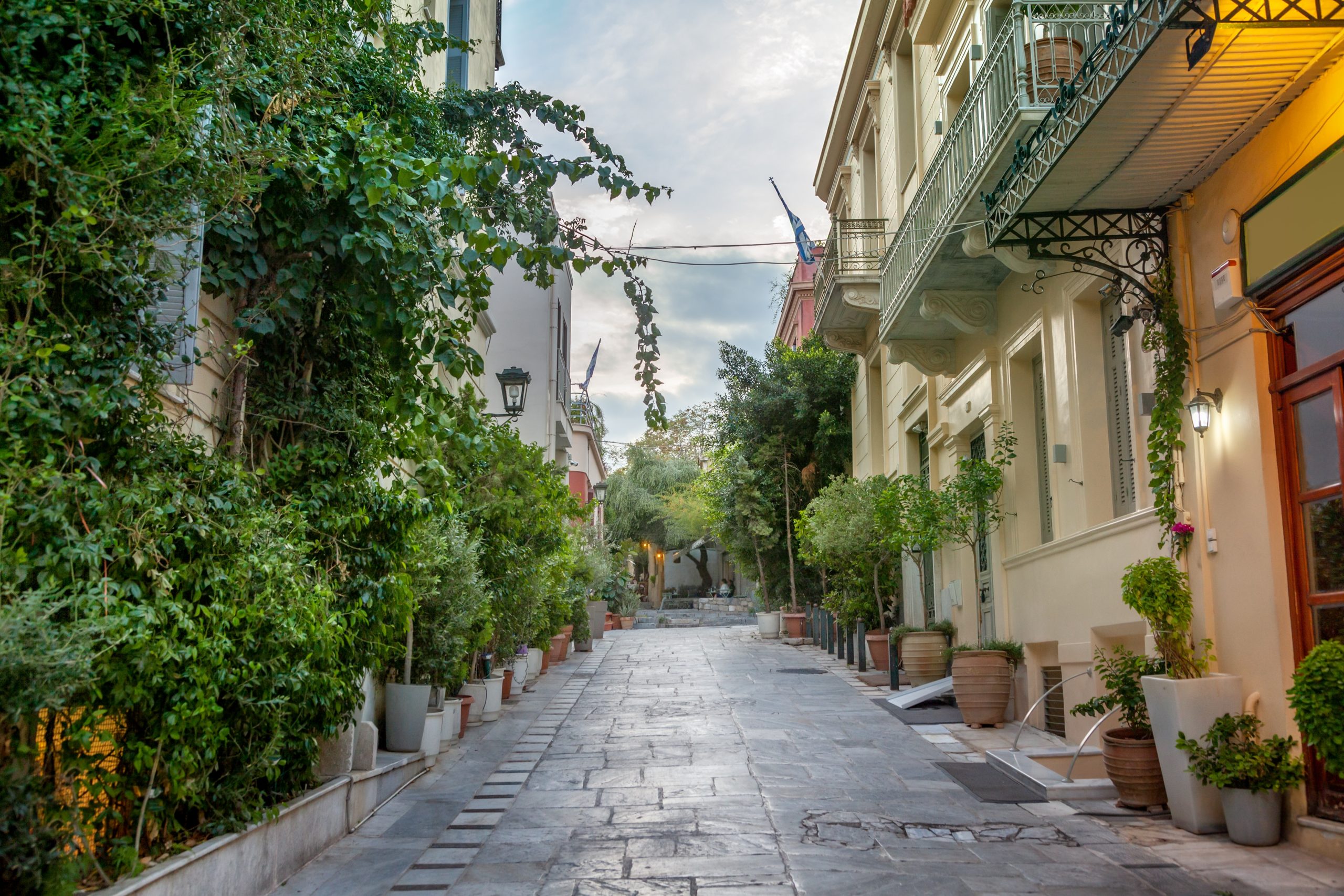
 Ghost streets are not just a figment of fairy tales. In the heart of Pagrati, a central Athens neighborhood, a secret passage hides in plain sight: Agios Fanourios Street. For over a century, this narrow lane has been walked, lived on, and celebrated—but until recently, it remained invisible to the state.
Six-story apartment buildings rose here in the 1960s, alongside older duplexes and the small Agios Fanourios chapel. Though modest in design, the chapel carries its own history. Local legend credits its construction in the early 20th century to Georgios Tsandilis, one of the first settlers of Vatrachonisi, a wooded islet of the Ilisos River, now fully absorbed into central Athens.
Every August, the street would overflow with people, fragrant with fanouropita, sweet cakes baked by women from all corners of Athens to honor the saint. The street itself appears in an 1895 notary contract (No. 36712/22-10-1895) by Athens notary Spyridon Armagos, confirming its long-standing existence.
Invisible Until July
Yet, until the end of July last year, this century-old street was absent from city planning maps. Buildings along it had official addresses facing non-existent streets, creating legal complications. A document from the Urban Planning Department of the Municipality of Athens notes:
“Properties on either side have their sole frontage on this street, which cannot be abolished as it continues to serve communal needs as exclusive access from and to approved streets.”
The issue was finally resolved by Deputy Minister of Environment and Energy Nikos Tagaras, who officially added the street to Athens’ urban map. The city block bordered by Filolaou, Chremonidou, Damareos, and Ifikratos streets was split in two by the newly recognized street, giving previously “faceless” buildings legal frontage.
New building regulations now apply to the two divided blocks: minimum plot size 200 m² (or 112.5 m² for pre-1973 properties), minimum frontage 10 m (or 6 m for older properties), floor area ratio 3.6, and maximum coverage 60%.
Forgotten Streets Across the City
Agios Fanourios is not an isolated case. Over the past fifteen years, more than ten streets in Athens, all pre-dating 1923, have been officially recognized, from Agios Panteleimonas to Metaxourgeio, Attiki Square, and Mets. Streets like Sevalier, Mersini, Mantineias, and Kynaigeirou have finally gained legal status.
Recent examples include:
- Sevalier Street in Agios Panteleimonas, officially recognized in 2023.
- Mersini Street, between Eynardou and Proussis Streets, also recognized in 2023.
- Mantineias Street in Kolonos, acknowledged as pre-1923.
- July Smith Alley, a narrow lane behind the Thiseio summer cinema, pedestrianized and preserved in 2015.
- Victor Hugo Street in Metaxourgeio, designated as historically significant in the same year.
- Kefalos Street in Arditou-Mets, bordering the archaeological site of the temple of Agrotera Artemis, formally recognized after a local heritage group request.
Even isolated plots in Kato Patisia found access through the recognition of previously nonexistent lanes, like Papantoniou Alley in 2011.
Restoring Order, Not Just Maps
These gaps in city planning are far from minor bureaucracy—they affect buildings, property rights, and entire neighborhoods. Recognizing “forgotten” streets doesn’t just add lines to a map; it restores legality, reintegrates the urban fabric, and completes the city’s puzzle. Athens’ invisible streets, finally seen, reclaim their rightful place in the city’s living history.