 Μake us preferred on Google
 Those who predicted that the wiretapping scandal involving the illegal surveillance of politicians, businesspeople, journalists, judges, and others would not come to an end with the case being shelved two years ago, following the publication of the widely discussed findings by Deputy Prosecutor of the Supreme Court Achilleas Zisis, are now, in effect, being proven right.
Even after the second decision to shelve the case by Supreme Court Prosecutor K. Tzavellas, who retired just two weeks ago, the wiretapping affair continues to be a subject of intense political confrontation, institutional friction, and judicial scrutiny, despite the two successive prosecutorial decisions to close the investigation.
But what is it that keeps the wiretapping affair—an issue inherently serious from both an institutional and substantive standpoint—at the center of judicial and political developments, despite the decisions by the judiciary to shelve the case?
A Boiling Cauldron
Legal experts following developments in the case believe that the absence, both politically and judicially, of satisfactory answers as to what actually happened and who was responsible has turned the wiretapping affair into “a boiling cauldron,” as a legal source familiar with the developments emphatically told To Vima.
NEWSLETTER TABLE TALK
Never miss a story.
Subscribe now.
The most important news & topics every week in your inbox.
“So long as convincing answers are not provided, so long as the tension generated by such a serious case is not defused,” the same source said, “the matter will not be closed. Quite the opposite—questions continue to multiply, as do new revelations.”
But let us look at where things stand today, almost four years after the allegations of illegal wiretapping exploded like a bombshell in 2022.
Following a series of judicial proceedings, which initially began at the Court of First Instance Prosecutor’s Office before being elevated, because of the seriousness of the case, to the Supreme Court Prosecutor’s Office, as well as parliamentary procedures that failed to produce results due to the responsibility of the government majority, the case ultimately led to two prosecutorial decisions to shelve the investigation.
The Decisions to Shelve the Investigation
Those decisions were issued at the highest prosecutorial level—by the Supreme Court Prosecutor’s Office. The first came from Deputy Supreme Court Prosecutor Achilleas Zisis in August 2024 (followed later by another), while more recently the case was once again placed in the archives through the findings of Supreme Court Prosecutor K. Tzavellas.
The decisions prompted reactions not only from opposition parties but also from victims of the wiretapping, among whom the most prominent participants in the judicial proceedings from the outset were PASOK leader Nikos Androulakis, journalist Thanasis Koukakis, former minister Christos Spirtzis, and a handful of others.
Samaras’ Request
Since then—and after the conviction of four private individuals, who received prison sentences totaling 126 years after being found guilty for their role in the illegal surveillance (they had remained outside the scope of the earlier prosecutorial decision by Deputy Supreme Court Prosecutor Achilleas Zisis, which had excluded them from the archived part of the investigation as those responsible for the unlawful monitoring)—three requests remain pending before the Supreme Court.
The most recent request, which reinforced the need for further judicial investigation of the wiretapping affair, came from former Prime Minister Antonis Samaras, who called for “the full clarification of how he was entrapped,” thereby increasing the responsibility of the prosecutorial authorities to examine the case in its entirety. Before Samaras’ request—which significantly added to the judicial backlog—other requests had already been submitted.
Despite the recent decision to shelve the investigation, Christos Spirtzis has requested further inquiry, as has lawyer Zacharias Kesses, who represents victims of the wiretapping scandal, relying on the contents of the conviction against the four defendants, among whom was Israeli national Tal Dilian.
Tal Dilian, who marketed the spyware known as Predator—which is illegal under Greek law—did not attend his trial, did not testify in his own defense, and also failed to appear before Parliament when summoned. However, following his heavy conviction and ahead of his appeal trial, scheduled for December, he has publicly stated that he had no involvement in the use of the software. According to his own claims, he marketed it not to private individuals but to state agencies.
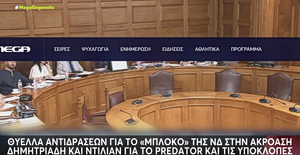
The summons issued to him, as well as to former close associate of the Prime Minister Grigoris Dimitriadis, by Parliament’s Committee on Institutions and Transparency produced no result, as the government majority ruled that neither of the two held a public office requiring them to testify.
Objections from opposition parties were insufficient to reverse that decision or compel the two men to appear.
It should be noted, however, that Grigoris Dimitriadis has testified twice before similar parliamentary committees and once before the Supreme Court.
Civil Lawsuits Seeking Damages
There is also another equally significant development beyond the criminal proceedings currently under judicial assessment, especially since the parliamentary process has, for the time being, failed to open the door to further investigation.
Victims of the wiretapping—not political figures but private individuals—have filed civil lawsuits seeking compensation for the unlawful surveillance to which they were subjected, the violation of their personal data, and related damages.
According to legal sources, their decision to broaden the judicial process through civil claims against private individuals—including all four convicted defendants—who are entangled in the wiretapping affair increases the pressure to reopen the investigation. Beyond criminal penalties (that is, imprisonment), those involved now face the significant prospect of having to pay substantial financial compensation.
Given these developments, and with other aspects of the investigation still open and expected to produce important new findings, the observation by lawyer Zacharias Kesses that “the case cannot be considered closed unless the victims are examined and their mobile phones are examined” reflects the breadth of the judicial proceedings, which, by all indications, are likely to continue for some time. At this stage, no one can predict where this judicial journey will ultimately end.