Two freezers—one at the Department of Biology of the University of Crete and the other at the Foundation for Research and Technology–Hellas (FORTH)—hold secrets that, until recently, had remained buried deep beneath the earth.
For the first time anywhere in the world, those secrets are coming to light.
Needless to say, these are no ordinary freezers. Maintained at -80°C, they preserve an extraordinary collection: hundreds of species of microorganisms that evolved over millions of years under extreme conditions in Gourgouthakas Cave, the deepest cave in Greece and one of the deepest in the world, located in Crete’s White Mountains (Lefka Ori).
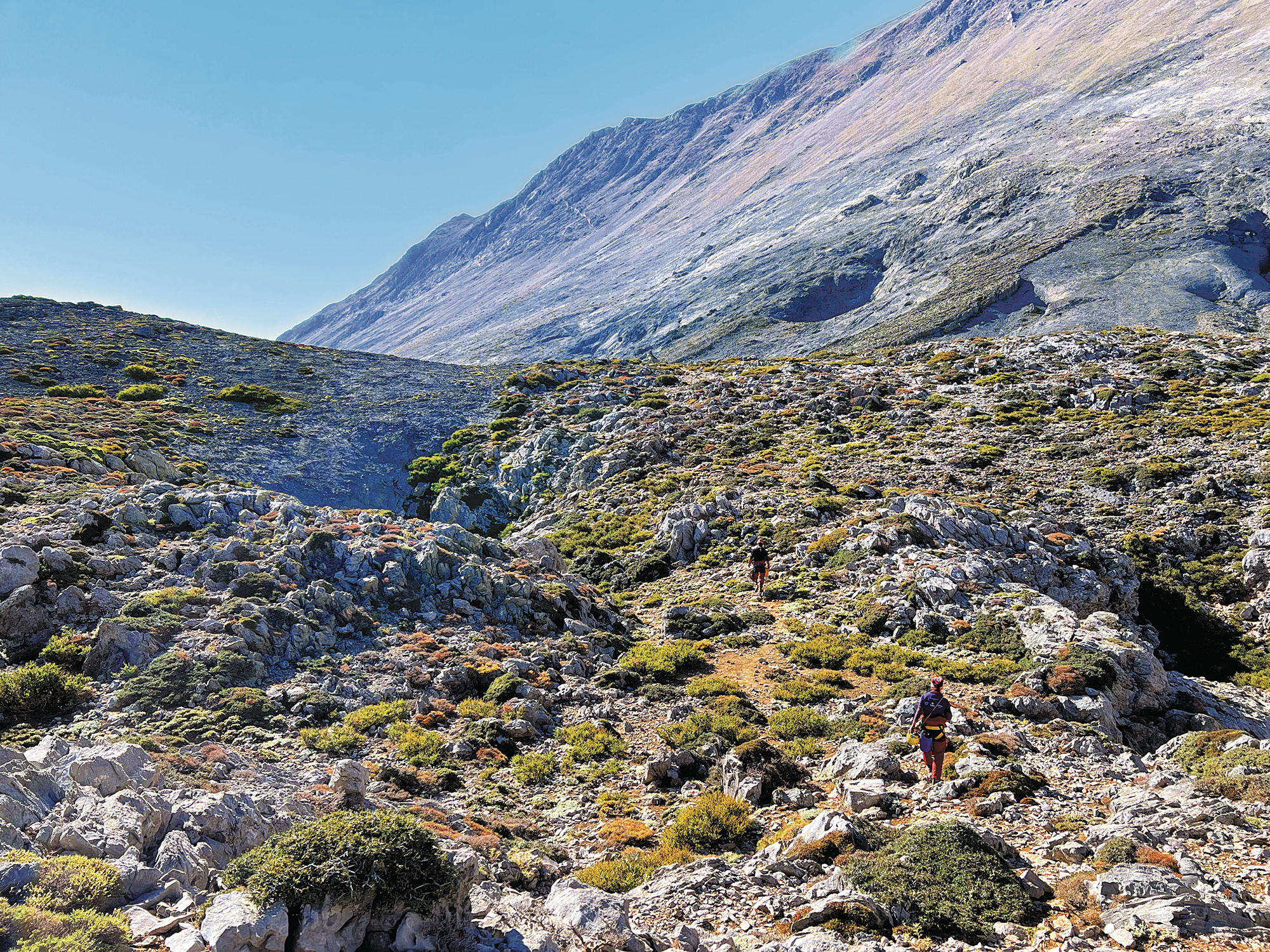
Cavers approach the entrance to the cave, with the northeastern slopes of the White Mountains,, whose peaks rise above 2.000 meters, in the background. Photo by Savvas Paragamian
Why are these organisms so valuable? Because evolution equipped them with bioactive molecules whose properties may prove antiviral, antibacterial, or anticancer. In other words, the contents of these two freezers constitute a biological repository unlike any other in the world.
An untapped scientific treasure
The properties of these bioactive molecules are being investigated by the research group of Panagiotis Sarris, professor at the University of Crete and researcher at FORTH. Their findings, published in the scientific journal Frontiers in Microbiology, suggest significant scientific potential.
The cave microbiome—the community of microorganisms that has adapted to life inside caves—remains largely unexplored. Yet studying it has become a major priority for researchers worldwide.
Speaking to TO VIMA Science, Sarris explained why:
“Deep caves are not merely geological formations. They are isolated ‘worlds within the world,’ where microbial life has evolved over millions of years in complete darkness, with almost no nutrients, low temperatures, and virtually no outside influences. This extreme isolation makes cave microbiomes exceptionally valuable for science. Unlike surface ecosystems, life here does not depend on photosynthesis but on alternative metabolic strategies based on chemical reactions involving inorganic elements. These adaptations often lead to the production of unique biochemical compounds—substances nature has ‘designed’ to survive in environments with extremely limited energy. Such molecules may prove invaluable in addressing challenges such as antibiotic resistance and much more.”
A scientific adventure
Before examining the team’s discoveries, it is worth telling the remarkable story behind them – a story of scientific exploration, interdisciplinary collaboration, volunteerism, passion for research, and… zero funding.
Everything described below was accomplished solely through the researchers’ commitment to science, without any government funding.
The project began in 2022, when an entirely Greek team of volunteer geologists and cave explorers, led by Markos Vaxevanopoulos and Giorgos Sotiriadis, set out to create a modern survey of Gourgouthakas Cave. Among the expedition members descending into the White Mountains was Savvas Paragkamian, the study’s lead author.
Gourgouthakas is not an easy place to explore. Stretching 2,384 meters in length and reaching a depth of 1,100 meters, with 100% humidity and temperatures ranging between 6°C and 7°C, the cave demands absolute respect.
“People usually ask whether there is enough oxygen inside caves,” Paragkamian told TO VIMA Science. “In reality, the greatest danger is water. If there’s even a possibility of rain, the expedition is postponed because certain passages can flood rapidly and trigger landslides.”
He emphasized that the expedition’s meticulous planning was key to its success. A support team, including volunteer cooks, remained at the cave entrance, while a supply station was established 600 meters underground. Communication systems and specialized caving equipment were also essential, following months of preparation.
The same level of care was devoted to collecting samples.
“We took great care to prevent contamination by surface microorganisms that we ourselves might have carried into the cave,” Paragkamian explained.
He spent 22 hours inside Gourgouthakas collecting both dry and liquid samples from different depths, eventually reaching the cave’s deepest accessible point. Three of those hours were spent resting, while the climb back to the surface alone took another seven hours.
A relay race against time
The rapid and safe transport of the samples proved equally critical to the project’s success.
Dry ice maintained the samples at -78.5°C until they reached the laboratory, but getting them there was no simple task.
After emerging from the cave, Paragkamian still had to hike for two hours to reach the expedition’s vehicles, which could not travel any farther. He then drove to Chania, where the samples were handed over to Christos Christakis for transport to Heraklion, allowing laboratory work to begin immediately to ensure the microorganisms remained viable.
The first challenge was cultivating organisms that had never before been studied. But under what conditions do you grow microorganisms that no one has ever cultivated?
“Each sample was cultured using four different growth media and at two different temperatures—the cave’s natural temperature and 25°C,” Christakis said.
“As for the culture media, one was nutrient-rich, another contained half the nutrients, while the other two were much poorer. The fourth medium contained no nitrogen because we wanted to investigate whether nitrogen-fixing microorganisms were present.”
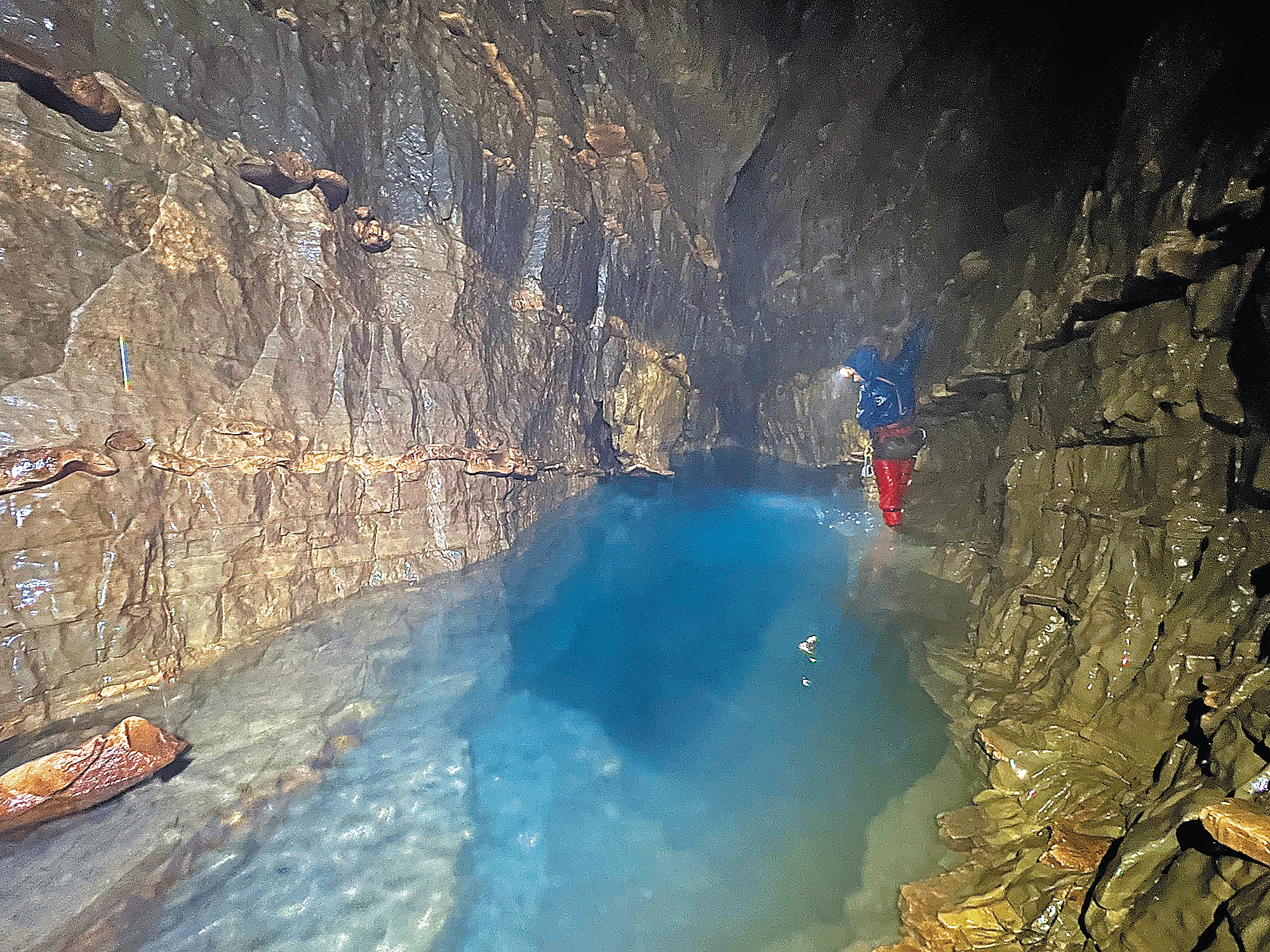
A researcher collects samples at a depth of 1,100 meters. Photo by Markos Vaxevanopoulos
Discoveries of exceptional value
After months of systematic work, the research team successfully cultured 865 species of microorganisms, including bacteria and fungi, creating a biological repository unlike any other in the world.
Using advanced molecular techniques, the researchers then identified the microorganisms and began investigating their biological properties.
“In addition to accurately mapping microbial diversity and revealing the functional capabilities of these communities, we discovered a wide range of bioactive molecules produced by these microorganisms,” Sarris said.
“In other words, deep-cave microbiomes are not simply poorer versions of surface microbial communities. They are distinct ecosystems with specialized functions and remarkably interesting new metabolic pathways.”
The team’s initial tests have already produced encouraging results.
Two microorganisms, identified by the codes SRL871 and SRL810, proved significantly more effective than commercially available products at combating pathogens that damage vegetable crops.
Research into the antimicrobial and anticancer properties of these biomolecules is still ongoing. But one thing already seems certain: in the years ahead, the scientific community is likely to hear much more about the remarkable discoveries hidden for millions of years inside Gourgouthakas Cave.