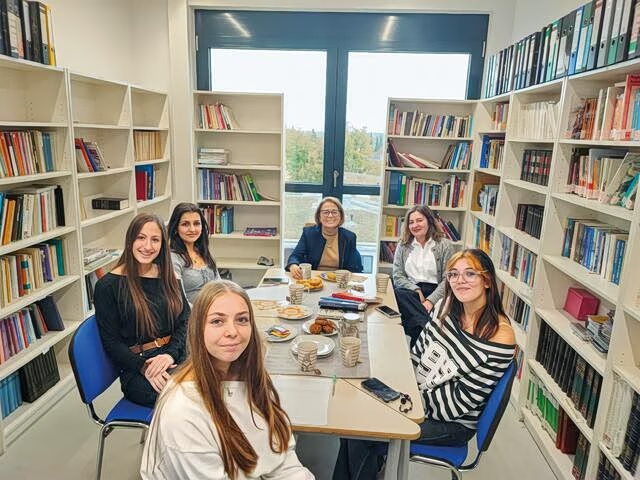
From the Pedagogical Academy of Larissa to the Ludwig Maximilian University of Munich, Vassilia Triarchi-Hermann came to Germany in the 1970s, driven by her love for educational science. A university lecturer, researcher, and advisor on educational policy in Bavaria, she has focused in particular on issues of bilingualism, intercultural education, and the school integration of children with a migrant background. She speaks to TO BHMA of Munich about her journey and the challenges she faced.
What was your dream as a child, and what motivated you to study education?
“When I was 15, I worked at the Psychological Center of Northern Greece during the summer, a center for the education of children with special needs. Living with these children, I became enthusiastic about what I experienced with them every day. I was especially impressed by the director of this institution, who had studied in Germany. I greatly admired both her way of interacting with the children and her work, which was pioneering in Greece at that time. That was when I decided that I wanted to help and to study Special Education in Germany. My ultimate goal was to improve the education of children with special needs in Greece.”
How did you come to Germany?
“After completing my two-year studies at the Pedagogical Academy of Larissa, I wanted to continue my studies in Special Education at a university in Germany, since in the 1970s it was not possible to pursue such studies in Greece. My father initially supported me enormously in realizing this wish, especially financially. Then, with a scholarship from the Goethe Institute, I completed my study of the German language and obtained the certificate required for admission to the Ludwig Maximilian University of Munich.”
And that is how your studies in Special Education began?
“Exactly. I studied Special Education (specialization: Speech Therapy), Psychology, and Phonetics. After four years of study, I received the degree of Magister Artium, and three years later, at the age of 28, I earned my doctoral degree with a scholarship from the German state (Deutscher Akademischer Austauschdienst).”
Was an academic career your own goal or your father’s dream?
“My university career was based on my father’s dreams. My own goal was to contribute to the education and upbringing of children and adolescents. That was my dream, and today I am happy to say that I was able to accomplish it. I worked as a teacher, speech therapist, professor at the Bavarian Academy for the Training of Teachers and Educational Administrators in Dillingen, and as an advisor at the Bavarian State Institute for School Quality and Educational Research. At the same time, I taught at the University of Munich in the field of Special Education for 30 years.”
What difficulties did you face at the beginning of your career?
“For personal reasons, I did not return to Greece, although that had been my dream. Even though I had studied in Germany, I faced difficulties as a Greek educator in finding work in Munich. With the help of the Greek Consulate General, I established two special classes for Greek children with learning difficulties, integrated into a Bavarian special school. I worked there for several years. At the same time, I managed to obtain a license to practice as a speech therapist in Bavaria. I began working at the university one year after graduating. I always had the support of my professor, who approved the inclusion of topics related to bilingualism in the course I taught. In the 1980s, these topics were not part of teacher education curricula, even though a significant proportion of students were of foreign origin.”
Do you believe that bilingual education can positively contribute to the development of students? If so, how?
“Yes, findings from international, longitudinal research confirm the positive impact of bilingual education on the cognitive, linguistic, and emotional development of children, as well as on their academic performance. It has also been established that for the education of children with a migrant background, it is very important that instruction—especially in the early school years—takes place primarily in their mother tongue. This contributes greatly to the development of what is known as ‘cognitive academic language proficiency.’ It is clear that this linguistic ability is essential for school learning and is simultaneously cultivated through it.”
Do you therefore believe that Greek children attending Greek schools can develop this linguistic ability?
“Of course! This explains why a large percentage of graduates from Greek schools in Bavaria have pursued university studies. In a research study I conducted as an advisor at the Bavarian State Institute for School Quality and Educational Research a few years ago, in which 716 former students of Greek schools participated—now living in Greece, Germany, and elsewhere in Europe and America—it was found that 68.20% attended a university, while 32.70% attended vocational training institutions.”
Do you think that teachers in Greek schools should have specialized knowledge?
“I believe that in their teaching they should take into account the abilities, skills, and also the weaknesses of Greek students growing up in a bilingual and bicultural environment. It is therefore essential that they possess scientific knowledge regarding the linguistic, cognitive, and emotional development of these children and acquire teaching methods that meet their students’ needs. For this reason, 31 years ago, the Department of Further Training and Professional Development of Greek Teachers was established at the Dillingen Academy.”
Can you tell us about the Dillingen Academy?
“The Dillingen Academy is the central institution for the training and further education of teachers and administrative staff in Bavaria. It is located in a monastery in the town of Dillingen, about 120 km outside Munich. Today, teachers from all levels of Bavarian schools participate in its training and professional development programs.”
How was the department for Greek teachers created, and what was the focus of the training?
“Members of the board of Greek teachers asked me to help them create a training program for teachers in Greek schools. Following an application by the then Consul General to the Bavarian Ministry of Education, in 1994 a two-year further training program in school counseling for Greek teachers was established. This program, financially supported by the Bavarian Ministry of Education, was integrated into the Dillingen Academy. The diploma of Counselor-Educator awarded to successful participants had official state recognition in Germany. For teachers who did not have the time to participate in the two-year program, seminars were also offered on school pedagogy, psychology, didactics, and information technology.”
Was this diploma also officially recognized in Greece?
“The degrees awarded to participants in the first three cycles of study received official recognition from the Greek Ministry of Education. However, those from the subsequent two cycles did not. For this reason, since 2015 only training seminars have been offered to Greek teachers.”
“It is essential that teachers seconded from Greece remain in Germany for at least five to six years.”
You also served as an advisor at the Bavarian State Institute for School Quality and Educational Research. What were your responsibilities there?
“At this institute, curricula are developed, as well as every educational or research program implemented at all levels of education, including vocational training schools in Bavaria. I was responsible for international collaborations, intercultural education and multilingual education, as well as for the Greek schools of Bavaria.”
What was your great dream for Greek schools?
“That they evolve into truly bilingual schools, where curricula are designed for Greek children growing up with two languages and two cultures, living in Bavaria rather than in Greece. It is also important that they be staffed by teachers with specialized knowledge and teaching skills. My dream was for Greek bilingual schools to provide equal opportunities to all their students—both those who, after 12 years of schooling, would be able to obtain a dual diploma, the so-called Abi-Apo (Abitur–Apolytirion), allowing them to study at universities in both Greece and Germany, and those who would choose to attend vocational training schools. Bilingual schools in which Greek children in Bavaria would acquire key skills and competencies enabling them to successfully meet the multifaceted challenges of a globalized society.”
Do you believe that stability among teaching staff is important?
“It is essential that teachers seconded from Greece remain in Germany for at least five to six years. From my many years of experience, I believe that 60% of each school’s teaching staff should consist of educators who live permanently in Bavaria, and that school principals should also be permanent. Frequent changes of teachers and principals create multiple and wide-ranging problems in the daily functioning of the school and certainly in the educational process.”
You have written a book about Greek schools. What motivated you?
“So far, three of my books on Greek schools have been published. The book Greek Schools in Munich. 1815–2021. A Historical Study presents the history of Greek schools in Greek. The book Students of Greek Schools in Bavaria. A Research Study presents the results of a study involving 716 former students of Greek schools in Bavaria. The third book, to be released in a few days, titled Einblicke in die Geschichte der Privaten Griechischen Schulen in München. 1964–2024 (Insights into the History of Private Greek Schools in Munich. 1964–2024), presents in German the most important aspects of the history of Greek schools in Munich. I devoted a great deal of time to writing these books. Why did I do it? Because I believed—and still believe—that the history of these Greek schools must be recorded and that their great and valuable contribution to Greeks must finally be presented.”
You also served as president of the Hellenic Cultural Foundation “Palladion.” How do you evaluate your tenure there?
“During my 11 years as president of this foundation, various conferences, lectures, and meetings were organized on historical, economic, political, and social topics, as well as concerts, art exhibitions, literary evenings, and joint training sessions for parents and teachers. An important contribution of the foundation was that, from the 2017–18 school year, Greek schools became examination centers for obtaining the Certificate of German Language Proficiency issued by the Standing Conference of the Ministers of Education of Germany. Another noteworthy initiative was the joint program of the foundation and the Bavarian Ministry of Education, ‘Greece—Then and Now,’ created in the 2013–14 school year. Within this program, partnerships between Greek lower and upper secondary schools and Bavarian humanistic high schools were established, including week-long student exchange visits, teacher training, and student competitions.”
Of all your activities, which did you love the most?
“I cannot single out one in particular. Each had its own uniqueness and beauty, its own demands, challenges, and interests.”
What message would you like to give to young people?
“Be flexible in responding to the stimuli and challenges you encounter daily, and approach them with creative imagination. My wish is that you discover early on what you enjoy doing every day and have the opportunity to integrate it into your professional life.”