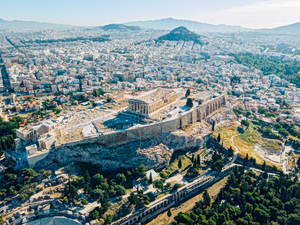
Athens has spent the last several years cementing its status as one of the Mediterranean’s most sought after destinations, drawing millions of visitors annually to its ancient monuments and increasingly vibrant urban culture. But new figures from the city’s tourism monitoring body suggest that behind the record arrivals lies a strain on the neighborhoods absorbing most of that growth.
The question facing City Hall, according to officials tracking the data, is no longer whether Athens needs tourism, but how to keep growth from eroding the quality of life of the people who actually live there.
What the numbers show
The Sustainable Tourism Observatory, which operates through Develop Athens the city’s development agency, tracks how tourism activity is evolving and how it affects individual neighborhoods within the Municipality of Athens. Its first update to the 2024 Tourism Carrying Capacity Study gives officials a running picture of where pressure is building across the city.
According to the Observatory’s figures, tourism activity has rebounded strongly, now noticeably surpassing pre pandemic levels. It is telling that in 2025 the Municipality of Athens had 19,071 tourist accommodation units in operation, compared with 14,288 in 2018, while available beds surpassed 105,000, an increase of 24.3 percent.
The growth of short term rentals has been especially strong: these units now number 18,769, an increase of 33.5 percent compared with 2018 and nearly 60 percent compared with 2021, when the market was still experiences pandemic related consequences. At the same time, the hotel sector continues to expand, with the number of hotels increasing by 29.1 percent over the same period.
The spike in accommodation availability for tourists, however, is only part of the picture. The updated study shows that the real tourism pressure is increasing even faster. Overnight stays per resident nearly tripled over the last eight years (up 183.7 percent), while tourists per resident increased by 142.2 percent.
Officials say the figures show that tourism activity in Athens’ neighborhoods is intensifying at a much faster pace than accommodation supply alone would suggest.
The historic center, according to the study, continues to bear the greatest pressure. Indeed, the analysis confirms that the largest concentration of tourism activity remains in the 1st Municipal Community, where nearly 60 percent of the city’s total tourist lodging capacity is (the Commercial Center, Monastiraki and Plaka, the Psyrri area, Makrygianni, Thiseio, Agiou Konstantinou and Kallirois).
The Commercial Center stands out in particular. Short term rental units have nearly tripled over the last eight year, while significant growth was also recorded in areas such as Koukaki and Exarchia, an indication that tourism development is beginning to spread beyond the traditional historic center.
Short term rentals
A measure of relief, however, appears to have come from the suspension of new short term rental license issuance in the 1st, 2nd and 3rd Municipal Communities. While in 2023 to 2024 the increase in short term rental units ranged between 18 percent and 20 percent, in 2024 to 2025 it was limited to between 1.7 percent and 5.4 percent.
“Athens needs tourism, but it also needs neighborhoods that remain alive for their residents. Today 60 percent of the municipality’s tourist beds are concentrated in the 1st Municipal Community. This alone shows that we cannot treat every area in the same way. We continue to invest in a form of tourism that creates value for the city without depriving its residents of their quality of life,” said Athens Mayor Haris Doukas.
Source: TA NEA