 Μake us preferred on Google
 Athens Mayor Haris Doukas said on Tuesday that the municipality’s decision to suspend new short-term rental permits in several districts of the Greek capital is beginning to deliver results, helping slow the spread of Airbnb-style accommodation in the city’s most heavily visited neighborhoods.
Citing the findings released this week of a study carried out by the municipality’s Sustainable Tourism Observatory, Doukas said the data confirms the conclusions of the city’s Tourism Carrying Capacity Study.
“According to the latest data, it appears that the suspension of new short-term rental permits in the areas where it is applied is paying off,” Doukas said.
The mayor went on to stress that while tourism remains vital to Athens’ economy, protecting residential neighborhoods is equally important. “Athens needs tourism, but it also needs neighborhoods that remain alive for their residents,” he said. Doukas noted that 60% of all tourist beds in the municipality are concentrated in the city’s 1st Municipal District, which includes much of the historic center. “This alone shows that we cannot treat all areas in the same way,” he said.
According to the municipality, the annual growth rate of short-term rentals in districts covered by the permit suspension slowed to between 1.7% and 5.4% in the 2024-2025 period, compared with growth of 18-20% in 2023-2024 – before the measure took effect.
“The data is a first indication that the measure is working as a mechanism to slow down the further spread of short-term rentals,” the municipality said in a statement. “However, as the existing stock remains active, tourist pressure is stabilizing without yet subsiding.”
The Sustainable Tourism Observatory tracks tourism activity across Athens, and assesses the impact on neighborhoods, housing, and local infrastructure.
Tourism Continues to Grow
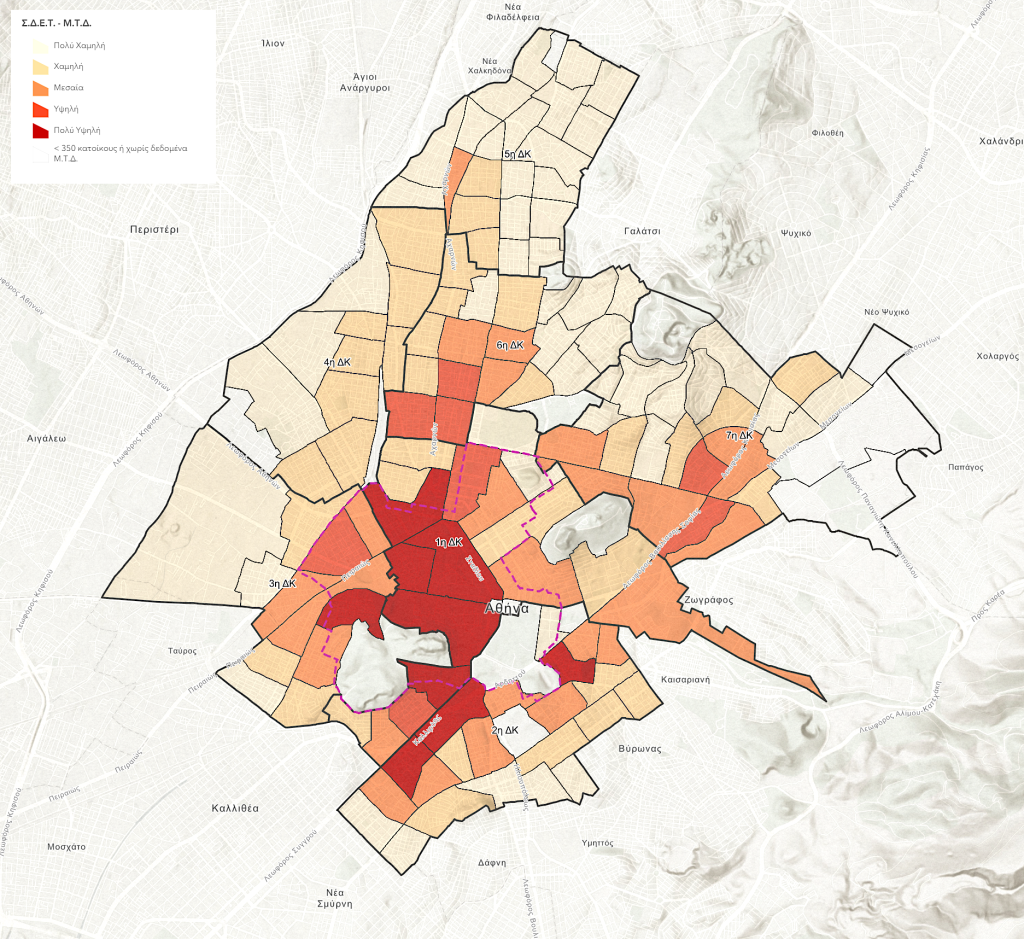
Map showing the concentration of tourism accommodation units in Athens. Photo: Municipality of Athens
The latest study, covering the 2018-2025 period, shows a strong rebound of tourism in Athens, following the Covid-19 pandemic. In 2025, the Municipality of Athens recorded 19,071 tourist accommodation units, up from 14,288 in 2018. Available tourist beds exceeded 105,000, up by 24.3% over the period.
Airbnb-style rentals came to 18,769 units in 2025, up by 33.5% over 2018 and nearly 60% higher than in 2021.
The number of hotels in Athens also increased by 29.1% over the same period.
The study found that overnight stays per resident have almost tripled over the past eight years, rising by 183.7%, while the number of tourists per resident increased by 142.2%.
“These figures reflect that tourist activity across Athens neighborhoods is increasing at a much higher rate than the increase in available accommodation,” the municipality said. “This makes it even more important to continuously monitor the impacts on housing, infrastructure, and the daily lives of residents.”
The findings come as Greece continues to tighten regulation of the short-term rental sector. Last year, the Tourism Ministry began implementing legislation requiring Airbnb-style properties that fail to comply with Law 5170/2025 to be automatically removed from the national registry and delisted from online platforms. Registration numbers (AMA) for non-compliant properties are revoked under the law.
Athens Welcomes 8.7m Visitors Last Year
In an interview to TO BHMA International Edition, Doukas argued that the Greek capital is bearing the burden of tourism without receiving its “fair share” of the revenues, which, he said, flow largely to the central government.
Last year, Athens welcomed approximately 8.7 million international visitors, with the majority arriving between May and September. At the same time, the wider metropolitan area is home to roughly 3.8 million residents, nearly one-third of Greece’s population. Add students, temporary workers and undocumented residents, and the number may be much higher.
“The majority of revenues go to the central state, while local governments in Greece receive only 2.7% of the state budget. Yet every day, the Municipality of Athens is called on to manage enormous pressures with limited resources,” he said.