The history of the Greek Revolution has largely been told through the achievements of its fighters, the sieges, the harsh mountains where traditional fustanella garments were stained with soil, blood, and sweat, and the battles where freedom was won at any cost. Far less often do we imagine what unfolded behind the weapons and flags, in homes, taverns, and hidden corners where love and passion flourished. The revolutionary leaders, far from the harems of Ottoman pashas, fought their own battles to win women’s hearts, driven by an unbreakable flame reflected both on the battlefield and in their private lives.
Mario, the Companion of Georgios Karaiskakis
Despite his marriage to Golfo Psarogiannopoulou and their three children, Georgios Karaiskakis was not a man who could live without a mistress. His life was turbulent—he began as a klepht in the mountains, became an armatolos, and later joined the Revolution, constantly placing himself in danger. Alongside him in every battle was Mario, a Christian-converted Turkish woman he had captured in Nafplio. The young woman quickly became his shadow. She cared for him when he was ill, cooked for him, and tended to his every need. On campaign, she dressed in men’s clothing and was called “Zafeiris.”
As historian Yiannis Vlachogiannis wrote in the newspaper Estia in 1917: “She had a round face, black eyes, and a braid wrapped around a red fez with a blue tassel. Karaiskakis, often ill and far from his own family, needed the care of a woman.” When his wife Golfo objected to Mario’s constant presence, he replied with his characteristic blunt humor: “Don’t worry, you silly girl, I’ve got enough for you too!”
Kolokotronis & Margarita
The indomitable “Old Man of the Morea,” Theodoros Kolokotronis, is remembered not only as a strategist and leader but also as a figure with a deeply emotional private life, revealed in the less visible pages of history. During his imprisonment at the Monastery of Prophet Elias in Hydra, he was cared for by a former nun named Margarita. In that unusual environment of confinement, their love was born. After his release, Kolokotronis took her with him, even during military campaigns.
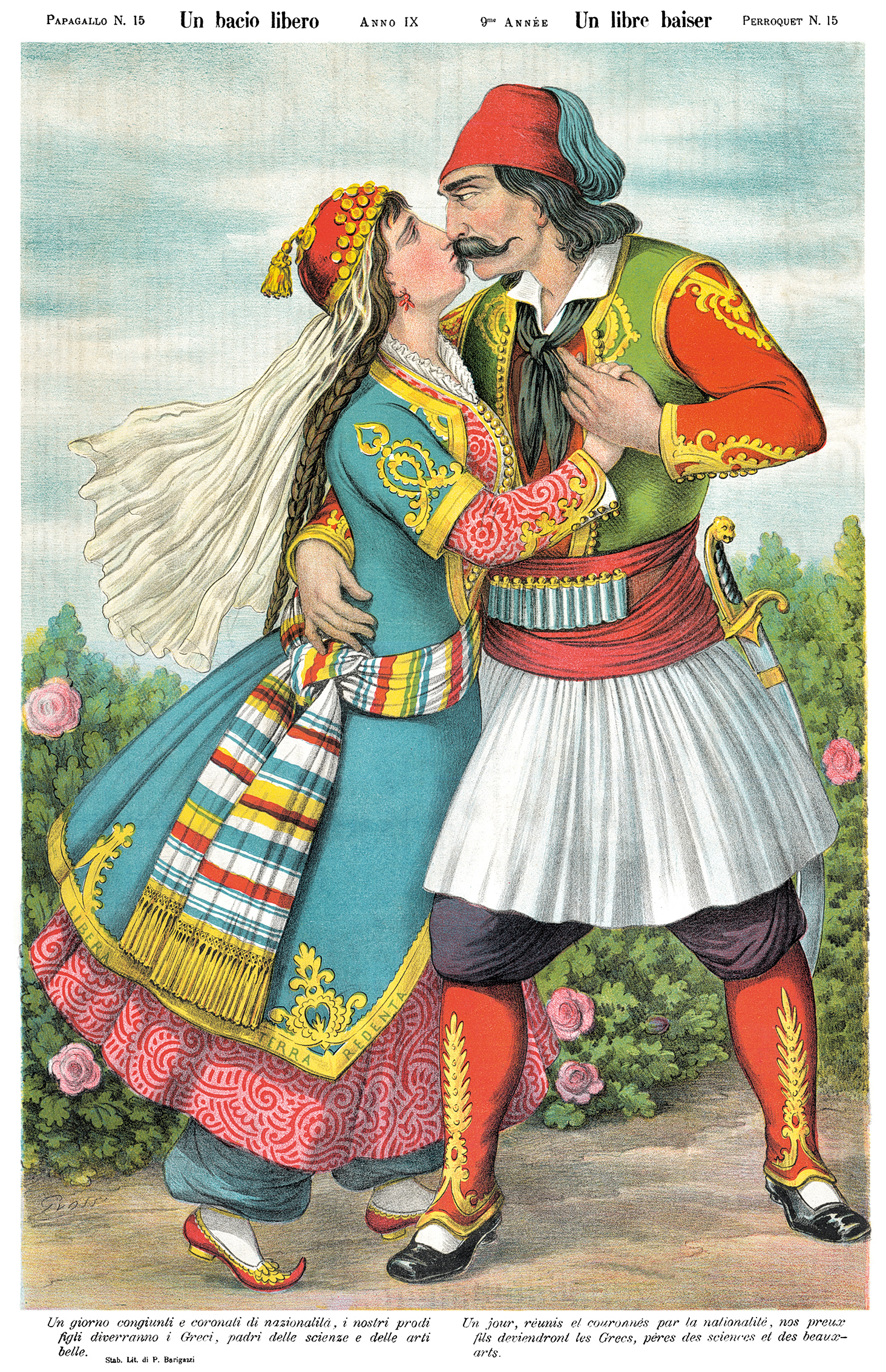
by Augusto Grossi for a weekly publishing by Il Papagallo magazine
A year later, Margarita gave birth to his child, named Panos in honor of Kolokotronis’ son who had been killed during the civil conflict of 1824. Despite the strict morals of the time, the commander did not hesitate to acknowledge the child in his will, writing: “I also leave a share to my son Panagiotakis, whom I had with Margarita, daughter of Angelis Velissaris from Chalikianika.” Panos grew up to become an officer, aide-de-camp to King George I, and later commander of the Hellenic Army Academy.
The Loves of Bouboulina
The naval commander Laskarina Bouboulina is said to have had numerous romantic connections with French officers, as well as a brief relationship with Kolokotronis. Rumors about this affair spread widely, and in an attempt to quiet them, she married her daughter Eleni to Kolokotronis’ son Panos. However, Eleni almost immediately began another relationship with Theodoros Grivas.
Another love, however, would cost Bouboulina her life. Her son Giorgis fell deeply in love with Vgeni Koutsi, a woman her family intended to marry to another man. He abducted her and brought her to his mother’s house. When her brothers arrived to take her back, Bouboulina sided with her son. In the ensuing conflict, she was shot and killed.
“A Warrior Who Is Defiled Will Be Devoured”
The life of Captain Zacharias, teacher of Kolokotronis, was filled with passions that often clashed with the harsh realities of war. Known for his brutality in the mountains of the Morea, Zacharias Barbitsiotis could not resist the allure of women. His greatest love affair was with Eirini Mourtzinou, whom he passionately loved. This relationship ultimately cost him his life.
Zacharias abducted her and took her into the mountains, abandoning safety and order in pursuit of his desire. But his passion had consequences. Eirini’s father, determined to protect his daughter, conspired with his brother-in-law Koukeas. When Zacharias arrived to claim her, he was shot dead. This event confirmed a popular saying among fighters of the time: “A warrior who is defiled will be devoured by the black serpent.”
A Shakespearean Love
Manto Mavrogenous and Dimitrios Ypsilantis met in Trieste during a period when Greek communities in Europe served as centers of revolutionary ferment. The young noblewoman from Mykonos, wealthy and deeply committed to the struggle, and the Phanariot officer of the Filiki Etaireia quickly became a couple and were engaged. Ypsilantis gave her a written promise of marriage, to be fulfilled after Greece’s liberation.
After the Revolution began, their paths crossed again in Greece. Following the capture of Nafplio in 1822, they settled in the same city. Mavrogenous had already spent much of her fortune funding ships and military forces in the Cyclades, and in Nafplio she lived opposite Ypsilantis’ home. Their relationship developed there amid intense political rivalries and military operations.
However, the Francophile politician Ioannis Kolettis, seeking to weaken Ypsilantis’ influence, spread rumors that Manto was involved with British philhellene Edward Blaquiere. Feeling betrayed, Ypsilantis ended the relationship. Though attempts were made to reconcile, the bond had already broken. During the Third National Assembly, Mavrogenous requested that her petition and written promise of marriage be read, but the assembly ignored her request. Dimitrios Ypsilantis died in 1832. Mavrogenous attended his funeral and spent her final years in Paros, far from Nafplio, dying in 1848.
The Abduction of the “Helen of Kea”
Vasos Mavrovouniotis, of Slavic origin and one of the most active commanders of the Revolution, met 16-year-old Eleni (or Elenko) Ioanniti in Kea in 1826. She came from a wealthy merchant family of Epirus origin, was educated, musically trained, and well known in the island’s social circles. She was already married to the local elder Michail Pangalos, an older influential figure, and was pregnant with his child.
Her encounter with Mavrovouniotis changed everything. He fell in love with her, and with her consent, abducted her, taking her to Andros, to the tower of Dimitrios Giannoulis in Ammolochos, where she remained under guard for months. Shortly afterward, Pangalos died of illness without ever seeing his daughter, and after Mavrovouniotis returned from a campaign in Lebanon, the couple married at the Monastery of Zoodochos Pigi in Gavrio.
Eleni accompanied her husband on military campaigns, serving as a nurse on battlefields and as his secretary, using her education. She is recorded in operations in Euboea and other fronts and is considered one of the first women actively involved in the medical support of the struggle. After the establishment of the Greek state, the couple settled first in Salamina and then in Athens, where Mavrovouniotis joined the new military hierarchy. They had four sons: Alexandros, Konstantinos, Georgios, and Timoleon.
Their marriage broke down in 1839. Differences in temperament and lifestyle—she educated, socially active, and liberal in Athens; he a soldier frequently absent due to duty—led to separation. During this period, Eleni began another relationship, which she admitted in a letter to Mavrovouniotis, ending their marriage.
The Casanova Priest
Grigorios Dikaios, known as Papaflessas, displayed a restless and rebellious character from a young age. In his youth, he had an affair with the wife of an Ottoman agha and was forced to become a monk to escape consequences. Before leaving, he is said to have declared he would return “either as a bishop or a pasha.”
In Constantinople, he rose to archimandrite and joined the Filiki Etaireia, but his lifestyle remained far from clerical ideals. He was frequently involved in affairs, attended feasts, and spent revolutionary funds on nightlife. Ottoman authorities repeatedly arrested him for “improper and unbecoming conduct,” and his name became associated with scandals. He later fell heroically at Maniaki, having lived fully the pleasures that fascinated him.
The Almost-Marriage with George Washington’s Nephew
Amid the glow of the Greek War of Independence, the young American officer William Washington—nephew of U.S. President George Washington—stands out. During his stay in Greece, he fell in love with 16-year-old Vasiliki, daughter of the slain Souliote commander Markos Botsaris, who died in 1823 at just 33 years old.
Captivated by her beauty, he asked for her hand in marriage. However, the proposal was firmly rejected by her mother and aunt, who insisted on consulting a male relative. They turned to Captain Kostas Botsaris, Markos’ brother, sending a letter that survives today, describing the American suitor and his request.
Kostas Botsaris, upon returning to Nafplio from a failed campaign, rejected the proposal, ending the young American’s hopes. Three months later, on July 16, 1827, William Washington was killed in battle at the age of 30, leaving behind an unfulfilled love story and a legacy of bravery.