 Μake us preferred on Google
October 25, World Breast Cancer Day, is an occasion each year to highlight the importance of early diagnosis of a disease that affects millions of women around the world.
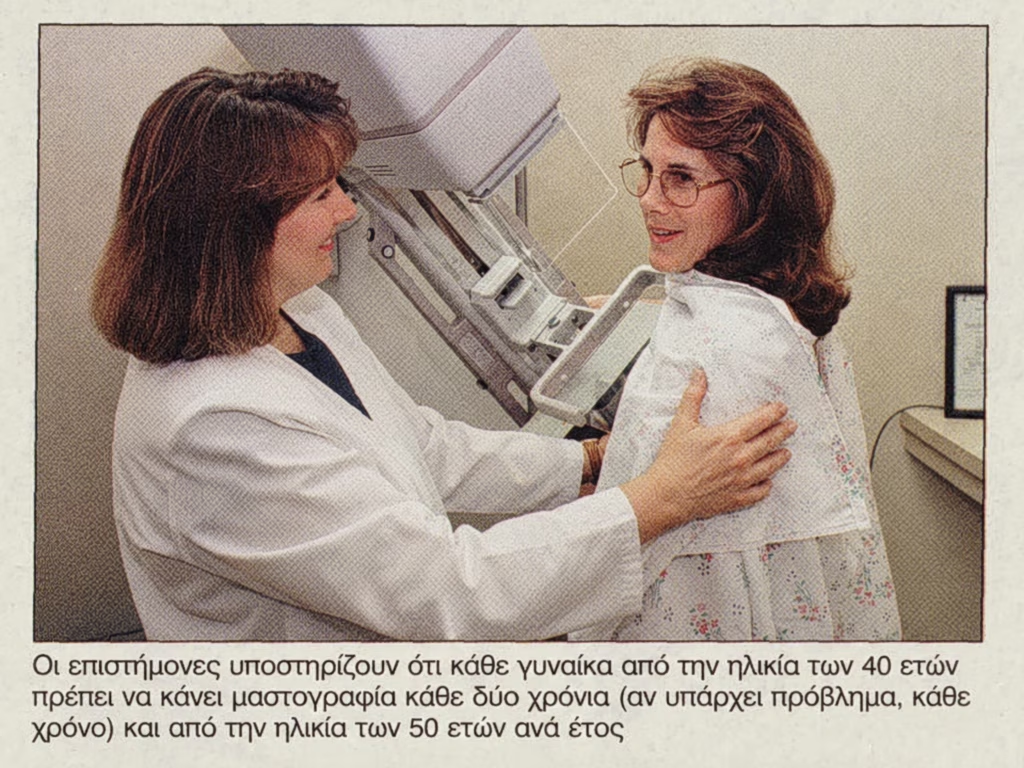
Today, mammography is an established screening method. But this was not always the case. The ability to detect cancerous tumors before symptoms appear, the safety of the exam and the need for regular monitoring of women occupied the scientific community for decades.
Articles published in TO VIMA and TA NEA trace the gradual evolution of mammography, from a diagnostic method to one of the most important tools for the early detection of breast cancer.
“Early Detection of Breast Tumors by X-Rays”
On February 7, 1967, TO VIMA, republishing a report from the Los Angeles Times, presented a new method of using X-rays that promised to improve the chances of treating breast cancer:
“A new method of using X-rays promises to increase the chances of curing breast cancer, as it makes possible the detection of cancerous breast tumors that until now could not be identified by any other method.”
The development had been presented at an annual meeting of the American College of Radiology. According to the article, Dr. Arthur Present, former chairman of the Mammography Committee, stressed that such tumors could not previously be detected either by palpation or by ordinary X-rays.
The importance of the new method was directly linked to the possibility of treating the disease more effectively:
“Thus, the early diagnosis of breast cancer will make it possible to combat the known complications and will consequently increase the chances of treating breast cancer.”
“Mammography: A Revolution”
Fifteen years later, mammography had gained an important place in the discussion about early diagnosis.
On November 22, 1982, TA NEA presented data announced at a scientific conference:
“Mammography must also be added to the methods of early diagnosis of breast cancer, which was also discussed at the conference and compared with other equivalent methods.”
As the newspaper noted, P. Piperopoulos described the introduction of mammography into early cancer diagnosis as “a revolution in the diagnosis of therapeutic outcomes.”
The article cited data on women’s survival and the condition of the lymph nodes at the time of diagnosis, in an effort to show the value of detecting the disease at an early stage.
It also highlighted an important technological development: the reduction of the radiation needed to perform the exam:
“Today, mammography can be performed with very low radiation, so much so that it is considered harmless and can be included in the tests of a checkup.”
Beyond being a method for investigating suspicious findings, mammography was now seen as an exam that could be part of women’s routine checkups.
The Debate Over the Safety of Mammography
Despite technological advances, the safety and effectiveness of the available methods remained a subject of scientific debate.
On November 18, 1984, TO VIMA attempted to distinguish between prevention and early diagnosis:
“The term ‘prevention’ has been used a lot lately. But in most cases, we mean nothing more than the early diagnosis of a disease, before its symptoms appear. Early diagnosis is of course not ‘predictive’ prevention, but it is of great importance.”
The article referred to the different methods of detecting breast tumors, from palpation to mammography, noting the concerns that still existed about radiation exposure:
“Mammography is a reliable method, but radiation can cause problems for women, especially when they are of childbearing age. A new method that recently began to be used for diagnosing breast tumors, thermography, has raised considerable hopes.”
However, the expectations for thermography, which had been considered as an alternative diagnostic method, were not supported by the scientific data the newspaper presented:
“The only reliable method for early diagnosis, the radiologists continue, is mammography,” the article added.
“The Key Is Creating Mammography Centers”
A year later, the discussion had shifted from the capabilities of the exam to the need for its systematic use.
On July 5, 1985, TA NEA, in a report by G. Gemenekis from London, relayed announcements by the British cancer research council:
“The British cancer research council announced at a press conference yesterday that significant progress has been made in the prevention of breast cancer, although no groundbreaking discovery has been made.
“The progress is due to the systematic monitoring of women at regular intervals.”
The importance of regular screening was now at the center of attention. As the council’s chairman, Professor Michael Baum, explained:
“The key is creating mammography centers so that regular monitoring of women is easy. And not only that, but the early detection of a small tumor makes treatment cheaper (for the state) and less unpleasant for the woman.”
Early diagnosis was now also linked to the possibility of less extensive surgery:
“It is also possible to remove this small tumor and administer chemotherapy at the same time without removing the breast.”
The professor concluded by insisting on the need for regular screening:
“But in any case, the professor concluded, regular mammography must be carried out so that we have early diagnosis.”
From a New Diagnostic Method to Systematic Screening
From the optimism of 1967 about detecting tumors that could not be felt by palpation to the 1985 call for organized mammography centers, the newspaper articles reflect a significant shift.
Advances in technology, the search for safer methods and the scientific evidence on the value of early diagnosis created the conditions for the wider use of mammography screening.
In the years that followed, mammography was incorporated into organized screening programs in many countries, with the aim of detecting breast cancer early and reducing deaths from the disease.