 Μake us preferred on Google
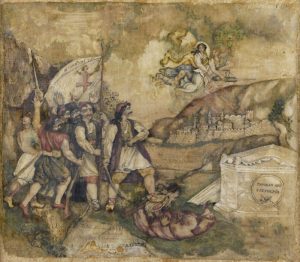
 Just 12 km to the South-West of the city of Tripolitsa (Tripoli, in modern times), on May 12, 1821, Greek forces under the command of Theodoros Kolokotronis delivered a crucial blow against the regional Ottoman forces at the Battle of Valtetsi, providing a momentous boost to the two-months-old struggle for independence.
The battle became one of the first major battlegrounds of the Greek War of Independence, helping pave the way for the fall of Tripolitsa, and ultimately, the birth of modern Greece.
Why is it important?
Victory at Valtetsi demonstrated that the Greek resistance had the ability to marshal themselves and hold fortified positions against much larger Ottoman forces and emerge triumphant.
To understand why Valtetsi mattered in the grand scope of things, it helps to look at it through a strategic lens. The organizational psychologist Karl Weick, in his influential 1984 paper Small Wins, argued that a single modest victory may seem insignificant in isolation, but that a series of such wins builds a pattern, drawing allies, raising perceived capability, and therefore making the next victory attainable.
The Basic Timeline of Events
Immediately following the Greek victory at the Battle of Levidi, on April 14th 1821, Kolokotronis established a network of camps at Valtetsi, Chrysovitsi, and Piana as part of a broader strategy aimed at eventually seizing Tripolitsa, the regional capital of Morias (what is today the Peloponnese).
The growing strength of the Valtetsi camp sent alarm bells ringing for the Ottomans, prompting a surprise attack from the city of Nafplion on April 25th.
This assault forced the defenders under Kyriakoulis Mavromichalis into the retreat. The Ottomans then burned the village.
Kolokotronis was not present at the time, having anticipated an attack from another direction, but made haste to return to reconstruct the camp from scratch.
Greek forces then began the process of building bulwarks in the surrounding hills and around houses that had survived the fire. They also fortified the main church.
A central watchtower was established, whose task it was to monitor Ottoman movements and alert the camps via smoke signals whenever enemy troops were approaching.
At the time, overall command was placed in the hands of Kyriakoulis Mavromichalis
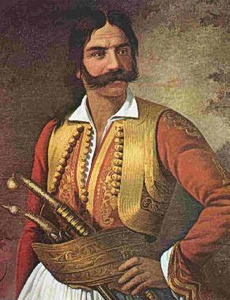
Portrait of Kyriakoulis Mavromichalis. Source: Hellenic Parliament
The Ottoman forces, under the command of a lieutenant of Hurshid Ahmed Pasha, the governor of Morias, arrived in Tripolitsa from Epirus. Learning that the Greeks had reestablished their camp at Valtetsi, he resolved to destroy it, then move on to crush other uprisings around the peninsula, and put any ideas of resistance by the Greeks to rest.
Commanding a force superior to that of the Greek fighters — around 5,000 according to Thomas Gordon, a former Scottish army officer, historian and philhellene, who participated in the later Siege of Tripolitsa and compiled one of the earliest rigorous histories of the revolution — he expected the Greeks to surrender at the mere sight of his overwhelming force.
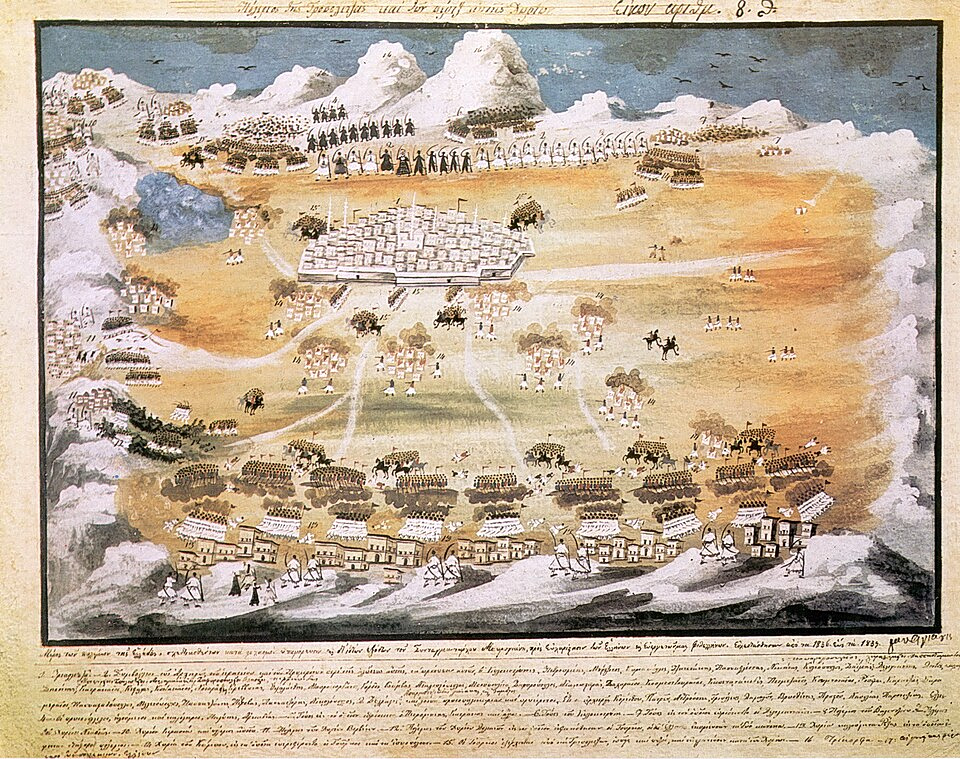
Mustafa postponed the assault by several days. Just before dawn on May 12th, he finally moved, deploying five separate columns to encircle and crush Valtetsi from multiple directions simultaneously.
The Battle
Kolokotronis at this point had returned to Chrysovitsi, when he spotted warning smoke signals and hurried toward Valtetsi with 800 men, alerting Dimitrios Plapoutas, another revolutionary commander, en route.
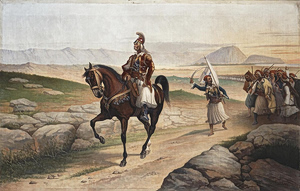
Theodoros Kolokotronis on horseback, leading his fighters towards Valtetsi
Arriving to find the battle already underway, he seized a hilltop position and opened fire on the Ottomans. When Plapoutas arrived at midday, the Greeks shifted to the offensive, and the Ottoman force found itself under serious pressure.
Fighting continued through the night, with neither side gaining a decisive edge. In the early hours of May 13th, Kolokotronis broke through the Ottoman encirclement to resupply the defenders, while a small reinforcement of around 400 men arrived from Vervaina.
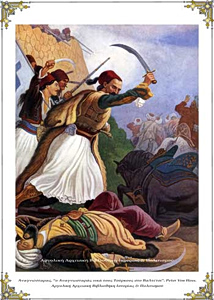
Anagnostaras, one of the Greek commanders in the Battle of Valtetsi. Source: Wikimedia Commons
When the battle resumed on the morning of May 13th, repeated Ottoman attempts to overrun the Greek positions all failed, resulting in a standstill. Upon hearing that fresh Greek reinforcements were approaching, Mustafa ordered a full retreat. The overall engagement had lasted almost 23 hours.
What is remarkable is the number of casualties on each side. While Greeks lost 4 men, and 17 were wounded, Ottoman casualties were in the hundreds. What it meant for the wider struggle, however, would become a matter of debate.
Numbers and Legend
The battle includes some notable historical embellishments that elevated the events of the 12-13th of May to legendary proportions.
One such exaggeration was that the Ottoman commanders offered 500 gold coins to any soldier who could capture even a single Greek position.
Another is that when Kolokotronis joined the battle, he tricked the enemy by claiming to have 10,000 men behind him.
Naturally, this battle became part of the formative lore of the Greek struggle for independence, so such exaggerated accounts can be expected. Some accounts of the battle cite 12,000 Ottoman forces, while others put the figure at less than half that number.
This was a common feature of many military memoirs across cultures. A prominent example is an account by Herodotus, concerning the Second Persian Invasion (480 BC), in which he cites the number of troops that King Xerxes brought with him as being 2.5 million men. Historians since have placed the number at the more realistic 100,000 – 300,000 range.
The Historical Debate: Levidi vs Valtetsi
There is some historical debate as to the significance of the battle for the wider struggle. For instance, the earlier victory at Levidi (April 14th) is sometimes cited as more militarily significant.
The argument for Levidi’s significance rests on chronology and symbolism, given that it was the very first engagement where Greek forces held their ground against Ottoman troops, proving that resistance was even possible.
If seen through the eyes of Weick, the two battles should not be understood as individual contestants for glory, but rather as sequential small wins, with neither of the two being decisive alone.
Their compounded power provided such a boost to Greek morale and confidence, that it built the momentum that made the capture of Tripolitsa in September of 1821 possible — and some might even say inevitable.