Young adults moving on their own appear to have driven much of the movement between communities in Bronze Age Greece, according to a new study that challenges assumptions about who migrated and why.
Researchers analyzed 199 skeletal samples from people buried at six archaeological sites in central and southern Greece. They identified 17 individuals, or about 8.5% of the sample, whose chemical signatures indicated that they had grown-up somewhere other than the area where they were buried.
None of the children studied were identified as nonlocal. Adults younger than 30 were the age group most likely to have come from elsewhere, suggesting that movement generally involved young individuals rather than entire families relocating together.
The peer-reviewed study, published in PLOS One on Sept. 23, examined mobility during different periods of the Bronze Age, with its main focus on the Middle and Late Bronze Age.
Researchers from the University of Gothenburg and institutions in Greece, Denmark, Germany, France, the Netherlands and Cyprus participated in the work. The findings were presented in a University of Gothenburg press release.
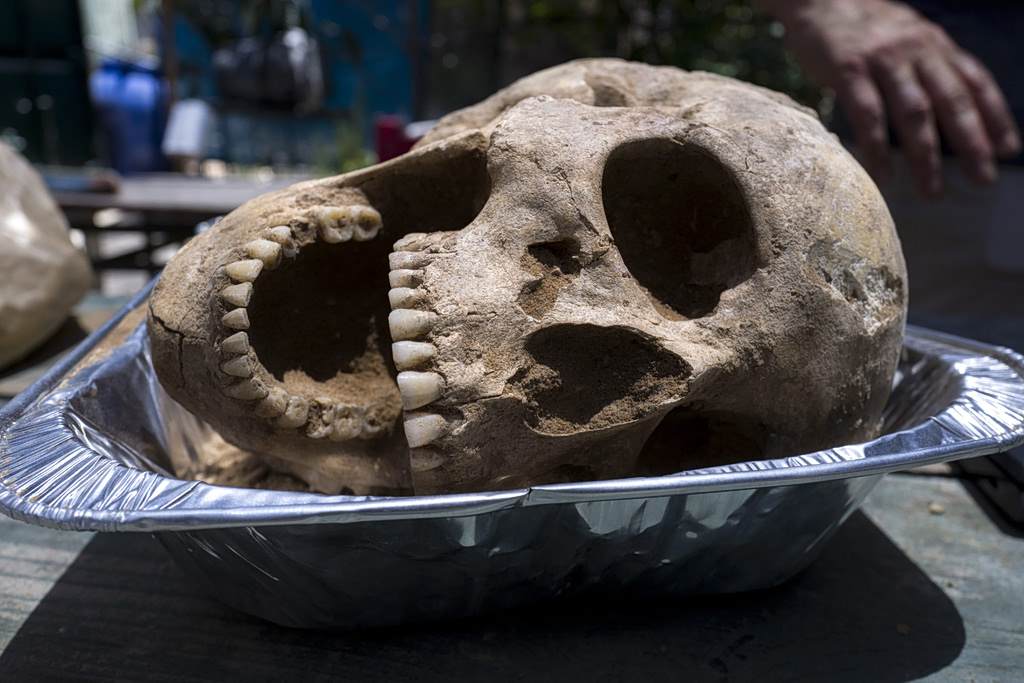
Image of a skull discovered during an excavation in Israel, being examined by researchers. EPA/JIM HOLLANDER
Challenging Assumptions About Women and Migration
Earlier research has frequently connected mobility in prehistoric patrilineal societies with women leaving their home communities to marry.
The Greek evidence revealed no clear gender divide. Nonlocal signatures were found among both men and women, leading the researchers to conclude that mobility probably had several social, cultural and economic causes.
“Our study demonstrates that the number of non-local women to men are comparable,” University of Gothenburg archaeologist Serena Sabatini said.
The underlying data showed nonlocal signatures in 10.3% of the men and 6.3% of the women whose sex could be determined. The researchers cautioned, however, that the numbers do not establish a clear male or female pattern. The sex of 58 people in the sample could not be determined.
Nonlocals were also found in both modest and richly furnished graves and across different burial practices. That finding suggests that movement was not confined to a particular social or economic group.
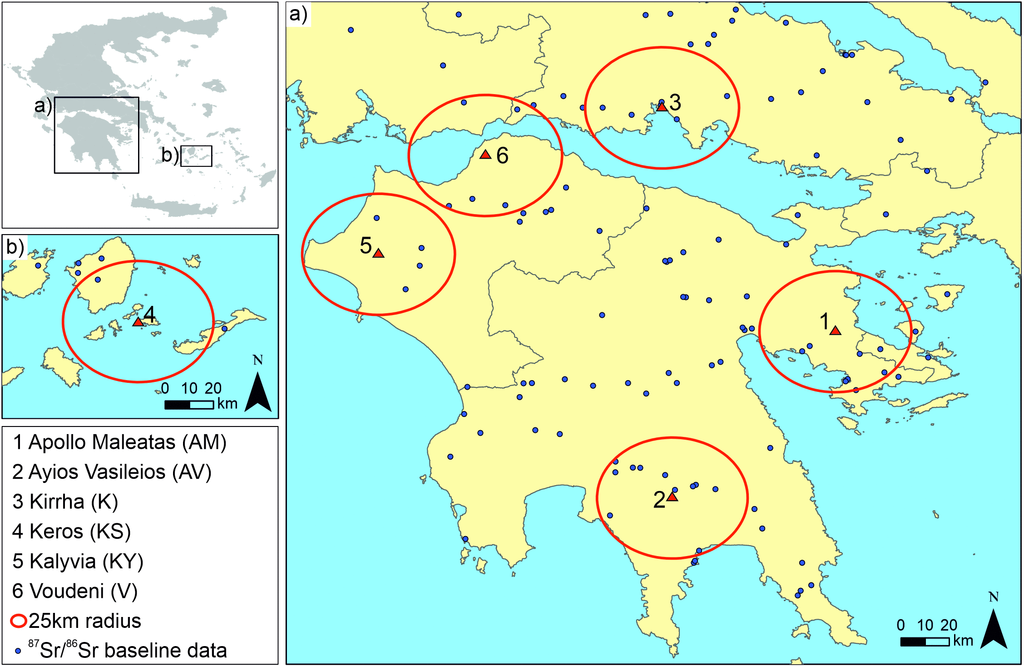
The image represents locations of the investigated archaeological sites in modern-day Greece. Frank AB, Moutafi I, Sabatini S, Frei R, Voutsaki S, Orgeolet R, et al. (2026) Exploring mobility in Bronze Age Greece: A Sr isotope perspective. PLoS One 21(9): e0357576. https://doi.org/10.1371/journal.pone.0357576
Tracing Childhood Through Strontium
The researchers examined ratios of strontium isotopes, which vary according to local geology and enter the human body through food and water.
By comparing a person’s strontium signature with the environmental baseline around the burial site, researchers can determine whether that individual probably grew up locally.
The study covered the archaeological sites of Kirrha, Ayios Vasileios, Voudeni, Apollo Maleatas, Keros and Kalyvia, and most of the samples came from the first three sites.
Across the communities and periods examined, the share of nonlocals generally remained between 5% and 10%. The relatively low proportion indicates that most people probably remained in or near their home communities despite the expanding commercial and cultural networks of the Bronze Age.
The nonlocal signatures nevertheless pointed toward movement from several different regions rather than one identifiable migration route. This supports a picture of multidirectional mobility across central and southern Greece.
Nonlocal Does Not Necessarily Mean “Foreign”
The researchers stressed that strontium analysis cannot identify a person’s exact birthplace.
All 17 nonlocal signatures were compatible with environmental data found elsewhere in modern-day Greece. Some also matched areas outside Greece because geological signatures can overlap across the Mediterranean.
The findings therefore do not demonstrate international migration. Several individuals may have moved only from another part of Greece or from a community relatively close to where they were eventually buried.
The study concludes that both internal and longer-distance movement may have occurred, but the available evidence cannot determine how frequently each took place.
Even with those limitations, the results provide a clearer view of mobility during a period of major transformation. Bronze Age Greece saw expanding exchange networks, changes in settlements and burial practices, and the emergence of increasingly complex Mycenaean societies.
The findings suggest that those transformations were accompanied by a steady, although limited, movement of people. Those who entered new communities were most often young individuals making the journey without evidence that their entire families moved with them.