 Μake us preferred on Google
On November 9, 1965, shortly after 5 p.m., a vast area of the northeastern United States and Canada was plunged into darkness. The streets were full of cars and thousands of workers were heading for the subway when the power suddenly went out. Traffic lights went dark, subway trains came to a halt, and thousands of people found themselves trapped in elevators and underground tunnels.
About 30 million people were left without electricity, and daily life in dozens of cities was paralyzed within minutes.
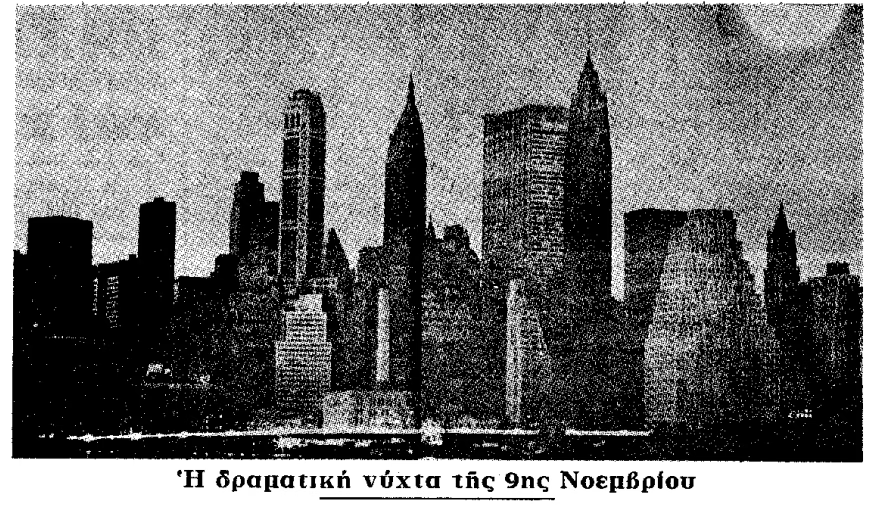
Two days later, on November 11, 1965, the newspaper ΤΟ ΒΗΜΑ reported:
“Last night was an eventful one for the 30 million residents of almost the entire east coast of the United States and Canada, due to a general interruption of the electric power supply.
“The blackout […] was felt especially in the big cities, and above all in New York. The interruption occurred at 5:30 p.m., precisely at the hour of heaviest traffic, and everything was paralyzed.”
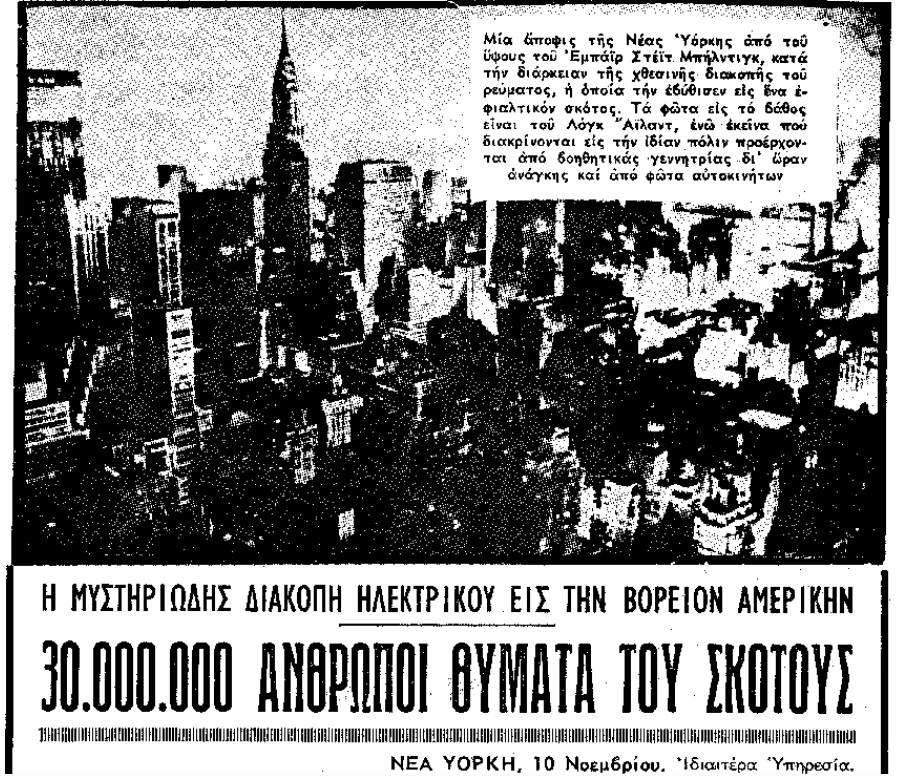
“ΤΟ ΒΗΜΑ,” 11 November 1965, ΤΟ ΒΗΜΑ Historical Archive | “TA NEA”
New York In The Dark
The city that had tied its identity to its illuminated skyscrapers, its signs and its busy streets suddenly faced an unusual silence:
“New York was literally paralyzed last night. The brightly lit streets and the illuminated signs had vanished as if by magic.
“Only the torch of the Statue of Liberty stayed lit, along with, of course, those buildings that had an external generator, and the headlights of cars in the streets, where the traffic lights had gone out. […]
“The subway had stopped, and 850,000 passengers were trapped inside the trains and in the stations.”
Police were put on alert, while hospitals without backup generators struggled to cope.
“Cities Went Dark Like Candles Being Blown Out”
On November 21, 1965, the newspaper returned to the event, publishing a text by French journalist Raymond Cartier, who described how the darkness spread from city to city within minutes:
“The power was cut on both sides of the Niagara at 5:17 p.m. Four minutes later […] American or Canadian cities around Lake Ontario went dark like candles being blown out.”
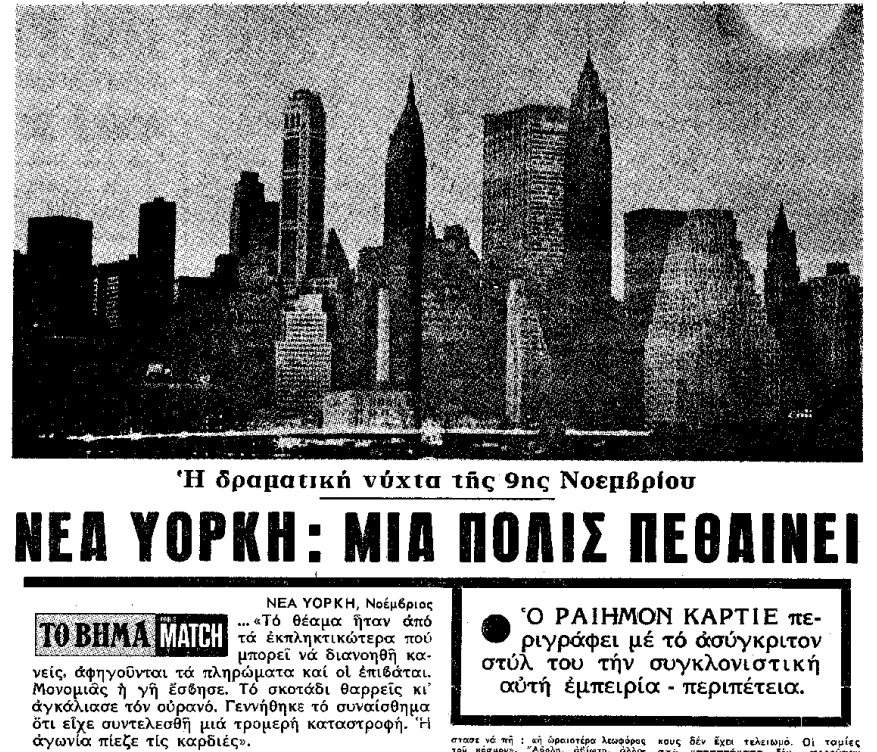
“ΤΟ ΒΗΜΑ,” 21 November 1965, ΤΟ ΒΗΜΑ Historical Archive | “TA NEA”
Within about 10 minutes, the darkness had reached New York.
According to Cartier’s account, residents handled the situation with remarkable composure despite the disruption:
“I saw […] people dancing in the streets… Others sang as they crossed the East River bridges to walk home to Brooklyn.”
Cartier was particularly struck by the absence of widespread looting or crime:
“The police recorded only seven cases of looting and made only 76 arrests.”
The Mystery And The Real Cause
In the first hours, no one could say with certainty what had caused the power grid to collapse:
“The cause of the interruption remains mysterious, in what is considered one of the most perfect networks for producing and distributing electric power,” ΤΟ ΒΗΜΑ reported on November 11.
As the newspaper noted, U.S. officials appeared to rule out sabotage, but President Lyndon Johnson set up a special committee to investigate the incident.
With the Cold War underway, authorities also examined the possible consequences for national security.
The real cause, however, turned out to be technical.
Subsequent investigations showed that the failure began near Niagara Falls, in Canada, when a protective relay that had been set to an excessively low threshold disconnected a main power transmission line.
The load shifted to the remaining lines, causing successive overloads and disconnections. Within minutes, the failure had spread across the interconnected grid.
Power was restored gradually during the night and the following hours, with some areas remaining without electricity for up to 13 hours.
The 1965 blackout marked an important turning point for the security of North America’s power grids and contributed to the creation of the North American Electric Reliability Council in 1968, which was formed to coordinate and strengthen the reliability of the electric power system.