 Μake us preferred on Google
The Archbishop of Athens and All Greece is elected by the Holy Synod of the Hierarchy, that is, by the serving metropolitans, as provided by the Charter of the Church of Greece. Elsewhere, a different system applies. In Cyprus, for example, the Archbishop (of Nova Justiniana and All Cyprus) is elected through a process in which laypeople have the main say in the first stage. Specifically, all Orthodox Christians over 18 who are registered on the relevant electoral roll elect, by secret ballot, three of the bishops of the Church of Cyprus (the “three-person list”).
In the end, the Holy Synod of the Church of Cyprus elects one of these three as the new Archbishop. All of this is fairly well known. What is less well known is that Greece, too, came very close to introducing a mixed system for electing the Archbishop, with laypeople taking part. But how did we get there? What prompted the plan to introduce such a system, which would have been a radical break in Greek church affairs?
The 1962 Election
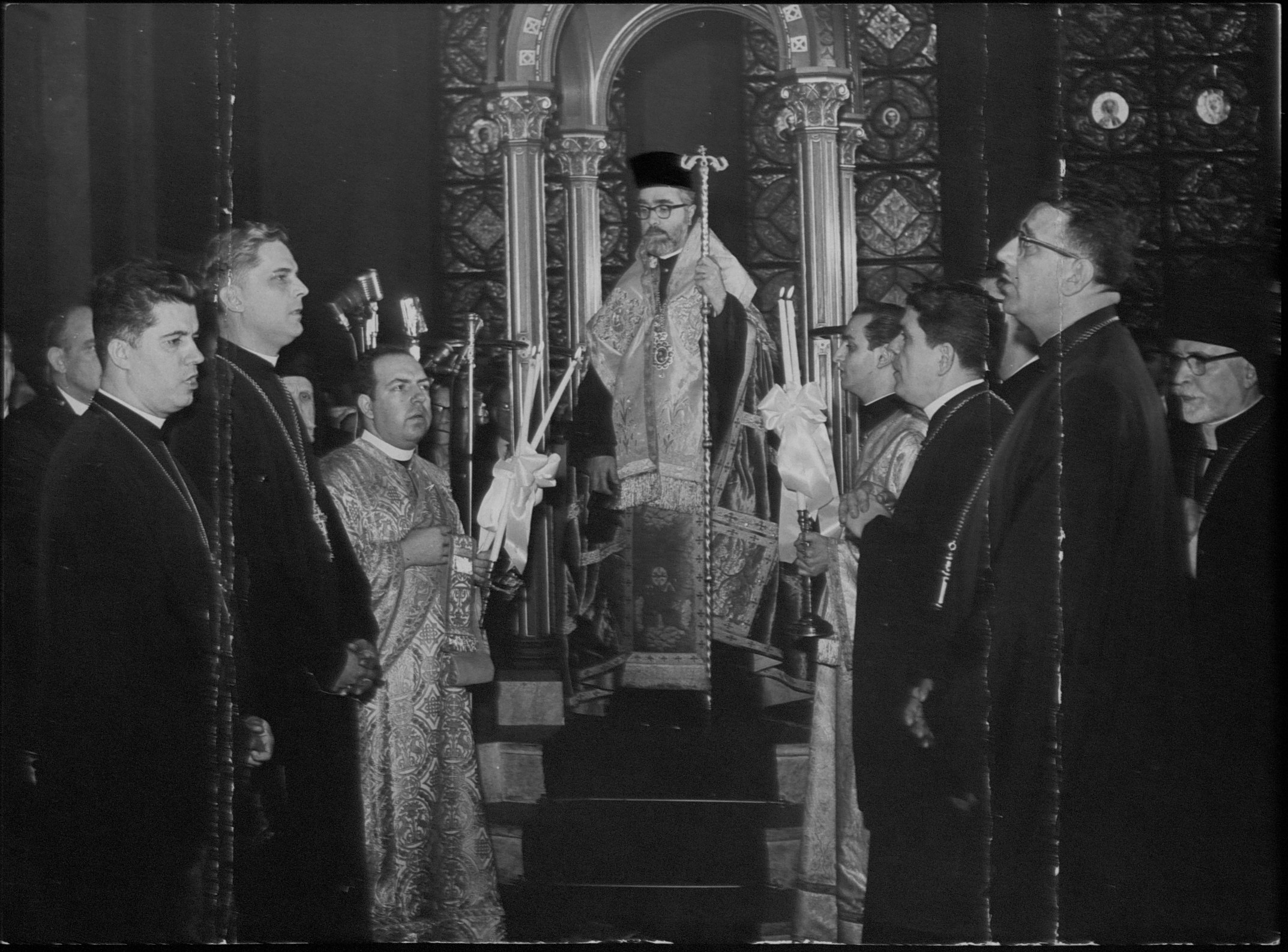
After the death of Theokletos II (Panagiotopoulos) on January 8, 1962, the question of electing a new Archbishop arose. The “favorite” was Metropolitan Iakovos (Vavanatsos) of Attica and Megaris, a man of considerable learning and pastoral work. However, believers and religious organizations outside the official church accused him, through insinuations, of “sexually unorthodox morals.” On January 13, the Holy Synod met at the Metropolitan Cathedral of Athens and, despite loud protests from the crowd gathered there, elected Iakovos as the new Archbishop with 33 votes. Metropolitan Chrysostomos of Philippi received 20 votes and Metropolitan Germanos of Mantineia four. (It is worth noting that in the first round, four votes also went to Ieronymos Kotsonis, then chief priest of the royal palace and later Archbishop.) Iakovos was enthroned as the new Archbishop on January 18 under heavy police guard.
The Political Dimensions
Once again, a church matter took on political dimensions, causing a crisis even between the king and the government of Konstantinos Karamanlis. Minister of Education and Religious Affairs Grigorios Kasimatis did not attend the new Archbishop’s enthronement, unlike the Grand Marshal of the Court, Dimitrios Levidis. Then Crown Prince Constantine reportedly contacted Karamanlis to convey the king’s displeasure. Once again, Karamanlis’s relations with the Palace were not at their best. Amid all this, the opposition could not stay idle. In a formal question in Parliament, Center Union lawmakers Stylianos Allamanis, Konstantinos Mitsotakis and Georgios Loulis accused the Karamanlis government of letting the situation spiral out of control.
The Threat And The Reactions
In the following days, tension peaked within the Hierarchy, among believers and among state officials. The government took action and, to find a solution, announced its intention to change the way the Archbishop is elected, with laypeople taking part! We read in ΤΟ ΒΗΜΑ of January 25, 1962: “Prime Minister Mr. Karamanlis yesterday chaired a lengthy meeting attended by most members of the Government. The meeting was devoted exclusively to dealing with the crisis in the Church. Afterward, the following government statement was released for publication: ‘The Government, applying the law in force with complete impartiality, avoided any involvement in the election of the Archbishop and in the developments that followed it.
Faced with the uproar that followed the election, it waited until today for the Church to deal with the matter on its own initiative. Since this has not happened, however, the Government, recognizing the division that exists among the faithful over the person of the Archbishop, and feeling obliged to help restore peace to the public conscience, intends to immediately submit a bill to Parliament. On the one hand, the bill will establish that in the future the Archbishop will be elected from among the serving metropolitans by a mixed body of clergy and laypeople. On the other hand, it will make it possible to declare the Throne vacant in the event of division over the person of the head of the Church. This decision will be taken not by the Government but by the established mixed electoral body, convened in extraordinary session following a decision of the Cabinet.’”
Was this a genuine intention or just a “ploy” to persuade the bishops themselves to find a solution? Nobody knows, and nobody ever will. The only certainty is that the government statement alone provoked many reactions, as the rest of ΤΟ ΒΗΜΑ’s report shows: “The views that qualified scholars of Canon and Constitutional Law raise against the two basic provisions of the announced government bill are clearly critical and negative. They note, first, that the formation of a mixed body of clergy and laypeople to elect the Archbishop must be guaranteed to take place through the vote of electors who are truly representative, especially of the lay element. Second, that the bill’s second provision, as worded in the government statement, on declaring the throne vacant in the event of division over the person of the Archbishop, abolishes any notion of the Church’s autonomy. It opens the way to even the most arbitrary interventions, under the pretext of division, by Governments serving party interests.”
The Voice Of The Intellectual World
The issue of Iakovos’s election left no one indifferent, not even intellectuals. In the same January 25, 1962, issue of ΤΟ ΒΗΜΑ, George Theotokas published the following text titled “The Moral Crisis of the Church Seriously Harms the Nation. How Will Our Country Get Out of This New Ordeal?” Prompted by the election of the new Archbishop, Theotokas wrote the following broader thoughts on the role of Orthodoxy in Greece and the world:
“The moral crisis shaking our church affairs must not, in any way, be taken in the conscience of the faithful as a crisis of the Catholic and Apostolic Orthodox Church. It is a local matter concerning an administrative subdivision of Orthodoxy called the ‘Autocephalous Church of Greece.’ This subdivision was created last century, hastily and without proper study, for reasons of expediency, by Otto’s Bavarian regents, foreigners who neither knew nor understood Hellenism. Still, it is through this subdivision that we connect with the spirit and tradition of Orthodoxy, whose spiritual summit for us remains, despite legal forms and political conditions, His All-Holiness the Ecumenical Patriarch.
We certainly cannot be indifferent to its fate. In our time, Orthodoxy is undeniably on the rise and is once again gaining a worldwide radiance it had lacked for many centuries. The signs of its progress are varied. There is the display of its unity, achieved recently under the auspices of the Ecumenical Patriarchate itself. There is its new missionary activity in black Africa. There is also the lively and steadily growing interest of the outside world in the sources of Orthodox spirituality, which had never been studied in the West the way they are studied and spread today. We must admit that this is owed mainly to the Russians of the Diaspora, who founded important centers of Orthodox spiritual life in Paris and New York. (…)
“Within this general progress of the Orthodox spirit, what is the position of our local Church? Morally, it is very important for a simple reason: our country is today the only one in the world where Orthodoxy is completely free and unrestrained and, as the Constitution says, ‘prevailing.’ In the North, it is spiritually pressured by Communism. In the East and the South, it is controlled by Islam. Here it is master of its own fate, and for this reason its life is much easier, its temptations certainly greater, but its presence brightly lit and its responsibilities in our time much heavier than anywhere else. Let others more qualified speak about its spiritual adequacy or inadequacy. But what even the least member of the flock has the right to judge and comment on is the seriousness of the Church, its dignity and its moral character, which must inspire respect in everyone without question.”
The Expected Resignation
If anything stands out in Theotokas’s text, it is how short-lived the church drama of that time was compared with the lasting role of Orthodoxy, not only in Greece but around the world, given its ecumenical dimension. And that is certainly more important than the story of the new Archbishop’s election, which drew in everyone: the bishops, the king, the government, the opposition, the faithful and the church organizations. So in the end, what remained of this whole story?
On January 25, 1962, Iakovos submitted his resignation to prevent the change in the system for electing the Archbishop: “I have come to the decision, and I am now proceeding to submit my resignation from the Archiepiscopal Throne of Athens, though not from my rank as bishop. I do so not of my own will, but under heavy and crushing pressure from the Government, and to prevent the State from interfering in the internal structure and administration of the Church. I consider such interference, since it lies outside the canonical order of the Church, destructive and ruinous for the authority and canonical autonomy of the Church, which I have loved to the point of devotion and served faithfully and wholeheartedly for 44 consecutive years. I sacrifice and offer myself up, and I throw myself into the sea like Jonah, for the sake of the canonical administration and life of the Church. I am certain that History will appreciate my self-sacrifice and complete dedication to the Church, with the fervent wish that the State will not dare to interfere in the internal affairs of the Church.”
The government’s “warning shot” about involving laypeople had worked, and the twelve-day Archbishop was now a thing of the past…
Spyros Vlachopoulos is a professor at the Law School of the National and Kapodistrian University of Athens.