 Μake us preferred on Google
Leon Trotsky was born on November 7, 1879. He would become one of the most important figures of the revolutionary movement in Russia and, 38 years later, would play a decisive role in overthrowing the country’s political and social system.
On November 7, 1917 (October 25 under the calendar then in use in Russia), the Bolsheviks, led by Vladimir Lenin and with a decisive contribution from Trotsky, overthrew the Provisional Government, marking the victory of the October Revolution.
The revolution deeply influenced the political and social developments of the 20th century, paved the way for the creation of the Soviet Union and reshaped the international balance of power.
From Tsarist Russia to Revolution
At the beginning of the 20th century, the Russian Empire faced deep social inequality, economic hardship and growing discontent with the tsar’s absolute rule.
The 1905 revolution had already exposed the depth of the social crisis, without bringing down the regime. Russia’s participation in World War I made the situation worse. Military defeats, enormous losses and shortages of basic goods fueled social unrest.
An article in the magazine “Tachydromos” on November 20, 1954, part of its “History of Nations” series, described the period from 1916 onward:
“And while the troops were retreating, the internal situation in Russia was becoming more serious. The people held the Court responsible for the disaster.”
In March 1917 (under the new calendar), the uprising that became known as the February Revolution led to the abdication of Tsar Nicholas II and the formation of a Provisional Government, later headed by Alexander Kerensky.
However, the new government failed to address the problems plaguing the country, and its decision to continue the war deepened public discontent.
In this climate, the Bolsheviks gained more and more influence, calling for peace, land and the transfer of power to the Soviets.
The Seizure of Power
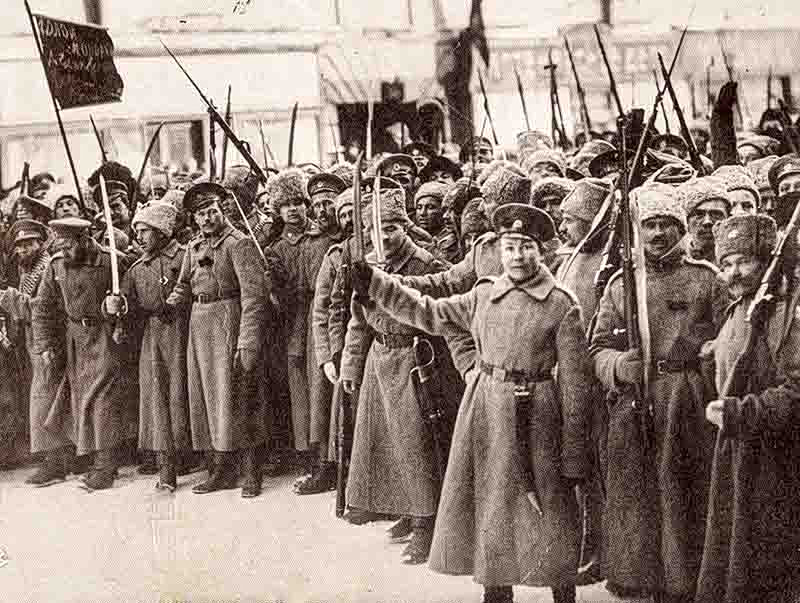
On the night of November 6 to 7, 1917, armed workers, soldiers and sailors, under Bolshevik leadership, seized strategic points in Petrograd, such as bridges, railway stations and communication centers.
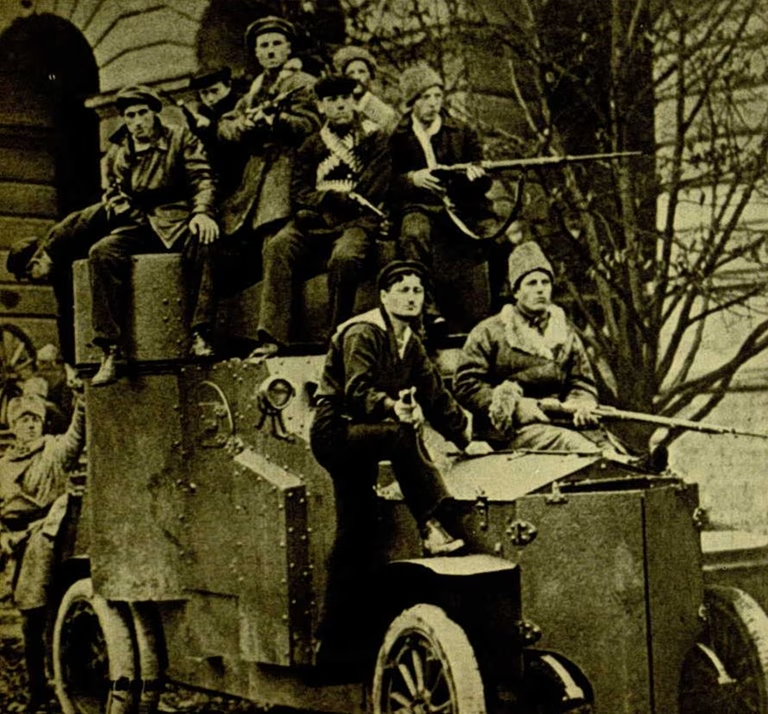
The operation was organized by the Military Revolutionary Committee of the Petrograd Soviet, in which Trotsky played a leading role.
The capture of the Winter Palace, where the Provisional Government was based, was completed in the early hours of November 8, sealing its overthrow.
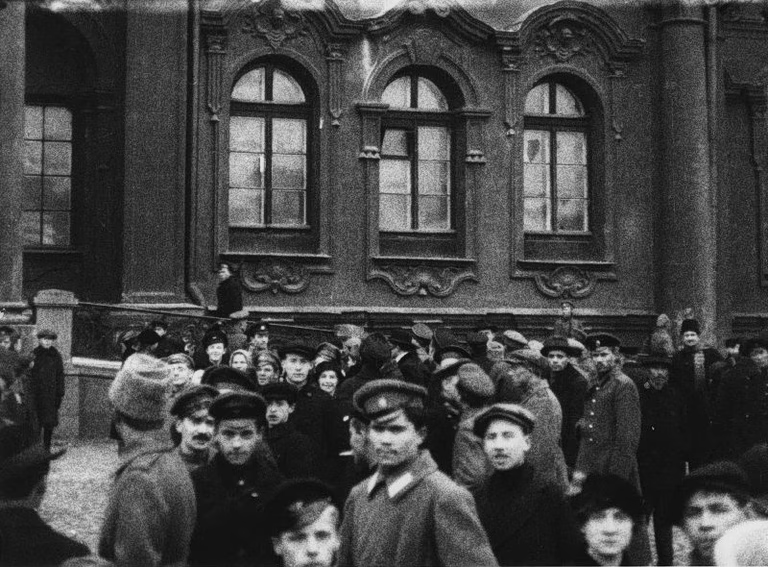
“Scene from Petrograd following the Bolshevik seizure of the Winter Palace on 7 November 1917, during the October Revolution. (Photo: Pyotr Novitsky)”
The “Tachydromos” article described the Bolshevik victory:
“The Bolsheviks then tried to seize power but did not succeed. They repeated their attempt later, and this time they achieved their goal.”
The revolution had triumphed in the capital, but the struggle for control of the country was only beginning.
Leon Trotsky Explains the October Revolution
Years later, Trotsky himself, by then exiled from the Soviet Union after Joseph Stalin’s political victory, tried to explain the conditions that led to the revolution.
The newspaper “Eleftheron Vima” of December 2, 1932, reported on a speech he gave in Copenhagen before an audience of 2,500 people:
“I did not come here to give a political lecture, but to speak about the October Revolution from a purely scientific and historical point of view.
“The big question has always been this: why was Russia the stage for the revolution?”
Trotsky sought the answer in the deep contradictions of Russian society, where a backward agricultural economy coexisted with rapidly growing industrial centers:
“Russia was a country of a mixed type, in which a very backward countryside and a weak industry coexisted. […]
“The bourgeoisie had developed, but it had no roots in the population. On the contrary, the workers, within the mass of the people, had become the vanguard of the revolution.”
Trotsky also defended the actions of the Bolsheviks, attributing decisive importance to them in the success of the revolutionary movement:
“The Bolshevik party […] played a role of the utmost importance in the revolution.”
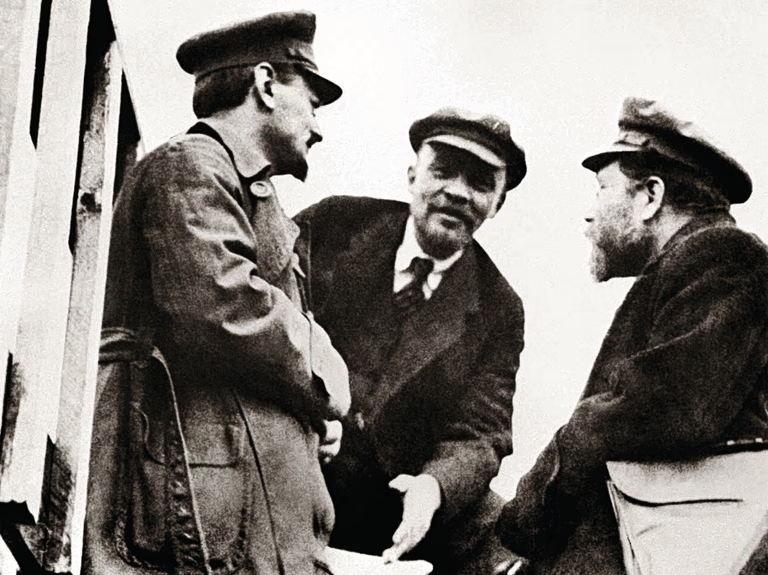
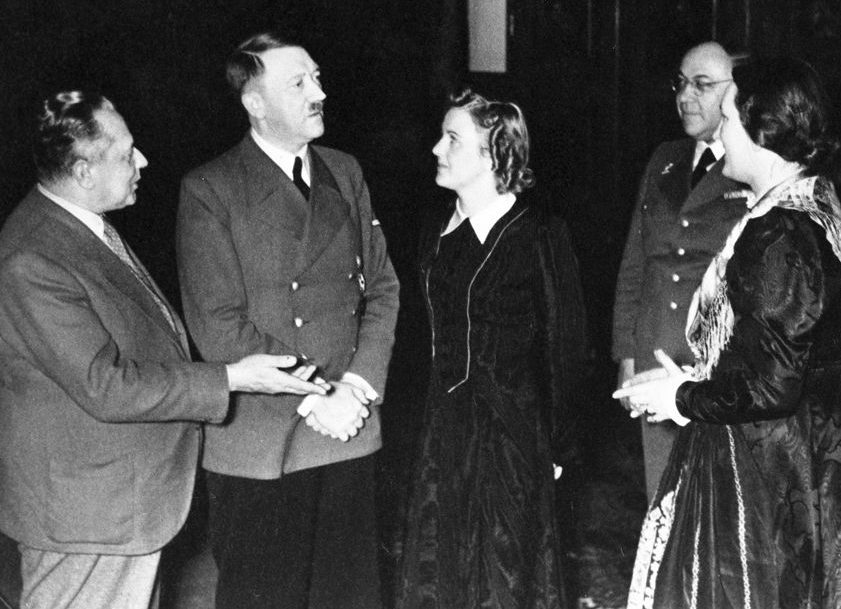
“Leon Trotsky, Vladimir Lenin and Lev Kamenev during a break at the Second Congress of the Communist International in Moscow, 1920.”
The Revolution and Its Cost
The Bolsheviks’ seizure of power did not bring immediate stability. Instead, Russia was plunged into a long civil war, during which the newly formed Red Army fought anti-Bolshevik forces.
The country faced economic collapse, famine and widespread destruction.
The “Tachydromos” article of November 20, 1954, noted:
“The conflict with the Germans, followed by the civil war and the war against Western intervention, resulted in leading the country into economic chaos.”
The Union of Soviet Socialist Republics was founded in 1922, and after Lenin’s death in 1924, an internal party struggle for his succession began.
Despite his leading role in the revolution and in building the Red Army, Trotsky was politically defeated by Stalin and sent into exile. His life ended violently in 1940, when he was assassinated in Mexico.
In his Copenhagen lecture, Trotsky had defended the revolution against those who questioned its results:
“Many said it was a chance event that could not last long, not a month, not a year. Now they speak differently. The revolution has withstood the test.
“It may be asked: did the revolution require so many victims? The answer is very difficult. But we will speak without innuendo. When something is judged, one must take into account how long it has lasted. Capitalism lasted seven centuries, and its result was the world war.
“We cannot, therefore, ask the revolution to establish an earthly paradise in a span of only 10 years.”
The Legacy of the October Revolution
Sixty-five years after the events of 1917, Sp. Theodoropoulos returned to the historical significance of the October Revolution in the pages of “Tachydromos”:
“Even if one disagrees with developments in the Soviet Union over these 65 years, one cannot fail to recognize that the October Revolution was one of the most important events of our century.”
The Soviet Union would continue to play a decisive role in world affairs until its dissolution in 1991.
More than a century later, the October Revolution remains a subject of historical study and political debate. For some, it was the great attempt at social transformation of the 20th century. For others, it was the starting point of an authoritarian system that severely restricted political freedoms.
Either way, November 7, 1917, remains one of the dates that changed the course of world history.