
 Μake us preferred on Google
 A Reuters investigation into more than 100 Chinese military procurement documents, research papers, patents, official statements, and defense-industry materials indicates that China’s military establishment is intensifying efforts to develop combat applications for humanoid robots and preparing for their eventual use in war. Previously unpublished records reveal that military institutions are testing how humanoids perform under battlefield conditions, working to acquire both the robots and the technology needed to train them, and studying how they could integrate with human soldiers. This effort picked up significant momentum during 2025 and 2026, with particular attention paid to improving robotic perception, physical manipulation, and training datasets.
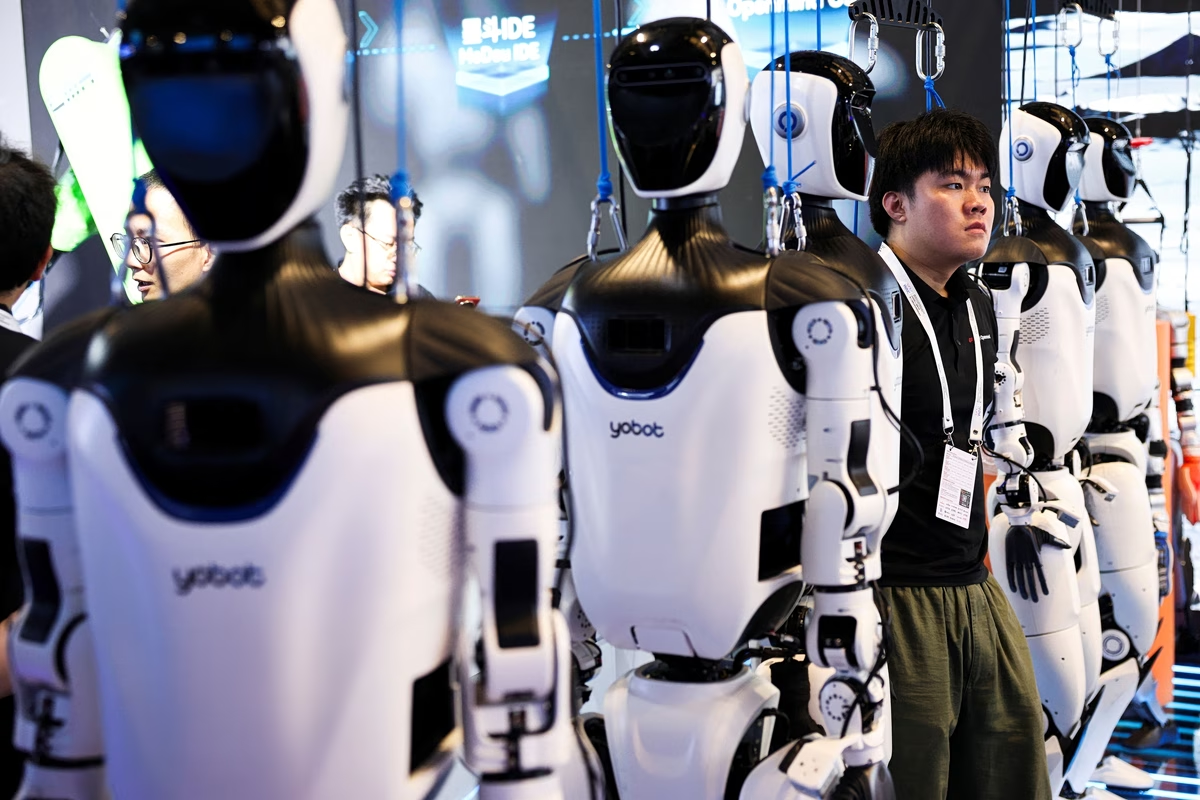
China currently dominates the humanoid robot manufacturing sector, producing roughly 95 percent of global shipments in 2025 according to BofA Global Research. This commercial lead gives the PLA a built-in advantage as it pursues military applications on top of an already-thriving industrial base.
China’s push into robotic warfare research reflects a broader global shift in military technology. In Ukraine, AI-guided semiautonomous drones have reshaped how reconnaissance and strikes are carried out, while ground robots now handle supply runs and casualty retrieval. Reuters has reported previously that China’s military has been closely studying lessons from that conflict, Europe’s deadliest since World War II.

A service member of the 422nd Unmanned Systems Regiment ‘Luftwaffe’ of the Ukrainian Armed Forces, carries a RAM-2X strike drone to a launch point while he works at a position near a front line, amid Russia’s attack on Ukraine, in an undisclosed location in Southern Ukraine, on an undisclosed date, 2026. REUTERS/Valentyn Ogirenko
UCLA mechanical and aerospace engineering professor Dennis Hong noted that sending machines into places too dangerous for people is a fundamental motivation behind robotics development, since a robot can be sacrificed where a human life cannot. China’s defense ministry and its top research institution, the National University of Defense Technology (NUDT), did not respond to requests for comment on humanoid robots’ military uses.
Reuters found no indication that China has actually fielded an armed humanoid robot with an active PLA unit. The technology still consumes significant energy and remains unreliable once removed from controlled demonstration settings. Carnegie Mellon mechanical engineering professor Aaron Johnson pointed out that real battlefield conditions introduce countless unpredictable variables that test robots in ways demonstrations cannot replicate.
Planning For Urban Combat
Chinese military planners have already sketched out a role for humanoids in city fighting. One scenario envisions six “combat robots,” a mix of humanoids, robotic dogs, and unmanned vehicles, divided into two assault squads that would work with soldiers to clear buildings floor by floor and room by room in enemy-held territory.
This scenario appeared in an August 2025 study by researchers at NUDT’s testing facility in Xi’an, which modeled an urban assault unit built around equipment the authors believed could be ready within five to ten years. The study left open questions about engagement rules, weapons loadouts, and how robots would handle encounters with civilians.
Juo-Min Chou, a researcher at Taiwan’s Institute for National Defense and Security Research, said that as humanoids improve in balance, sensing, and endurance, they could become useful in confined spaces such as buildings, tunnels, and ship interiors, since their combination of hands and legs theoretically allows for mobility, climbing, and object handling together. She added, however, that for simpler tasks like scouting or hauling supplies, robots with wheels, tracks, or four legs remain cheaper and more practical to deploy in large numbers.
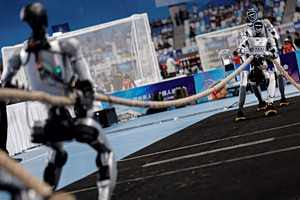
Unitree’s humanoid robots with BAAI’s THOR (Towards Human-level Whole-Body Reaction) system compete in a tug-of-war contest during the 2026 World Humanoid Robot Games at the National Speed Skating Oval in Beijing, China, August 25, 2026. REUTERS/Tingshu Wang
Chinese military commentators have floated an expanding set of roles for humanoid robots. A PLA Daily piece from July 2025 suggested their function could shift over time from a supporting role to a primary combat one, and raised the possibility of robots being cleared to fire on human-verified targets. In December, the PLA’s Eastern Theater Command released an AI-generated video depicting humanoid and four-legged robots overrunning Taiwanese defenses in an imagined future conflict.
China is not the only country pursuing battlefield humanoids. The U.S. Army launched a competition last year to build militarized humanoid systems capable of eventually working beside soldiers, with potential uses spanning reconnaissance, security, clearing obstacles, handling hazardous materials, and both offensive and defensive missions in cities. Up to ten finalists were expected to demonstrate their systems to Army evaluators this year, with follow-on contracts worth as much as $1.25 million on offer. Still, American robotics firms lag well behind China in building two- and four-legged machines; Reuters reported last month that Unitree, one of the world’s top makers of humanoids and robot dogs, developed its popular quadruped designs using research originally funded by the U.S. military. Neither the Pentagon nor the Army commented for the story.

A humanoid robot takes part in a wushu contest during the second World Humanoid Robot Games at the National Speed Skating Oval in Beijing, China August 26, 2026. REUTERS/Florence Lo
Behind Enemy Lines
Chinese military interest in humanoid applications began building in 2024, when NUDT and the Academy of Military Sciences co-hosted a defense technology forum that included a panel on military uses for humanoid systems. Neither organization answered Reuters’ inquiries.
The following year, NUDT went further, explicitly treating humanoids as tools for the battlefield. A university competition in June 2025 included a simulated infiltration exercise requiring robots to enter hostile territory, map the area, and locate targets, while another event tested robots performing identity verification, discipline checks, and security patrols at military installations. The university described the competition partly as a way to push humanoids closer to real combat readiness.
Procurement activity around this period pointed toward the same objective. In May 2025, the PLA solicited bids for a humanoid robot that included installation and technical training. Four months later, another procurement notice, listing an NUDT email as its point of contact, sought an intelligent perception and dexterous manipulation system built into a humanoid robot. The available records lacked detail, and Reuters could not confirm whether these contracts were awarded or which companies or robot models may have been involved. This past June, the PLA allocated roughly $300,000 for a system to gather and label camera, radar, and motion data for humanoids, including data on the types of terrain they can cross. These specifications suggest China’s military is now focused not just on robot hardware but on the perception, manipulation, and training systems that experts consider essential for moving humanoids beyond scripted demonstrations.
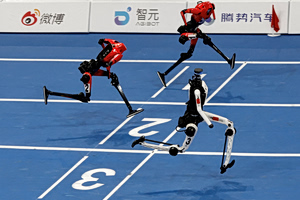
A Tiangong Ultra humanoid robot crosses the finish line in 8.86 seconds, next to Honor humanoid robots, during a 100m large-size group semifinal race, at the 2026 World Humanoid Robot Games at the National Speed Skating Oval in Beijing, China, August 25, 2026. REUTERS/Tingshu Wang/File Photo
Remote Control For Now
By 2026, humanoid robot development had expanded beyond military research institutions into China’s broader defense industry. One example is the Fuxi robot built by the state-owned defense manufacturer Norinco, described in company materials published in August as suited for guard duty, round-the-clock reconnaissance, automated patrols, and other high-risk assignments. Norinco says Fuxi can operate with its teleoperation system, letting a human remotely control the robot rather than requiring it to make decisions independently, addressing what many robotics specialists consider humanoids’ biggest current limitation. Norinco did not respond to a request for comment.
Malcolm Davis, a senior analyst at the Australian Strategic Policy Institute, said humanoid robots aren’t yet practical for real combat use, but predicted that could change within five to ten years.
Even under remote control, humanoid systems intended for eventual autonomous use will eventually confront serious ethical questions. International humanitarian law requires forces to tell combatants apart from civilians and to avoid attacking those who are wounded or surrendering. The International Committee of the Red Cross has warned that autonomous weapons may have difficulty reliably recognizing surrender, since such judgments often depend heavily on context, behavior, and apparent intent.
The U.S. military mandates legal review and realistic testing for autonomous weapons systems, along with human judgment from commanders and operators over the use of force. China’s defense ministry stated in March that AI-powered weapons should remain under human oversight. None of these concerns appear to have slowed China’s exploration of humanoid military applications. Academy of Military Sciences researcher Wang Yonghua wrote in a November commentary that humanoids still face unresolved challenges in movement, perception, and intelligence, and that widespread military use would depend on technical breakthroughs, cheaper manufacturing, and industrial-scale production. If those conditions are eventually met, Wang wrote, humanoid robots would flow onto the battlefield in large numbers.