 Μake us preferred on Google
The Marsh CFA Institute Global Pension Index, published on 20 October 2026, offers an important lesson for Greece: pension systems must provide adequate retirement incomes today without compromising their ability to meet future obligations. Australia received an A grade and a score of 80.6, while Italy scored 57.4 and Spain 63.3. Both Southern European countries received particularly weak sustainability scores. Greece is not included in the index, but these comparisons raise questions that its policymakers can no longer afford to ignore (CFA Institute, 2026 Global Pension Index; Super Members Council).
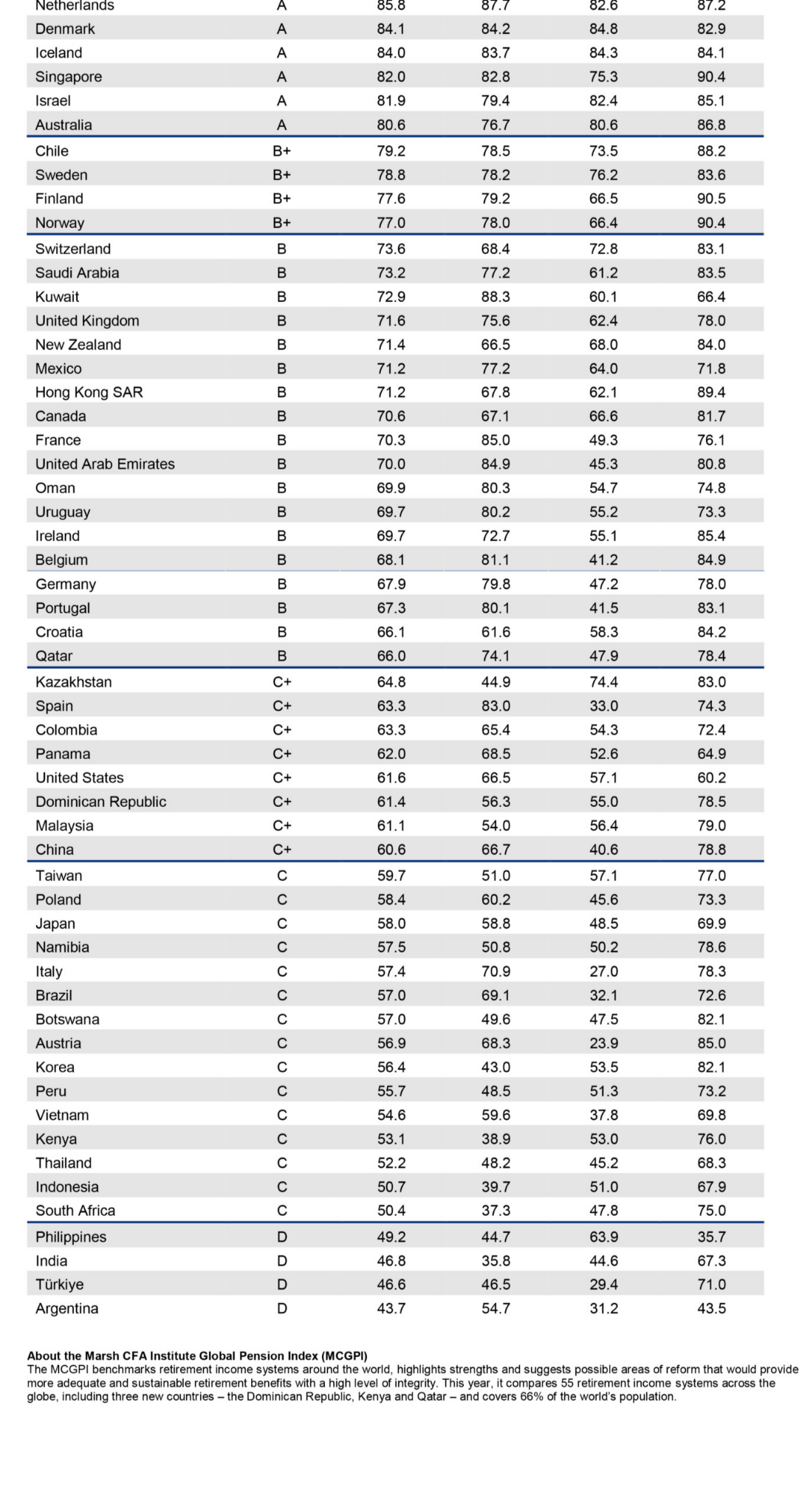
France which is in the spotlight these days provides an especially instructive comparison. It scored 70.3 overall, with strong adequacy but a weaker sustainability score of 49.3. The fiscal figures reinforce the point: according to the OECD, public expenditure on cash old-age pensions and survivors’ benefits amounted to 13.4% of French GDP, compared with 16.2% in Greece, 12.9% in Portugal and 3.4% in Australia, based on the latest available observations. These figures measure public pension expenditure, not total government spending or the overall cost of retirement.
France demonstrates that strong retirement protection can coexist with significant fiscal pressures. For Greece, the challenge is to sustain adequate pensions while reducing the long-term burden on public finances (OECD, Pensions at a Glance 2025, Table 8.2).
For Greece, this debate builds on questions that have been explored in previous articles for TO VIMA, including “Learning and Adapting to Pension Best Practices” and “From Shadows to Accountability: TEKA and the Greek Reform Challenge”. Pension reform is not simply about cutting benefits or adjusting tax incentives. It requires credible funding, transparent governance and a fair balance between current provision and future obligations.
Australia’s model offers a useful contrast. It combines a tax-funded Age Pension with compulsory superannuation, allowing accumulated retirement savings to supplement public provision.
The Super Members Council projects that expenditure on the Age Pension specifically will decline from 2.3% of GDP to 1.8% by 2066, even as the population above pension age doubles. This is a projection for one component of Australia’s retirement system, not a figure directly comparable with the OECD’s cross-country public pension expenditure data.
Nevertheless, it illustrates how compulsory retirement savings can help moderate long-term pressure on public finances. Greece cannot simply transplant the Australian model, given its different labor market, income levels and institutional history, but it can learn from the importance of building retirement security over a working life (Super Members Council, October 2026).
The issue extends beyond pension design to the management of public money. Government repos with public-sector entities can serve legitimate short-term cash-management purposes, but liquidity is not the same as lasting fiscal capacity. Their scale alone does not establish insolvency or prove that pension assets have financed government expenditure. It does, however, make transparent reporting of public funds, obligations and risks essential.
The same principle applies to TEKA, Greece’s funded supplementary pension system. Contributions intended to support future individual entitlements must be transferred, credited and invested transparently and on time. Reports of delays in transferring contributions warrant a clear explanation, including whether members’ accounts were credited correctly and whether any financial consequences arose. Such reports do not establish a connection between TEKA assets and government repos; that requires separate evidence. They do, however, underline the importance of accountability in a system whose credibility depends on members trusting that their contributions are managed for their intended purpose.
Australia’s introduction of Payday Super on 1 July 2026 reinforces the importance of timely pension contributions. Employers must now pay superannuation alongside wages, with contributions generally required to reach employees’ funds within seven business days. The reform is intended to reduce unpaid super and ensure retirement savings are invested sooner, giving them more time to compound. Although Greece’s pension arrangements differ, the principle is relevant: timely transfers, transparent records and effective enforcement are essential to protecting future entitlements and maintaining public trust. (Australian Treasury, Payday Super; Fair Work Ombudsman, Payday Super: New rules starting 1 July 2026).
The 2026 index offers Greece neither a direct ranking nor a ready-made blueprint. It provides a framework for asking three essential questions: are pensions adequate, can they be sustained, and are the institutions managing contributions and assets accountable?
Greece needs more than short-term fiscal relief or periodic adjustments to pension rules. It needs a system that protects retirement incomes without placing an unfair burden on future taxpayers. Ultimately, pension reform must be judged not only by the state’s ability to meet today’s payments, but by its capacity to honor tomorrow’s obligations while maintaining public trust.