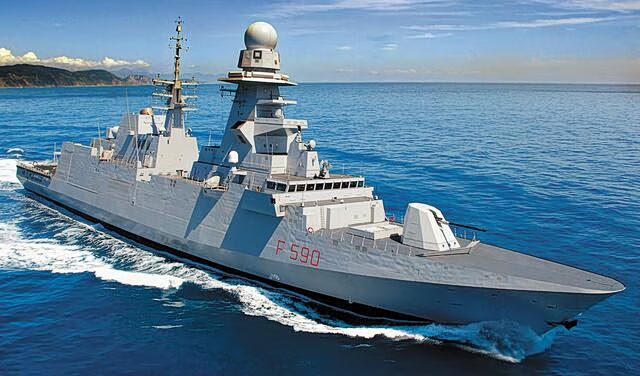
Greece and Italy formally activated the acquisition program for two Italian FREMM frigates in Rome on Tuesday, moving the deal from a political commitment to an implementation phase that establishes the legal, financial and technical framework for the transfer of the two warships to the Hellenic Navy.
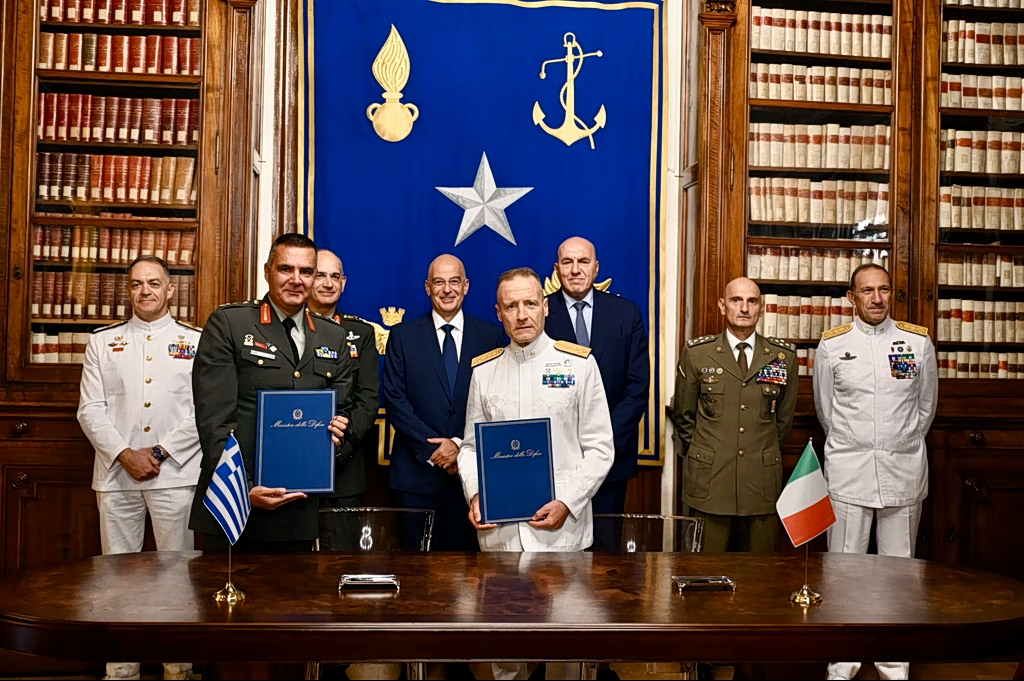
The implementing arrangement was signed by Greek and Italian defense procurement officials in the presence of Defense Minister Nikos Dendias and his Italian counterpart Guido Crosetto. The agreement implements a memorandum of cooperation and declaration of intent signed by the two countries in La Spezia on Sept. 29, 2025, concerning the acquisition of two Italian Bergamini-class FREMM frigates, with an option for two additional ships.
The two vessels are the Carlo Bergamini (F-590) and Virginio Fasan (F-591).
Under the agreed timetable, the Bergamini is to be transferred to Greece during the first half of 2028, followed by the Fasan during the first half of 2029. The arrangement also provides for initial and follow-on support to maintain the ships’ operational availability.
The timetable resolves a key issue in the negotiations, as Italy had sought to retain its existing major surface combatant strength until newer FREMM EVO frigates become available.
Planned modifications, weapons
The two ships will undergo modifications before entering Greek service, with Athens seeking to make them as operationally compatible as possible with its four French-built FDI frigates.
The upgrade package remains under discussion with Italian shipbuilder Fincantieri and is expected to cover anti-ship missiles, Aster surface-to-air missile configurations, naval-gun ammunition and anti-submarine warfare capabilities. Greece is also considering installing CAPTAS-4 towed sonar systems on both ships, bringing them closer to the configuration of the FDI frigates. The Virginio Fasan already has the system.
The Bergamini is configured for general-purpose operations, while the Fasan specializes in anti-submarine warfare. Both ships are about 144 meters long and displace roughly 6,700 tons.
The purchase price of the vessels in their current condition is separate from the eventual cost of modifications, weapons and long-term support. Earlier estimates put the overall program at about 700 million euros plus 100 million euros for follow-on support, but more recent defense-source estimates indicate that the final cost for the first two ships could approach 1 billion euros.

10-ship core
The two FREMM frigates will form part of Athens’ planned core fleet of 10 major surface combatants, alongside the four new FDI frigates and four MEKO-class frigates after modernization.
The aim is to create a more capable and interoperable fleet able to operate across the Aegean, the Eastern Mediterranean and beyond. The Greek Defense Ministry has described the combination as a high-capability force intended to protect Greece’s sovereignty and sovereign rights in the Aegean and Eastern Mediterranean.
Dendias has also kept open the possibility of acquiring two additional FREMM frigates under the broader “2+2” framework. Any further purchase would depend on Greece’s operational requirements and fiscal capacity.
Greek industry participation
The agreement goes beyond the transfer of the two ships and provides for Greek industrial participation. Greek shipyards are expected to take part in maintenance work and in the integration of new systems, giving the deal an additional industrial dimension.
The Greek defense minister presented the program as part of a broader effort to strengthen deterrence and adapt the Hellenic Navy to a changing security environment, while also deepening defense cooperation with Italy.
Crosetto similarly framed the agreement as more than a naval procurement deal, emphasizing closer cooperation between the two countries and their defense industries. The Italian side is expected to work with Greece on the modifications required for the ships, while Fincantieri’s involvement could contribute to the development of Greek industrial and technical capabilities.