 Μake us preferred on Google
When Patrick Stewart was a working dad best known for performing Shakespeare on stage in England—if he was known at all—he started to notice that when he came home after a Saturday matinee, his children always seemed to be watching a TV show with “these nice-looking guys with colored T-shirts on.” He didn’t know what the show was called and didn’t think much of it.
In fact, he later said that he didn’t know anything about “Star Trek” until he had a meeting with the show’s creator, Gene Roddenberry , about starring in a new series: “Star Trek: The Next Generation.” At first, he was hesitant to take the role of Starfleet Capt. Jean-Luc Picard. It came with a six-year contract and there was more work he was anxious to do on the stage. But his friends told him it was a nonissue: There was no way the show would last a year, let alone six.
“I remember one friend saying to me, ‘Look, come to Hollywood, get a suntan, make a bit of money for the first time in your life and go home,’ ” Stewart said in a previously unpublished portion of an interview with The Wall Street Journal in 2022. “Well, it didn’t quite turn out like that.”
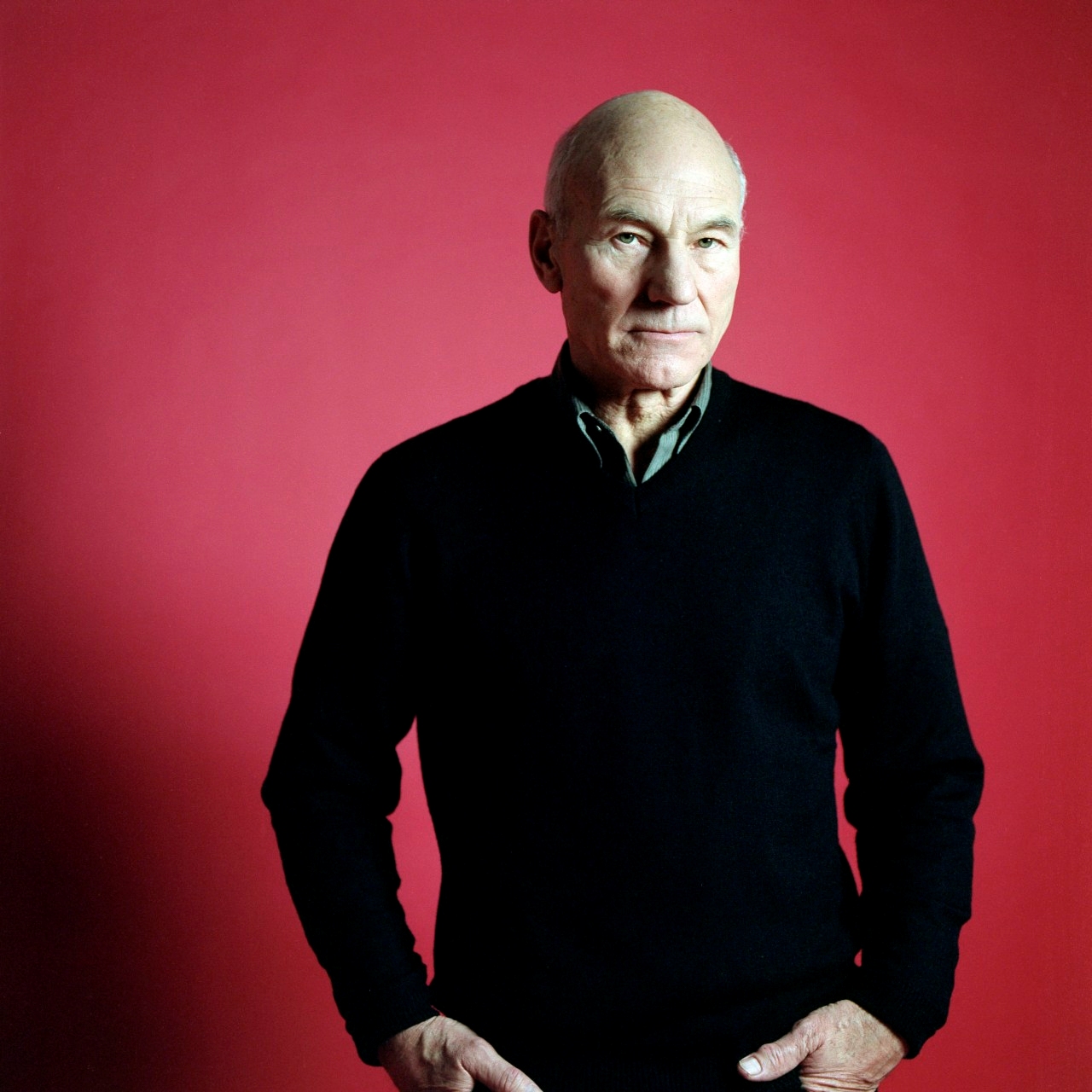
Stewart was Jean-Luc Picard until he died Wednesday at age 86, according to a social-media announcement. The announcement said he died at his Los Angeles home following a diagnosis of Alzheimer’s disease and Lewy body dementia.
He appeared in seven seasons of “The Next Generation,” four “Star Trek” movies, and returned to the character in 2020 for the streaming series, “Star Trek: Picard.” In between, he brought other iconic characters to the stage and screen: Macbeth in London’s West End, Ebenezer Scrooge on Broadway (and TNT) and Professor Charles Xavier in “X-Men” (2000) and its sequels. But to many of his fans, after the 1987 premiere of “Next Generation,” he was always the diplomatic space explorer.
Stewart received fan letters and was approached in public by people who wanted to tell him what the show meant to them—strangers on the street, flight attendants, a police officer who reached for a “Next Generation” VHS after another impossible day on the job. To them, the series and his character were more than a pop-culture institution; the show became a kind of balm for their mental health.
“That entertainment can be entertaining and has the capacity to do that,” he told the Journal, “is something that I think we have to be very proud of.”
The home front
Patrick Stewart was born to Gladys and Alfred “Pat” Stewart on July 13, 1940, in Mirfield, England. He was raised in a home without indoor plumbing. His mother worked in a textile mill. His father was away fighting in World War II when he was born; dad’s return wasn’t entirely welcomed.
Pat didn’t seem to care much for domestic life. Stewart would later describe his father as a “weekend alcoholic” who came home swinging at his wife. Patrick and his brother, Trevor, could tell from the tenor of the song their father was singing as he approached the house what the family was in for: Romantic ballads meant he was in a good mood, army songs spelled trouble, but the sound of footsteps without song was the most terrifying.
“It’s taken me decades of analysis, beginning in the late 1980s, to understand and cope with the impact of the violence, fear, shame and guilt I experienced as a child,” Stewart wrote in “Making It So,” the memoir he wrote during the Covid-19 pandemic. “The first and most important step was to acknowledge to myself that these things had happened at all.”
Stewart was introduced to Shakespeare by a teacher, Cecil Dormand, who assigned “The Merchant of Venice” to his class. As a student, Patrick didn’t understand it, but a seed had been planted: “There was color in his language,” he wrote in his memoir. “I saw pictures being painted.”
Dormand later cast him as Joseph in the school’s Nativity play, which suited him just fine because he had a crush on the girl playing Mary. “The stage was a far safer place for me than anything I had to live through at home—it offered escape,” he told the Guardian in 2009. “I could be someone else, in another place, in another time.”
After Queen Elizabeth II knighted him in 2010, Stewart said he owed “literally everything” to Dormand: “Although many people in my life have had great influence on me, without this man none of it would have happened.”
As Stewart was finishing secondary school, Dormand encouraged the 14-year-old to consider drama school and a career as an actor, but he demurred, saying people like him didn’t become professional actors. But he continued acting and took a job as a trainee reporter at the local newspaper, where his assignments included writing short obituaries, which wore him down. After the interviews, the surviving family inevitably insisted on showing him the corpse resting in another room. The job ended after he missed an assignment because it conflicted with rehearsal for a play; his editor told him he had to choose between the paper or the theater, and he went with the latter, taking a job selling furniture that offered nights free for acting.
At 17, Stewart began studying at Bristol’s Old Vic Theatre School. By 19, he had landed at the cleanly bald look that would be his signature for the rest of his life. He would sometimes audition for roles both in and out of hairpieces, telling producers they could have two actors for the price of one.
For the next three decades, he paid his dues and climbed the ranks: He toured with Vivien Leigh in the early ’60s and eventually landed a spot with the prestigious Royal Shakespeare Company, where his long run included working with colleagues like a young Ben Kingsley. He also picked up TV work in the U.K., including playing the role of the Soviet spy chief Karla in BBC adaptations of John le Carré’s “Tinker Tailor Soldier Spy” and “Smiley’s People.”
The Next Generation
By the mid-80s, Stewart was a busy middle-aged actor, but he wasn’t exactly famous. A humbling moment came when a production of “Who’s Afraid of Virginia Woolf?” failed to make the jump to London’s West End because his co-star declined to stick with the production and the producers thought they no longer had a lead who could sell tickets.
“It really hurt, that remark. All those years of work at the (Royal Shakespeare Company),” Stewart told the Times (London) in 2007. “But I guess it was a pragmatic point of view. I wasn’t bankable, and he couldn’t sell this production on my name.”
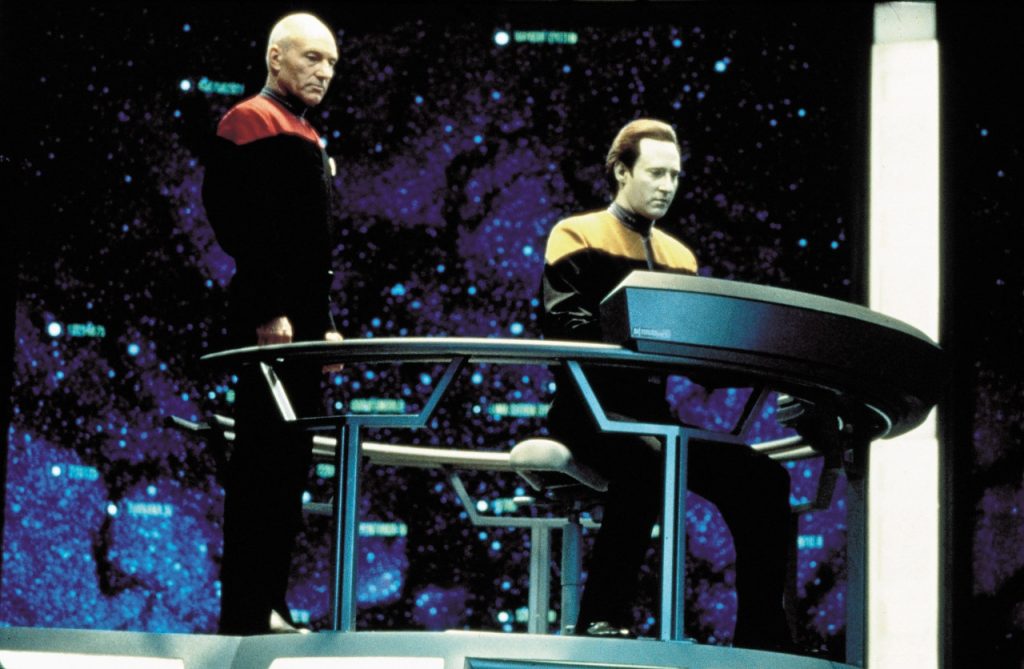
That is when he got a job aboard the USS Enterprise. “The Next Generation” was a new series, but, as Roddenberry explained in a guide for writers and directors, it would share a strong connection to the original: “The new Star Trek episodes will continue the tradition of vivid imagination, intelligence and a sense of fun, while still assessing where we humans presently are, where we’re going, and what our existence is really about.” Jean-Luc Picard, he wrote, would be a revered Starfleet legend who “deserves the description ‘distinguished’ despite being only in his youthful fifties.”
The transition from Royal Shakespeare Company to the set of a Hollywood TV show took some getting used to. Shooting the first season, Stewart was serious to the point of insufferable. As he recounted in his memoir, he once called a meeting to lecture the cast about goofing off. When actress Denise Crosby protested that they were just having some fun, he replied emphatically that “we are not here, Denise, to have fun,” then ran into his trailer after his colleagues laughed at his tantrum.
“By the end of the first year, we’d broken him down,” Brent Spiner, the actor who played “Data” in the series, later told the New York Times, “and he became perhaps the silliest of us all.”
The series premiered in September of 1987, when Stewart was 47 and, according to the Los Angeles Times, an “unknown British Shakespearean actor.” He was never unknown again. Like the original, the show became a cultural phenomenon, with more than 31 million viewers tuning in to its 1994 finale.
The role of the intensely focused, duty-bound explorer consumed Stewart. “It came to a point where I had no idea where Picard began and I ended,” Stewart said in 2007. “We completely overlapped. His voice became my voice, and there were other elements of him that became me.”
Audiences and filmmakers didn’t differentiate between the two much, either. In the years after the series ended, he reprised Picard in films like “Star Trek Generations” (1994) and “Star Trek: First Contact” (1996) but he had a hard time getting away from the persona he created on “Next Generation.” His biggest screen role outside “Star Trek,” X-Men’s Professor Charles Xavier, was a short drive from Picard.
“All my life I’ve been typecast,” Stewart told Entertainment Weekly in 2016. “It’s just that the types keep changing.”
Homecoming
During his ascent, Stewart said it would have never occurred to him to put family ahead of work, which he came to regret. He was married three times. First, to Sheila Falconer, in 1966. The couple had two children before they divorced in 1990. His marriage to Wendy Neuss, who had been a “Next Generation” producer, in 2000, also ended in divorce. In a ceremony officiated by the actor Ian McKellen in 2013, he married American musician Sunny Ozell, nearly 40 years his junior. Stewart’s survivors include a son, Daniel Stewart; a daughter, Sophie Stewart; and Ozell.
“I love my children. But our relationships, they haven’t worked out,” he told the Guardian in 2023.
In the first decade of the 2000s, Stewart received some of the best reviews of his career for acting in a string of highly successful Shakespeare productions in England, including “Macbeth,” that also played on Broadway.
“What makes this one a must-see is Mr. Stewart’s thrilling recognition that his character is as close kin to the fatally introspective Hamlet as he is to power-wielding men of ill will like Richard III,” Ben Brantley wrote in the New York Times, of the production’s run at the Brooklyn Academy of Music. “His performance is the first I have seen to realize completely what the scholar Harold Bloom means when he calls this play ‘a tragedy of the imagination.’”
Once again, he thrust himself into the role. The part was so emotionally exhausting, he would go home after each show and drink until he passed out.
“It was the only way I could find to do it,” he told the Guardian in 2022. “And I think that year opened up new possibilities for me. Everything has to count; it’s not just fun any more.”
By his late-70s, he could no longer resist the pull of Jean-Luc Picard.
After proclaiming for years that he was done with the role after the 2002 movie, “Star Trek: Nemesis,” he agreed to return to the character for the streaming series, “Star Trek: Picard.” The show premiered in 2020 and ran for three seasons, after which, he said he was angling for a “Picard” movie.
“One of the ways any culture will be judged by history will be by the quality of its entertainment,” Stewart told the Los Angeles Times Magazine in 1991, during the “Next Generation” run.
“In this business, one can never attempt to see into the future,” he went on, “although it’s what we’re attempting to do on a daily basis. I don’t know what people will say of this show 100 years hence. But ‘Star Trek’ has maintained its grasp for 25 years. Where are we going?—if there are still any of us left to inquire—will continue to be asked then.”