 Μake us preferred on Google
 Cyprus has become the latest flashpoint in the widening conflict engulfing the Middle East, as a string of European nations scramble to deploy warships and aircraft to the eastern Mediterranean island — and Britain finds itself under pressure to keep pace.
Italy’s Defense Minister Guido Crosetto announced Thursday that Rome, alongside Spain, France and the Netherlands, would send naval units to the island in the coming days. “Together with countries such as Spain, the Netherlands and France, in the coming days, we will send naval units for the protection of Cyprus,” Crosetto told the Italian parliament.
Spain confirmed it would dispatch its most advanced air-defense frigate, the Christopher Columbus, which is expected to reach the Greek island of Crete — roughly 150 miles northwest of Cyprus — around March 10, before continuing onward. The Spanish Defense Ministry said the vessel would also be available to assist in civilian evacuations from the broader Middle East region. The deployment is notable given that Spain has declined to align itself directly with U.S. military operations in Iran.
France, meanwhile, is sending its flagship nuclear-powered aircraft carrier, the Charles de Gaulle, accompanied by a frigate, to the Mediterranean. The French Embassy in the United Kingdom confirmed the deployment, posting an image of the carrier on social media with the caption “Heading to the Mediterranean.”
Heading to the Mediterranean. pic.twitter.com/ds7SxIT8iS
— French Embassy UK🇫🇷🇪🇺 (@FranceintheUK) March 4, 2026
Greece, has already positioned forces on the island. Kyriacos Kouros, Cyprus’s high commissioner to the United Kingdom, noted on Sky News that Greek naval and air assets had arrived ahead of allied forces. “Already we have the presence of Greek forces on the island,” he said. “Two frigates arrived, four aircraft arrived, all of them with abilities to combat drones.”
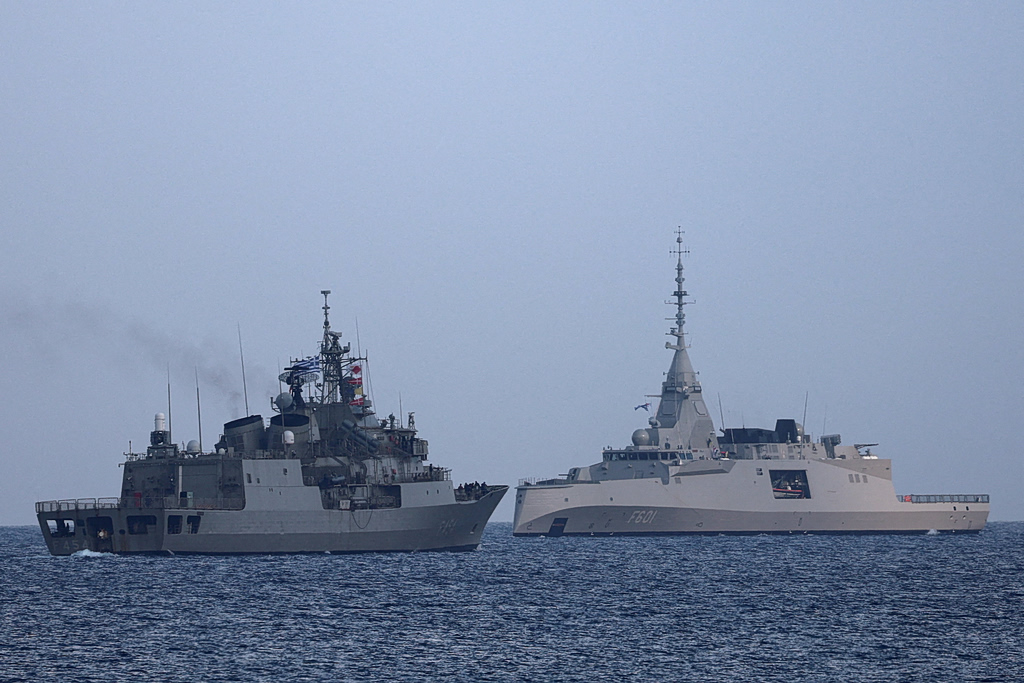
Greek frigates “Kimon” and “Psara” near the port of Limassol, as the conflict in the Middle East intensifies, Cyprus, March 4, 2026. REUTERS/Yiannis Kourtoglou
Greek Prime Minister Kyriakos Mitsotakis also held a phone call with French President Emmanuel Macron, during which the two leaders discussed developments in Iran, Cyprus and Lebanon. According to Greek government sources, Mitsotakis briefed Macron on the defense assistance Greece is providing to the Republic of Cyprus, and the two agreed to maintain close communication and coordination on developments in the wider region.
Drone Strike on British Base
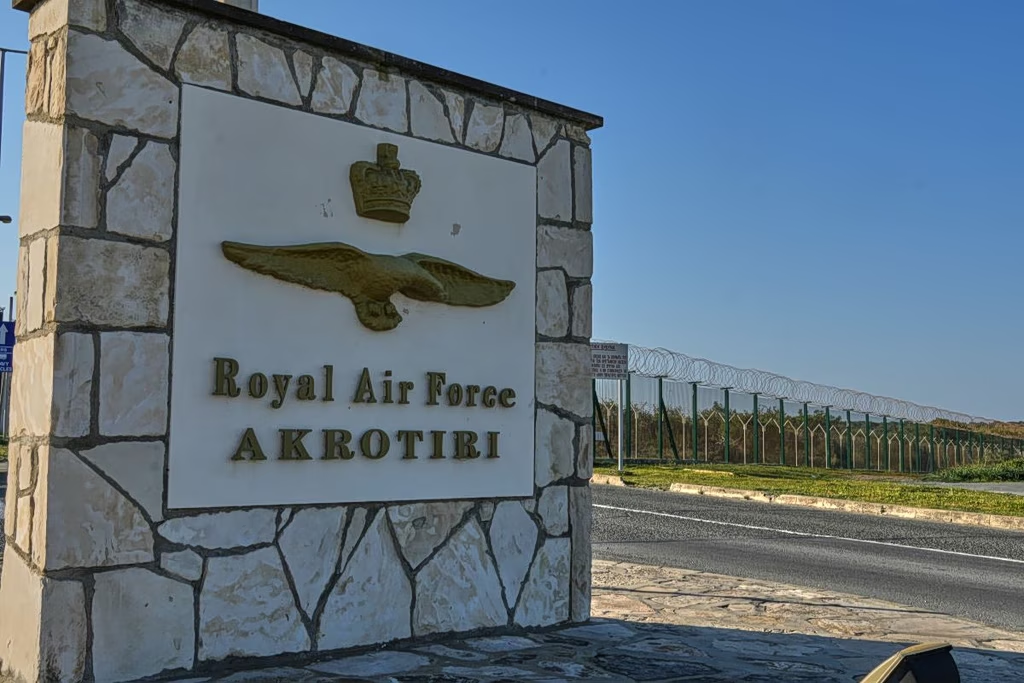
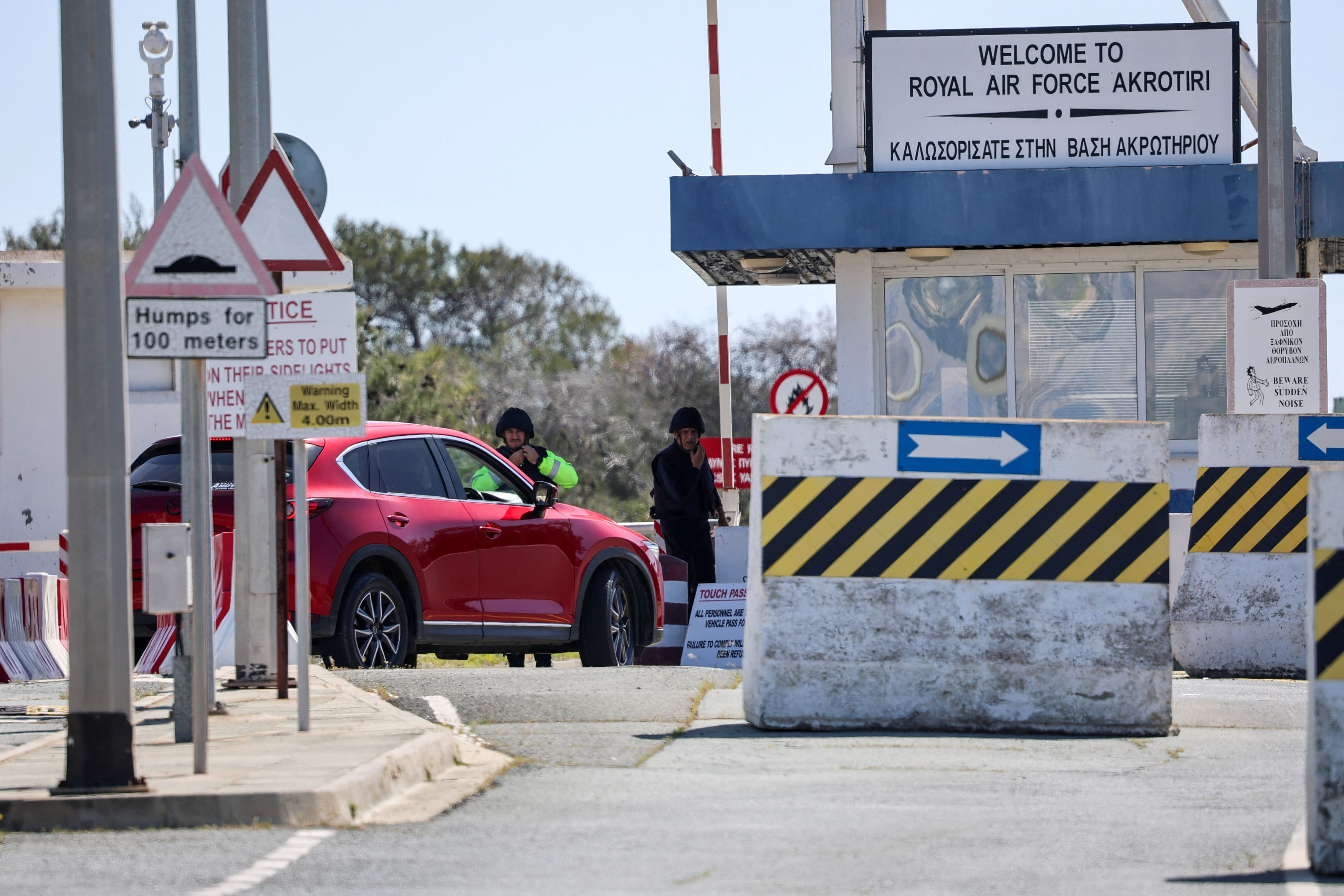
The trigger for the mobilization was a drone strike on the Royal Air Force base at Akrotiri, located on Cyprus’s southern coast, on Sunday night. The base is one of two so-called Sovereign Base Areas — patches of territory that have remained under British jurisdiction since Cyprus gained independence from Britain in 1960 — and its runway was hit by the projectile. A second attack was intercepted on Monday. British and Cypriot officials said they suspected the drone was a Shahed-style device launched by the Lebanese militant group Hezbollah, though Britain’s Ministry of Defense has not officially confirmed that assessment. As a precautionary measure, families of military personnel have since been evacuated from the site.
Britain Under Fire
Cyprus’s high commissioner to the U.K., Kouros, did not mince words. He said Cypriots were “disappointed” with the British response, contrasting it with the swift deployments announced by other European allies. “The least we expect is the Britons to also be present since, as I said, we are not only defending Cypriots on the island,” he told Sky News.
According to reporting from the Financial Times, shortly after Sunday’s strike, a Cypriot government spokesman expressed “dissatisfaction” that there had been “no clear clarification that the British bases in Cyprus would under no circumstances be used for any purpose other than humanitarian reasons.”
In an apparent response to the mounting criticism, British Defense Secretary John Healey flew to Cyprus on Thursday for in-person talks aimed at reassuring the cypriot government . Britain had announced earlier in the week that it is sending the Type 45 destroyer HMS Dragon to the Mediterranean, though the vessel is not expected to arrive until next week. Helicopters with counter-drone capabilities are also being deployed to the island.
The longstanding friendship between the UK and the Republic of Cyprus is strong in the face of Iranian threats.
This morning with Cypriot Defence Minister @PalmasVasilis I discussed how the UK is further reinforcing our air defences to support our shared security. pic.twitter.com/VkrjxVQRNZ
— John Healey (@JohnHealey_MP) March 5, 2026
UK Prime Minister Keir Starmer sought to strike a firmer tone, writing on social media: “The UK is fully committed to the security of Cyprus and British military personnel based there.”
The UK is fully committed to the security of Cyprus and British military personnel based there.
We’re continuing our defensive operations and I’ve just spoken with the President of Cyprus to let him know that we are sending helicopters with counter drone capabilities and HMS… pic.twitter.com/0tsZb4dG2i
— Keir Starmer (@Keir_Starmer) March 3, 2026