
 Μake us preferred on Google
 It could be described as a smart move or a mutually beneficial strategic choice. The ideal term in today’s vocabulary is “win-win,” and it applies to the clever decision by major orchestras across the United States to add film soundtracks to their repertoire alongside masterworks by Mozart, Beethoven, and Mahler.
It would be a hasty judgment to see this initiative as a step down, since it is in fact a practice that boosts revenue and broadens concert hall audiences. At its core, it is a flexible move by the classical music industry, which had been looking for ways to address its financial challenges. And live soundtracks offer a simple but powerful solution: the film plays on a giant screen while the orchestra performs the score live.
The numbers tell the unambiguous story. At the Minnesota Orchestra, 36% of attendees at film concerts were walking into a symphony hall for the very first time. There is an even more striking dimension: 38% of those new audience members return to buy ticket packages for classical programs as well. That, by any measure, counts as a victory.
The good news is reflected in other American orchestras as well. The Pittsburgh Symphony has nearly doubled these productions, with management describing them as its “fastest-growing series” based on measurable results. Conductor Sarah Hicks reinforces this point, noting that the real significance is that this represents a revenue stream that simultaneously addresses the perpetual concern of every orchestra: getting young people through the doors.
Iconic Soundtracks
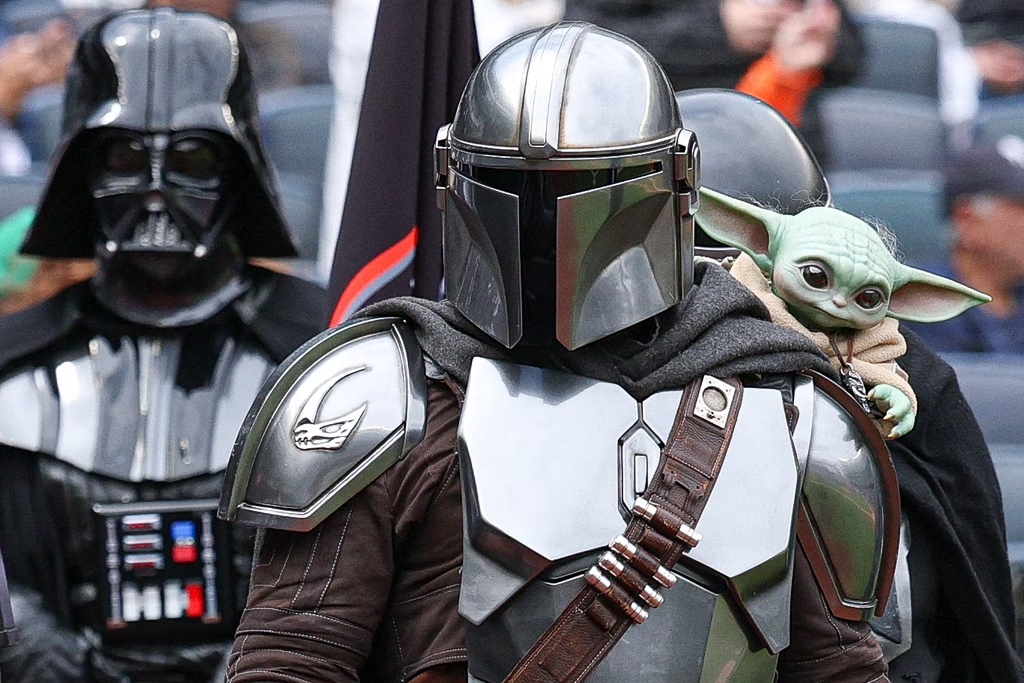
None of this is entirely new, of course. The connection between the big screen and symphonic music has deep roots. Great composers long viewed cinema as a vast canvas, from Sergei Prokofiev, who wrote the score for Sergei Eisenstein’s “Alexander Nevsky,” to Hollywood legends Franz Waxman and Erich Korngold. And who could forget the iconic scores composed by John Williams, responsible for some of the most recognizable and beloved musical themes in cinema history, among them “Jaws,” “Star Wars,” “Superman,” “Indiana Jones,” “E.T. the Extra-Terrestrial,” “Seven Years in Tibet,” “Jurassic Park,” and the first three Harry Potter films.
Live soundtracks are far from easy for orchestra musicians, demanding surgical precision and extraordinary stamina. As Jacob Joyce, orchestra director in Pittsburgh, puts it: “There is absolutely no margin for error.” Ben Dettelbach, a 28-year-old trombonist, adds another interesting angle: “Half the brass soloists in the world decided to pick up a trumpet or a French horn because they heard the Star Wars soundtrack.”