 Μake us preferred on Google
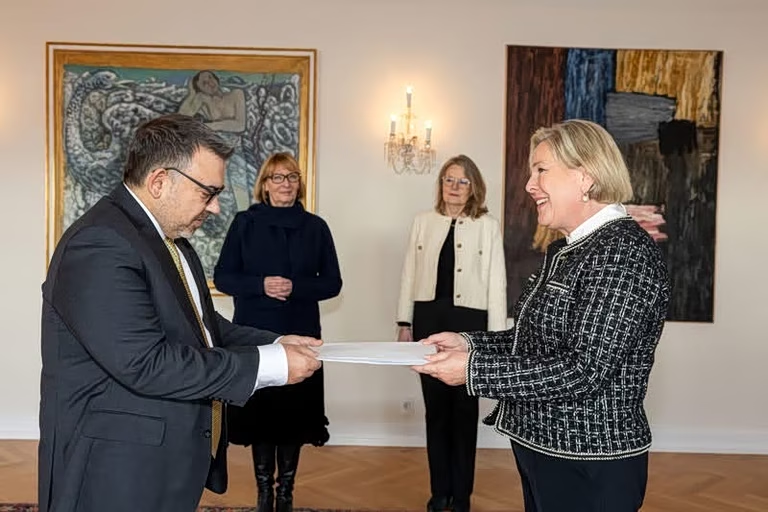
 The new Ambassador of Greece to Oslo, Mr. Efthymios Charlaftis, visited Reykjavik, Iceland, last week and presented his credentials to the President of Iceland, Ms. Halla Tómasdóttir. Under different circumstances, this would simply be the usual practice of Greece’s diplomatic envoy to Norway also representing the country in the North Atlantic island of the Vikings.
However, the Greek Ambassador crossed half the ocean, facing both opportunities and challenges. Although the Icelandic President expressed admiration for ancient Greek civilization, confirmed alignment on major international issues, and acknowledged the potential for further bilateral relations, all of this takes place at a moment when Athens must seriously take into account geopolitical developments and data.

On February 6, the Icelandic government approved Ankara’s request to open a Turkish embassy in Reykjavik, with operations scheduled to begin within the current year. This Turkish move is not coincidental, nor is it related to the small number of Turks living in Iceland.
The geopolitical upgrade of Iceland
Iceland holds major geostrategic value in the North Atlantic due to its position in the GIUK Gap (the passage between Greenland, Iceland, and the United Kingdom), which controls submarine and commercial routes (a choke point). Although it does not maintain a standing army, its existence is decisive for NATO activity in the Arctic (since 2014 NATO presence has increased through surveillance aircraft and anti-submarine capabilities), and its importance is continuously upgraded due to monitoring Russian activity in the region. Its ties with the United States remain strong, while it also plays an important role in environmental policy, research, and sustainable shipping.
New maritime routes make Iceland a potential logistics hub between the Arctic, Europe, and North America. At the same time, the country functions as a strategic gateway to the maritime routes of the Atlantic and the Arctic Circle, with direct relevance to trade routes leading to Asia.
Naturally, the shift of the global geopolitical center of gravity toward the Arctic highlights it as a critical parameter for strategic balance, as Iceland can function as a control point of sea routes, a NATO operational springboard in times of crisis, and a means of strengthening political, economic, and geopolitical cooperation with major powers (the USA, Russia, China).
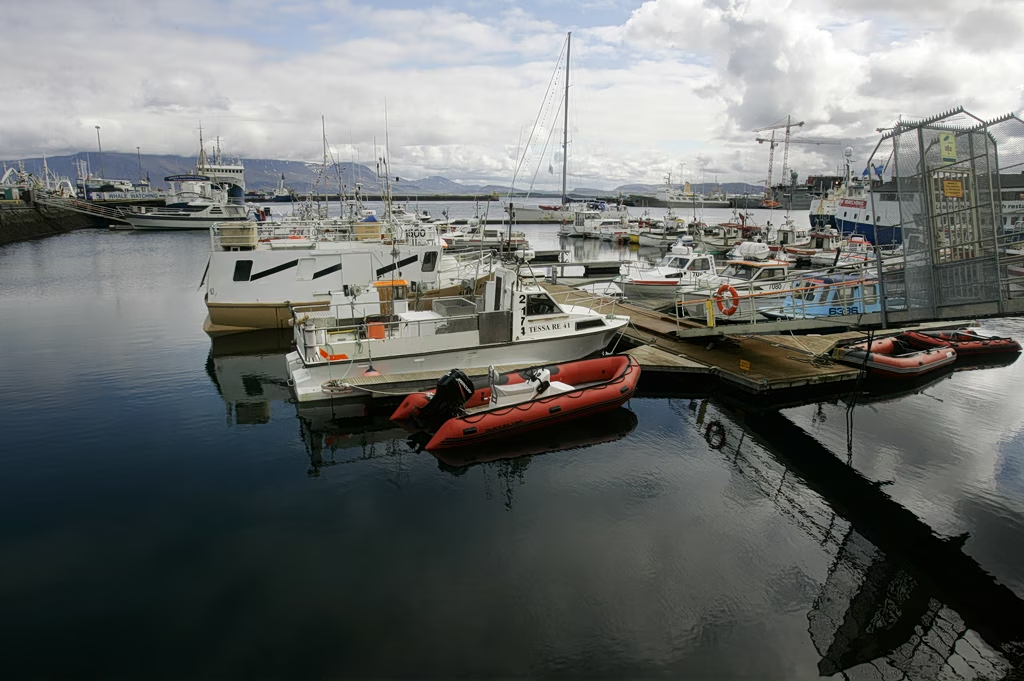
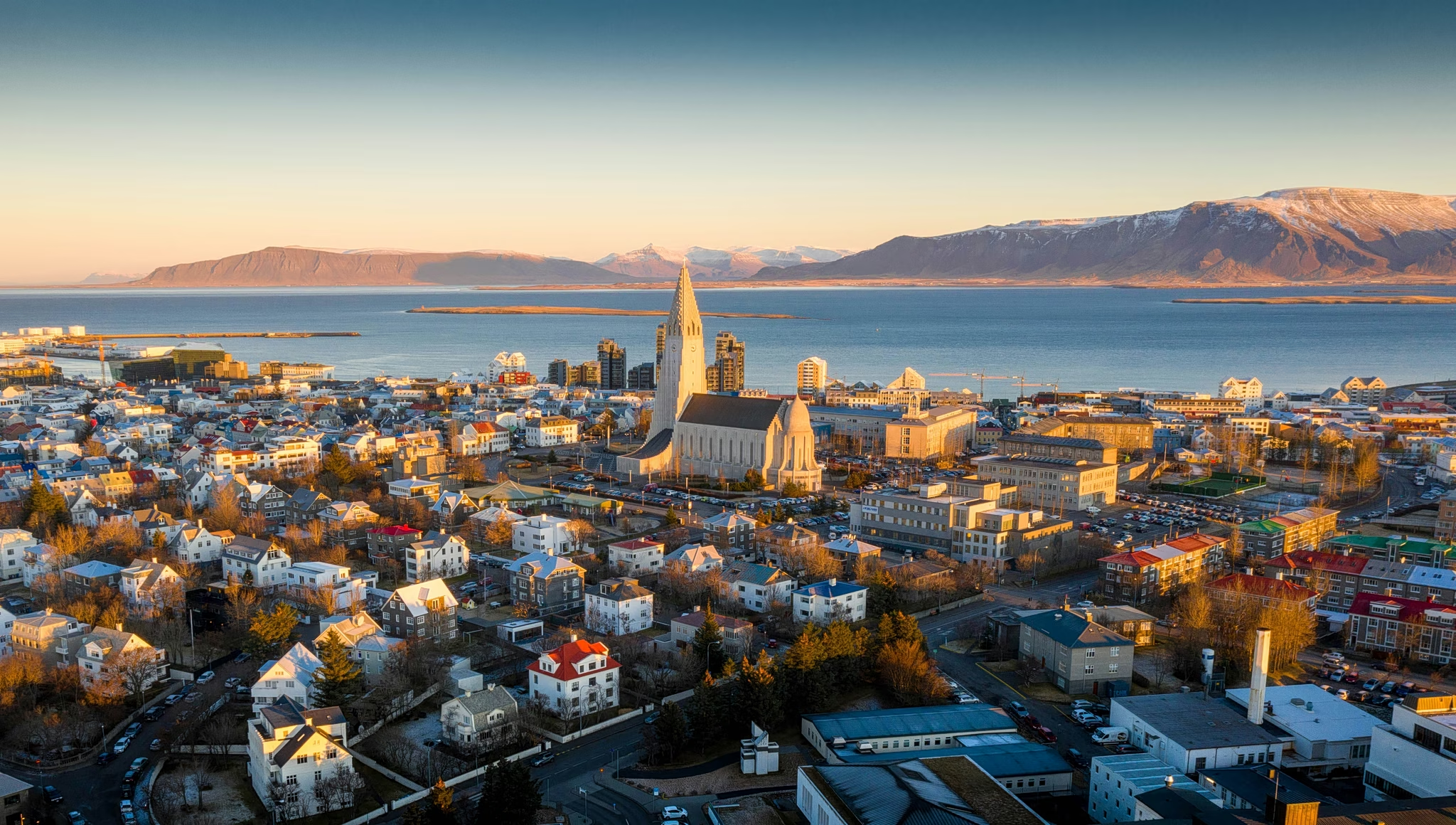
Harbor, Reykjavik (AP Photo/Kirsty Wigglesworth)
Turkey in the Arctic: Strategy and benefits
In recent years, Turkey has been attempting a strategic penetration into the North Atlantic and the Arctic, expanding its presence there through Norway (since 2019 it has conducted five TASE – Turkish Arctic Scientific Expeditions), and through active participation in protocols such as the Spitsbergen for the Svalbard Islands (Greece signed the same protocol in 1925, without any active involvement to date).
Iceland is a member of the Arctic Council, in which Turkey participates as an observer state. The new embassy in Reykjavik will provide Ankara with direct access to countries and institutions of Northern Europe, with multiple benefits—commercial, economic, and geopolitical. Furthermore, it will allow Turkey to shape a new framework of influence over Arctic decisions and programs, to actively participate in security, research, and maritime route issues, and to strengthen its international image. In this way, Turkey upgrades its role as a maritime power and expands its strategic interests in the North Atlantic and Arctic regions.
The establishment of the embassy sends a clear message that Ankara seeks a global presence beyond the Mediterranean and the Balkans—given its already active engagement in Africa. It creates a direct channel of political communication with Iceland and a new springboard for bilateral and multilateral diplomacy near Greenland and the broader Arctic region.
In the medium term, it strengthens Turkey’s image as an emerging global diplomatic power in Arctic affairs, new maritime routes, and energy resources. All of this demonstrates that the Turkish embassy in Reykjavik constitutes a strategic step of political, economic, and geostrategic penetration into Northern Europe and the Arctic.
The Greek community in Iceland
The Greek presence in Iceland is small but noteworthy. The first organized migration movements were mainly linked to academic and professional activities, while the economic crisis of the 2010s led to an exponential increase in the Greek population, which today numbers at least 800 people.
In 2004, when Greece lifted the trophy of the European Football Championship, only 8 Greeks living in Reykjavik celebrated there, as recounted by one of them, Antonis Koumouridis, then a resident physician in Iceland and today a plastic surgeon living and working in Norway. Most Greeks in Iceland live in Reykjavik and work in tourism, hospitality, education, and research, while also participating actively in businesses—including even a Greek loukoumades shop—as well as in educational and cultural activities.

Since Greece does not maintain an embassy in Reykjavik, diplomatic relations are covered by the Greek Embassy in Oslo. Over the past 20 years, however, the Icelandic philhellene Rafn Alexander Sigurdsson, Greek Honorary Consulate in Iceland, has significantly contributed to strengthening bilateral relations, supporting the Greek community and acting as a bridge between the two countries.
In 2017, during the visit there of Ecumenical Patriarch Bartholomew and Metropolitan Cleopas of Sweden, the foundations were laid for the Greek Orthodox parish of Apostle Bartholomew in Reykjavik, under the jurisdiction of the Metropolis of Sweden and All Scandinavia, recognized by the Icelandic authorities. Despite its establishment, however, the spiritual needs of Greeks remain significant, as there is no permanent or regular priestly presence.
At present, Greece maintains limited contact with Icelandic universities through programs such as Erasmus. At a time when Turkey possesses structures such as the national DEHUKAM Center for Maritime Law and Sea Studies, and systematically seeks to establish footholds to challenge the status quo in the Aegean and the Eastern Mediterranean, Greece urgently needs to utilize the opportunities provided by its diaspora and the Greek shipping industry.
Air and cultural connection Athens – Reykjavik
The restoration of the direct air connection between Athens and Reykjavik, which was suspended two years ago due to the bankruptcy of the carrier Play OG, is a critical factor for strengthening Greece–Iceland relations. A possible new connection would bring multiple benefits: it would boost tourism and Icelandic visits to Greece, promote bilateral economic and commercial relations, facilitate students and entrepreneurs, and ensure better service for the needs of Greeks living in Iceland, while also increasing the international footprint of Greek airlines.
The historical and cultural dimension further strengthens the importance of Greece for the “Frozen Island,” and vice versa. Greece is particularly beloved by Icelanders: Iceland is referred to as Thule by Pytheas of Massalia and Pliny, while Icelandic mentality is so similar to the Greek that Icelanders have been described as “the Mediterranean’s of the North.”
It is no coincidence that a favorite Greek song of Icelandic philosophy professor at the University of Oslo and internationally leading expert on Plotinus, Eyjólfur Kjalar Emilsson, is “The Train Leaves at Eight”, with lyrics by Manos Eleftheriou and music by Mikis Theodorakis. This cultural familiarity makes closer ties between the two countries both natural and strategically beneficial.