 Μake us preferred on Google
 Action for Democracy, a non-profit organization promoting democracy, whose advisory board includes figures such as Francis Fukuyama, Timothy Garton Ash, and Timothy Snyder, has published a report titled “Mapping the Global Authoritarian Ecosystem.” It is based on the “Authoritarian Collaborations Index” (AuthCollab), a database that tracks and analyzes cross-state collaborations with authoritarian actors worldwide, allowing users to explore the data in real time.
The Research Data
The report was compiled from a dataset of approximately 72,000 collaboration events. It identifies the patterns by which authoritarian leaders interact with and support one another, focusing on seven categories: finance, diplomacy and legislation, network-building, propaganda, military and technology, information sharing, and transnational repression. Mapping these collaborations serves as a call to develop a more effective counter-strategy.
China, Russia, and Iran in Two-Thirds of Authoritarian Collaborations
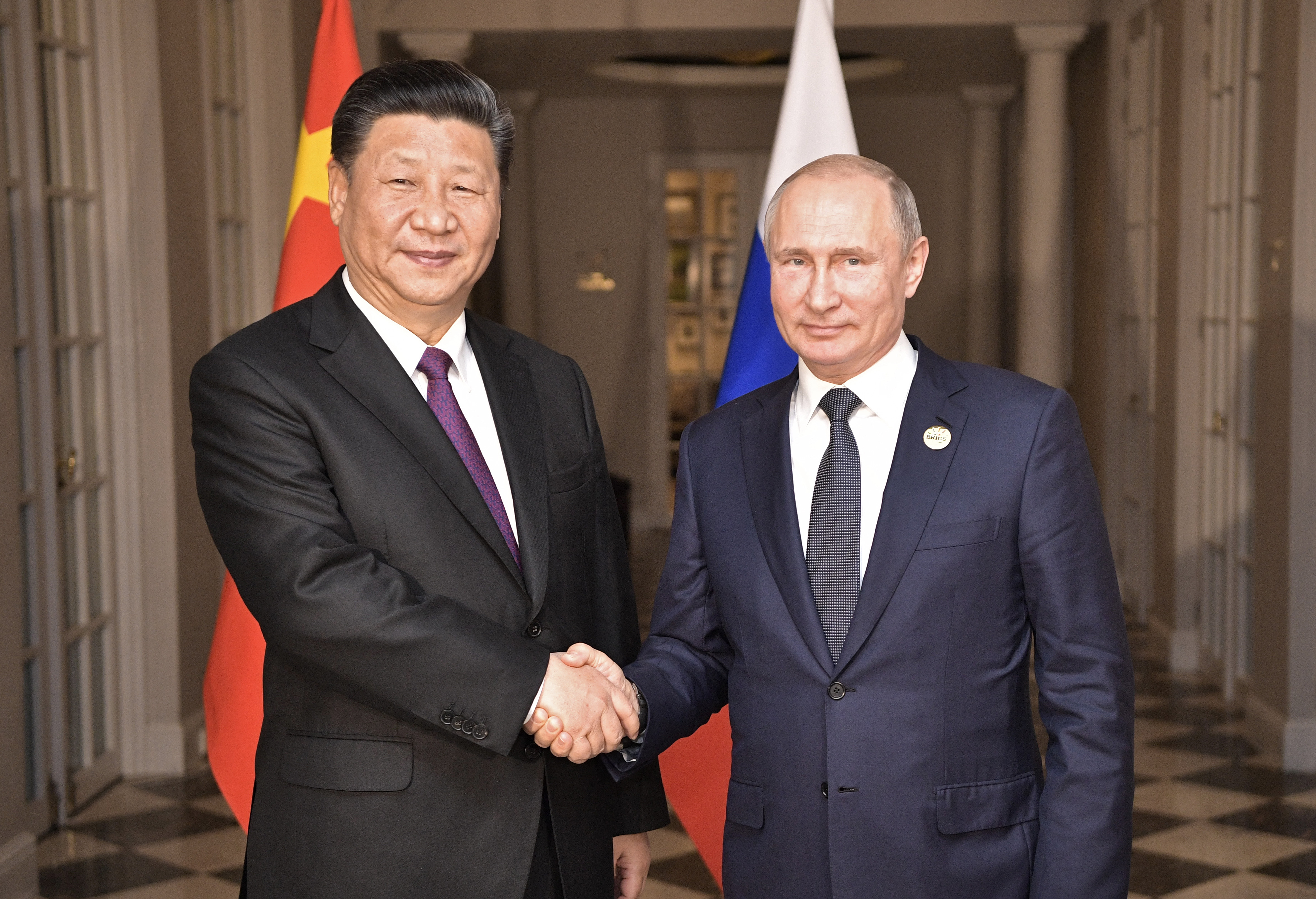
Among the key findings is that China and Russia sit at the heart of an authoritarian axis which, together with Iran, accounts for two-thirds of all global authoritarian cooperation incidents in 2024–2026. The breadth and depth of these collaborations is expanding, with significant penetration into Europe as well. The interactions include narrative alignment, joint consultation on “governance” solutions, and the spread of technologies that facilitate repression.
On the positive side, the study emphasizes that liberal democracies can now mount a comprehensive response rather than reacting piecemeal and reflexively, and can act preventively rather than as a reactive fire brigade. This is made possible by monitoring the infrastructure of collaborations and recurring actors.
Authoritarian Regime and Movement Collaborations
The AuthCollab Index is the first of its kind, using political science typology grounded in natural language processing (NLP) applied to large language models (LLMs) and high-frequency open-source mapping to identify and classify collaborations, enabling users to navigate large volumes of information. One of the database’s most significant contributions is that it allows tracking of collaborations between authoritarian regimes and movements operating within democracies.
Russia and China: Pillars of Authoritarianism
The core findings from the AuthCollab Index are revealing: Russia and China are coordinating a global network of anti-democratic activities. Russia accounts for 28.6% and China for 23.9% — together participating in more than half of the approximately 72,000 authoritarian collaborations. Iran ranks third at 12.4%, closely followed by Turkey at 12.3%. Also in the top positions are Saudi Arabia at 9.3%, Egypt at 8.8%, India at 8.3%, Kazakhstan at 7.1%, and Azerbaijan and Pakistan both at 6.7%.
The emerging international landscape is one of two global pillars of authoritarianism, Russia and China, a middle tier of regional powers, and a range of smaller states.
Diplomacy as the Primary Form of Interaction
The primary form of interaction is diplomacy, followed by economic and military cooperation. A telling example is Russia, where diplomatic and legislative engagement accounts for 40.6% of cases, economic investment for 25.8%, military cooperation for 14.8%, propaganda for 6.2%, network-building for 5.9%, training for 4%, and police repression for 2.9%.
Similar patterns emerge in the data for China and Iran. We are in a period of significant and deliberate growth and expansion of these collaborations through official forums, summits, and shared media networks such as BRICS TV and the Belt & Road News Network.
There are common lines of support, such as state-funded fake election observation missions, which lend a veneer of international democratic legitimacy, as occurred, for example, in elections in Russia, Venezuela, and Myanmar. Another notable form of assistance is offering refuge to ousted authoritarian leaders, such as the airlifting of Bangladeshi Prime Minister Sheikh Hasina to India, or the granting of asylum to former Syrian President Bashar al-Assad in Moscow.
Repression Tactics
Assistance with repression tactics is also significant, for example, internet shutdowns in Iran supported by Russian and Chinese military technology. Notably, Russian laws targeting “foreign agents” and “LGBTQ propaganda” have been replicated in Georgia, Hungary, and Kazakhstan.
China’s “party schools” provide cadre training in many African and Middle Eastern countries on organizing single-party political systems, as well as expertise in citizen surveillance systems. A notable case is Thailand, which helps neighboring authoritarian regimes locate dissidents in exile — as in 2024, when six anti-Hun regime activists were handed over to Cambodia and faced treason charges, and in 2025, when 40 Uyghurs were deported to China.
“Shared Authoritarian Values” Override Religious and Cultural Differences
Another interesting finding is that the “shared values” of authoritarian ideologies override religious and cultural differences. Muslim-majority states, for instance, deport Muslim Uyghurs to China. Also notable is the alliance between Venezuela, Iran, and Hezbollah — a secular socialist regime, the Shia “Islamic revolution,” and an armed group in Lebanon — united under the banner of anti-Westernism.
The Dangerous Penetration of Europe
The most alarming findings concern the infiltration of authoritarian regimes into Europe, particularly in Hungary, the Czech Republic, and Slovakia. A striking example was Slovak leader Robert Fico’s trip to China in September 2025, where he appeared at the Victory Day military parade in Beijing alongside Vladimir Putin, Xi Jinping, and Kim Jong-un.
There are also significant collaborations with opposition parties across Europe, including Marine Le Pen’s National Rally in France, Alice Weidel’s Alternative for Germany (AfD), Geert Wilders’ Party for Freedom in the Netherlands, Jarosław Kaczyński’s Law and Justice in Poland, Santiago Abascal’s Vox in Spain, André Ventura’s Chega in Portugal, Tom Van Grieken’s Vlaams Belang in Belgium, Dimitris Natsios’ Democratic Patriotic Popular Movement Victory (NIKI) in Greece, the Alternative Democratic Reform Party in Luxembourg, and others.
The Authoritarian Collaborations Index demonstrates that the infrastructure of authoritarian governance has matured into a globalized ecosystem with shared strategic resources and cooperation on repression techniques. It represents a tool for researchers, journalists, and policymakers who seek a proactive and coordinated defense of democratic norms.