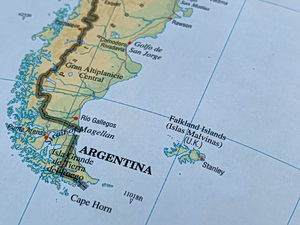
The Falklands are windswept, remote and thousands of miles from Britain. Yet this week they have once again found themselves at the centre of an international argument stretching from Buenos Aires to Westminster – and potentially all the way to the White House.
The immediate trigger is oil.
Argentina has announced that it will pursue criminal charges against Navitas Petroleum, several of its subsidiaries and executives over the development of offshore resources around the Falkland Islands, which Buenos Aires calls Las Malvinas.
The Sea Lion project, in which Israel-listed Navitas holds a 65 per cent stake, is expected to begin production in 2028. The field is estimated to contain around 1.7 billion barrels of oil.
For Javier Milei, however, the issue is not simply energy. It is sovereignty.
In a nationally televised address, Argentina’s president declared that “the Malvinas are Argentine, historically and legally”, describing offshore drilling as a “clear and urgent danger” to Argentina’s sovereignty.
He seized on Donald Trump’s suggestion that Washington might reconsider its traditional position on the dispute, declaring that the “winds of change” were blowing in Argentina’s favour.
Britain has responded with equal clarity.
Foreign Secretary Ed Miliband, appointed to the post in July following Andy Burnham’s arrival as Prime Minister, said: “The UK’s position on the Falkland Islands is unwavering. The Islands are British and will remain so because that is the overwhelming position of the Islanders. Their right of self-determination is paramount, grounded in international law and we will resolutely uphold it.”
It is a confrontation that combines an old territorial dispute with a new geopolitical reality: an Argentine president closely aligned with Trump, an American president increasingly willing to challenge established diplomatic assumptions, and an offshore oil project potentially worth billions.
For the experts speaking exclusively to To Vima, the central question is whether this is simply another cycle of Argentine rhetoric – or whether the combination of oil and a changing relationship between Washington and London has altered the calculation.
Speaking to TO VIMA, Professor Michael Clarke, Visiting Professor in the Department of War Studies at King’s College London and former Director-General of the Royal United Services Institute, is unequivocal.
“The Falklands issue will not change, regardless of what Milei or Trump says.”
For Clarke, the fundamental question is straightforward. “I have a simple question to them: when did Argentina ever, ever own or populate the islands? On what basis can they claim them?”
He sees geographical proximity as an insufficient argument. “It seems to be mere proximity. In which case Alaska should be given back to Russia, Taiwan to China, the Channel Islands to France, etc etc.”
But Clarke’s strongest argument concerns the wishes of the people who actually live on the islands. “And have a look at UN statements on self-determination as critical to decisions over sovereignty.”
The Falkland Islanders have already expressed their preference. In the 2013 referendum, with a turnout of 92 per cent, 99.8 per cent voted to remain a British Overseas Territory. Clarke points to the extraordinary margin.
“The last time anyone asked the Falklanders in 2013 the result, on a 92% turnout, was 99.8% in favour of remaining British territory.”
Then comes the detail that, in his view, makes the result impossible to ignore: “Three (three) people voted against. So it’s no contest in legal terms.”
‘If Britain hangs onto RAF Mount Pleasant, Argentina will never get onto the Falklands’
Yet Clarke does not believe the dispute can be understood solely through international law or diplomacy. There is a military equation at its heart.
And for him, that equation has a very clear centre of gravity: RAF Mount Pleasant. “In defence terms it all hinges on RAF Mount Pleasant.” He describes the strategic calculation in stark terms. “If Britain hangs onto it, Argentina will never get onto the Falklands. If Argentina gets hold of it, then Britain will never get back onto the islands.”
His conclusion is deliberately blunt: “It’s a simple military equation.”
The prospect of a repeat of the 1982 conflict remains remote. Argentina is not threatening an invasion and Britain retains a significant military presence on the islands.
But the strategic importance of the territory has not disappeared. If anything, the emergence of oil has increased it.
‘Self-determination is paramount’
Rachel Utley, Associate Professor of International History at the University of Leeds, places the dispute in a longer historical and legal context.
Speaking to To Vima, she says the British position has long been rooted in a principle that London regards as fundamental. “At a foundational level, the UK Government’s position has long been determined by its commitment to the legal principle of self-determination, or the right of peoples to decide on their own form of government.”
She points to archival evidence showing that self-determination was a major consideration in negotiations over the future of the Falklands/Malvinas, particularly around the period leading up to the 1982 invasion.
“Archival materials underline that it was a major consideration in negotiations about the future of the Falklands/Malvinas until the beginning of the 1980s, and especially after Argentina’s invasion of the Falkland Islands in 1982.”
The 2013 referendum, she argues, reinforced that principle.
“More recently, the Falkland Islands referendum in 2013 resulted in an overwhelming vote in favour of retaining the status of Overseas Territory of the United Kingdom, further underlining the clear wishes of the Islanders.”
For Britain, that is the heart of the argument. The population of the islands has spoken – overwhelmingly.
‘The prospect of using the Falklands as leverage over Britain has been very real’
But Utley sees another issue emerging from the current crisis: the United States. Washington has traditionally been cautious over the sovereignty question while maintaining a broadly supportive position towards Britain.
Donald Trump has disrupted that pattern. Utley points to his approach to other strategically important territories, including Greenland and the Chagos Islands.
“Given Trump’s disruptive approaches, including his shift of position on the UK plan to hand over the British Indian Ocean Territory (Chagos Islands) to Mauritius, and his threats to Danish sovereignty over Greenland, the prospect of using the Falklands as leverage over Britain (or as retribution, in light of perceived lack of support for the war against Iran) has been very real.”
That matters because the relationship between Trump and Milei is unusually close.
Milei has increasingly presented Argentina as an ideological ally of Washington, while Trump has shown a willingness to use territorial and strategic questions as leverage in broader disputes.
Utley believes that makes the Falklands question harder to dismiss. “This is even clearer considering the apparent closeness between Trump and Milei, and will be amplified by the question of oil.”
Her conclusion is sobering. “Given current differences in many aspects of UK-US relations, a US President whose approach to US foreign policy has been overtly abrasive on many issues, and the current US administration’s tendency to assert its own regional and broader interests in many forms, the current Falklands question is unlikely to blow over any time soon.”
‘This could prove to be a fairly low-risk but high-reward strategy’
Peter Clarke, Operations Administrator at RUSI, believes the most significant part of Milei’s latest intervention may not be the rhetoric over sovereignty. It may be the sanctions.
Argentina’s threat of criminal proceedings against companies involved in developing the Sea Lion field gives Buenos Aires a mechanism for applying pressure without taking military action.
Peter Clarke describes it as: “A fairly low-risk but high-reward strategy.” He argues that the sanctions could allow Argentina to exert influence around the Falklands while avoiding the enormous risks associated with military intervention.
“It would allow Argentina to exert some control over the Falklands without risking military intervention or any significant Argentinian asset, given the relatively small size of the oil companies involved.”
And there is a second benefit. Argentina does not necessarily need to seize the oilfield to claim a political victory. It could simply prevent the Falklands from exploiting it.
“Just denying these resources to the Falklands would be a significant foreign policy coup for the Argentinians.”
Why? Because it would demonstrate that Buenos Aires can affect events around the islands without resorting to force.
“It would show that they are capable of influencing events in and around the islands without a military intervention.”
And that, Clarke says, would turn the issue back on Britain. “It would also be a significant foreign policy failure for the UK, since HM Government is responsible for the foreign policy and protection of the islands.”
Milei, he believes, would then have a powerful political story to tell at home. “Milei would definitely be able to capitalise on this in his domestic messaging, and likely his international messaging too.”
‘Milei’s statements are primarily intended for his domestic audience’
There is another explanation for the sudden intensity of Argentina’s campaign: politics. Peter Clarke believes Milei’s intervention is aimed principally at Argentinians themselves.
“President Milei’s statements are primarily intended for his domestic audience and will have the most impact there.”
He argues that the government has been losing popularity.
“His government has been decreasing in popularity since May, and being seen to pursue Argentinian claims over the Falklands is a fairly common method of trying to raise approval levels.”
That does not make the threat irrelevant.
Indeed, Clarke sees the sanctions strategy as potentially effective precisely because it offers Milei political rewards without requiring a military confrontation.
The Falklands remain one of Argentina’s most emotionally powerful national causes.
‘The Falklands/Malvinas have always been the most prominent foreign policy issue’
Matthew Benwell, a political geographer at Newcastle University, takes a similar view of the domestic political significance – but warns against treating Milei’s position as entirely new.
“The Falklands/Malvinas have always been the most prominent foreign policy issue for successive Argentine governments.”
What changes, he says, is the volume. “What tends to vary is the amount of noise, and therefore international attention, generated by each administration about the sovereignty question.”
Milei had until recently been comparatively restrained. “Up until now, Milei and most of his government had been relatively quiet on this issue aside from the usual diplomatic statements and events held for key anniversaries.”
But the oil timetable changes the equation. “With the date of oil exploitation nearing (projected for 2028), expect to see Milei and his government increase the pressure on the governments of the UK and the Falkland Islands.”
Then comes one of the most intriguing questions of the entire dispute. Israel.
Navitas Petroleum is Israeli-linked, and Milei has built an exceptionally close relationship with Benjamin Netanyahu’s government.
Benwell says: “I’m particularly interested to see how he deals with Israeli involvement in this oil exploitation (via Navitas) given his strong bilateral relationship with Netanyahu’s Israel.”
That creates a diplomatic triangle involving Buenos Aires, London and Jerusalem – with Washington increasingly hovering over it.
‘I’d expect Milei to look to Trump for more supportive statements’
Benwell believes the Trump relationship could become increasingly important.
“Milei has an extremely warm relationship with President Trump which he has leant on for domestic political gain in the past.”
He expects the Argentine president to seek further American support. “I’d expect Milei to look to Trump for more supportive statements on Argentina’s Malvinas claim in the coming months.”
And there may be a receptive audience. “These might well be forthcoming especially if UK/US relations continue to deteriorate although whether this leads to a change in the neutral stance of the US remains to be seen.”
That final qualification is critical. Trump may use the Falklands as leverage without formally abandoning Washington’s traditional position. The distinction could prove decisive.
‘The US has the potential to significantly change the situation’
Peter Clarke is also cautious about predicting an outright American realignment. But he believes Washington possesses the ability to transform the dispute if it chooses.
“The US has the potential to significantly change the situation.”
He points to discussions within Washington over the Falklands and the historical US position.
“Given the aforementioned discussions the US has been having over the last few months, and their historical position on the topic, they are now more likely to back the Argentinians in the matter than the UK.”
Yet he stops short of predicting a formal American shift.
“However, given the US’s commitments in Iran, I would not expect the US to devote significant time or resources to the issue.” The more immediate danger, he suggests, could be diplomatic rather than military.
“The US may not support UK foreign policy responses to any Argentinian sanctions on oil companies developing the Sea Lion oil fields.” For Britain, that would be deeply uncomfortable.
‘The oil fields around the Falklands are a driver behind this renewed interest’
Oil is not a new factor in the Falklands dispute. Attempts to develop offshore resources have been discussed for decades. But the economics have changed. Peter Clarke says:
“It is likely that the oil fields around the Falklands are a driver behind this renewed interest.”
The incentive is particularly strong when oil prices are high. “With the price of oil as high as it is, the incentive to develop the fields has seldom been greater, and securing them would be financially beneficial to the Argentine government.”
But he makes an important distinction. Argentina may not realistically expect the oil project to result in a transfer of sovereignty.
“Given the low likelihood of a transfer of sovereignty any time soon, gaining use of the oil fields is not likely the objective of this current initiative.”
Instead, preventing the Falklands from exploiting the resources could itself become the objective. That is what makes the sanctions strategy so attractive.
‘A far-right libertarian president motivated by economic interests’
Benwell is even more direct about the economic dimension. “These are probably critical for sparking the interest of President Milei especially.” He describes Milei as: “A far-right libertarian president who is motivated by economic interests first and foremost through the exploitation of the country’s natural resources.”
But again, the argument is not that Milei has suddenly discovered the Falklands.
“The emphasis on energy resources and maritime claims around the Falklands/Malvinas aren’t new, however, and previous presidents – Alberto Fernández, Cristina Kirchner etc. – have drawn attention to this.”
Previous governments also introduced economic measures against companies and individuals involved in oil exploration. The difference now is the geopolitical backdrop.
‘Trump has demonstrated his interest in strategically located islands’
Benwell sees parallels between the Falklands dispute and Trump’s approach to other territories. “There are some parallels with other contemporary geopolitical events.”
He points specifically to Greenland and the Chagos Islands.
“President Trump has demonstrated his interest in strategically located islands and territories (e.g. Greenland, Chagos Islands – Diego Garcia) around the world and his disregard for established alliances when it comes to pursuing US foreign policy.”
So far, Trump’s Falklands comments have been relatively loose. “For the moment President Trump has only made fairly flippant remarks about the sovereignty dispute.”
But Benwell warns that the consequences would be very different if Washington moved beyond rhetoric.
“If he decides to change the US’s position or call for negotiations this could create headaches for the UK Government and would demand a significant diplomatic response.”
A dispute that refuses to disappear
More than 40 years after the war, the Falklands dispute has become one of those conflicts that appears frozen until suddenly it is not. The sovereignty question has remained unresolved.
Argentina continues to claim the islands. Britain continues to administer them. And the islanders overwhelmingly continue to identify themselves as British.
The 2013 referendum remains the strongest expression of that choice. But the emergence of the Sea Lion field has added a new incentive for Buenos Aires to exert pressure.
There is money beneath the dispute. There is politics above it. And increasingly, there is Donald Trump. For Professor Michael Clarke, however, the fundamental argument remains unchanged. “The Falklands issue will not change, regardless of what Milei or Trump says.”
For Britain, the decisive principle is self-determination. For Argentina, it is sovereignty. For Milei, it is also domestic politics. For the oil companies, it is a potentially enormous commercial opportunity.
And for Trump, the islands could become another bargaining chip in a rapidly changing relationship with Britain.
That leaves the South Atlantic facing a familiar dispute in an unfamiliar geopolitical climate. The Falklands may be thousands of miles from Britain.
But the battle over who controls them – and who controls the wealth beneath their waters – is once again being fought far beyond their shores.