Climate change, industrial pollution, and biodiversity loss — the so-called “triple planetary crisis” — are driven by the way modern economies extract, use, and discard raw materials. For the European Union (EU), the issue has now moved beyond the narrow boundaries of environmental policy. It affects the resilience of European industry, its dependence on imported resources, supply chains, and ultimately its competitiveness.
This was the central message of the discussion held on Wednesday, June 17, during the plenary session of the European Economic and Social Committee (EESC), where the forthcoming European Circular Economy Act was presented as a strategic challenge for Europe. The law, which is expected to be approved by the European Commission by the end of the year, raises a difficult question: can the European economy reduce its environmental footprint while remaining competitive at the same time?
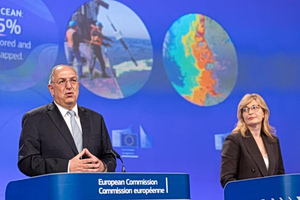
Teresa Ribera, Executive Vice-President of the European Commission and Commissioner for Competition, gave the discussion a geopolitical dimension. The circular economy, she said, is necessary for Europe’s resilience and competitiveness, for reducing its dependence on imported resources, and for strengthening its strategic autonomy.
The ambition is significant. Reality, however, points in the opposite direction. According to the latest Eurostat data, the circular material use rate in the EU reached 12.2% in 2024, an increase of four percentage points compared with 2004. The indicator measures the share of materials used in the economy that come from recycled waste reintroduced into production. Despite the progress, nearly 90% of the material base of the European economy continues to rely on primary materials.
The picture of material flows makes the challenge of the circular economy even greater. In 2024, the EU economy processed 7.70 billion tones of materials, 67% of which came from natural resources extracted within the EU, 19% from imports, and 14% from recycling and backfilling. The circular loop, therefore, remains small compared with the size of the European economy.
That is why the discussion cannot be limited only to recycling rates. The key question concerns whether recycled materials can replace primary extraction, whether products are designed to last, whether repair and reuse become economically normal practices, and whether secondary raw materials can circulate within a functioning European market.
This is also the logic behind the opinion adopted by the EESC, following a request from the European Commission, which is based on five pillars: a single market for secondary raw materials; support for repair, reuse, and remanufacturing; green public procurement; reform of extended producer responsibility; and, finally, widely applicable technical standards.
The Irish rapporteur of the EESC opinion, Cillian Lohan, expressed it clearly during the plenary: circularity must become a “horizontal principle.” In his accompanying text, he went a step further, noting that Europe needs to move from the logic of “using resources better” to the logic of “using fewer resources.”
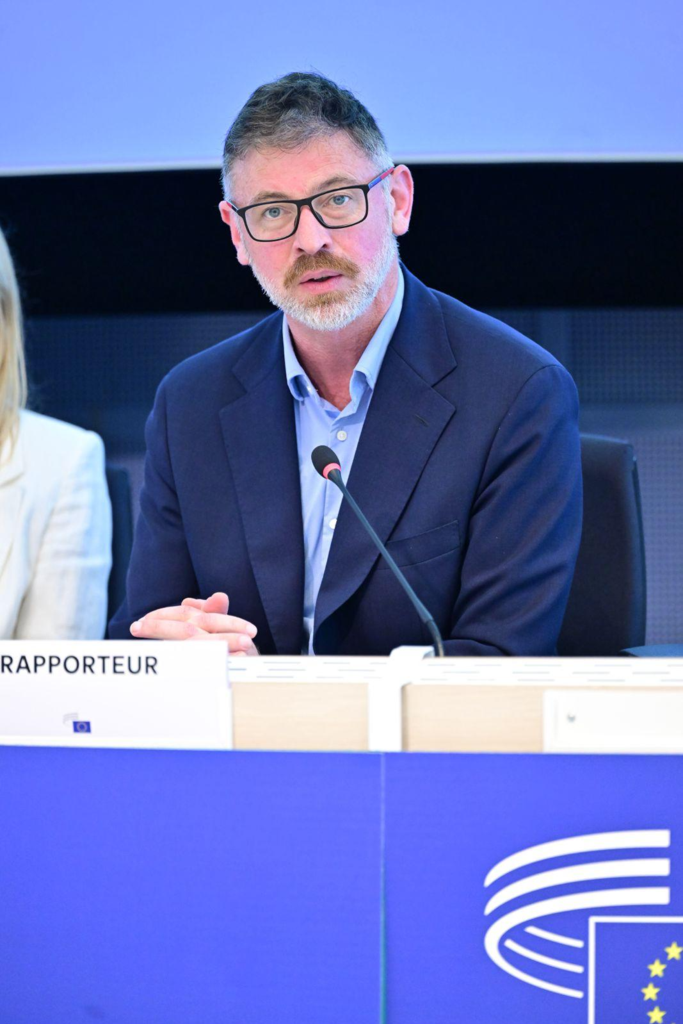
Cillian Lohan, EESC’s rapporteur on the future of the Circular Economy Act
Lohan’s distinction is significant. Europe has invested for years in efficiency. It recycles more than it did in the past. It produces greater economic value per unit of material consumed. However, if total demand for resources continues to increase, efficiency gains are absorbed by the scale of consumption. That is why the idea of establishing clear material footprint targets is gaining particular importance, comparable to climate targets.
Targets, however, do not create markets on their own. Circularity must become a useful tool of industrial policy. If primary materials remain cheaper, if recycled materials are considered unreliable, if small and medium-sized enterprises cannot access financing, and if public procurement does not reward circular design, the circular economy will remain within the realm of a “regulatory aspiration.”
Speaking exclusively to To Vima, Lohan describes the past decade as a “period of visible but insufficient progress.” The right to repair, eco-design, extended producer responsibility, and remanufacturing have moved the discussion closer to the beginning of the production chain. The pace, however, remains, as he notes, “very slow, although in the right direction.”
As the EU’s strategic priorities shift from the Green Deal toward competitiveness, security, and defense, the vision of a European circular economy can either be strengthened or weakened. Lohan identifies the risk that circularity could become merely a “label serving existing sectoral targets.” This, as he characteristically notes in To Vima, “would constitute a new wrapping of [policy] inertia.”
One way to understand the issue is through the example of a “white” household appliance. Lohan argues that European citizens should not enter a shop looking for a “circular” washing machine. The real criterion is whether there is, from the outset, a durable, repairable, refurbished, and affordable option available in the local economy. Washing machines with long lifespans, that are easy to repair, and that do not require consumers to bear the green cost at the store checkout.
According to the Irish rapporteur of the EESC opinion on the Circular Economy Act, the circular economy becomes in practice a “soft form of reindustrialization” when repairable products support networks of technicians, craftsmen, and workshops, especially outside urban centers. “Instead of discarded products being transported elsewhere, components can be recovered, reused, and remanufactured even far from large cities.”
Behind the sought-after consensus in the EU, however, lies a hard truth. Lohan rejects the idea that in the circular economy “everyone automatically wins.” A genuine circular economy, he argues, changes business models. “Those who have invested more heavily in the linear model will not benefit in the same way. Some will adapt, others will lose.”
The forthcoming European Circular Economy Act will therefore be judged by its impact on the market. Will it make secondary raw materials reliable and competitive? Will it create demand for repair and remanufacturing? Will it make circular choices affordable for households and sustainable, especially for small and medium-sized enterprises?
The answers are not obvious, but they will determine whether the circular economy remains a “green” loop of limited applicability or evolves into a central pillar of a more resilient and sustainable model of economic development for Europe.