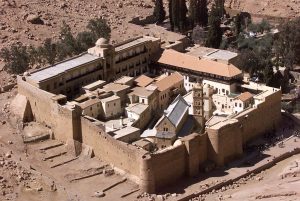
The Trump administration has publicly signaled its support for protecting St. Catherine’s Monastery, the sixth century Greek Orthodox sanctuary at the foot of Mount Sinai, as a legal battle in Egypt leaves unresolved the ownership of lands used by its monastic community for generations.
“The United States recognizes and seeks to protect St. Catherine’s historic and religious significance as the world’s oldest continuously operating monastery,” a State Department spokesperson said in a written response to To Vima.
The statement was limited in scope. It did not endorse the monastery’s ownership claims or define the legal protections Washington believes should apply. But it represented a notable expression of American interest at a moment when the monastery and the Egyptian government remain engaged in litigation and Greece is seeking guarantees that would preserve the institution’s rights, Greek Orthodox identity and uninterrupted religious life.
The dispute rests on a distinction that is legally significant but difficult to sustain in practice. A guarantee that the monks may continue to worship and use the monastery does not necessarily establish their ownership of surrounding properties, including gardens, agricultural land and other sites they consider essential to the community’s survival.
The uncertainty deepened last month when no ruling was publicly issued on August 23, the date on which Egypt’s Court of Cassation had been expected to consider two appeals concerning the monastery.
Several Greek news organizations described the development as a postponement that could provide more time for negotiations. But no publicly available Egyptian court order or docket entry has confirmed what procedural action occurred that day, and no new hearing date has been officially announced.
The two appeals challenge a May 28, 2025, ruling by the Ismailia Court of Appeal. That decision preserved the monks’ ability to use the principal monastery complex and its religious and archaeological sites. It also ordered them to vacate several nearby plots, including vineyards and gardens, that the court said were occupied without sufficient legal title.
The ruling caused alarm in Greece and throughout the Orthodox Christian world because of its implications for properties long administered by the monastic community.
Both sides appealed, but for different reasons. The Egyptian government is seeking broader recognition of state claims over disputed properties. The monastery is seeking recognition of its ownership rights over its assets. Until the Court of Cassation rules or the two sides conclude an agreement, the legal question remains unsettled.
Egypt has repeatedly insisted that the monastery’s religious character and continued operation are not in danger. After the 2025 judgment, the Egyptian presidency reaffirmed what it called its full commitment to preserving the monastery’s unique and sacred religious status. President Abdel Fattah el Sisi and Prime Minister Kyriakos Mitsotakis of Greece have also pledged to prevent the dispute from damaging relations between their countries.
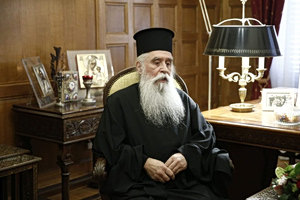
The State Department’s response follows a July meeting between Massad Boulos, President Trump’s senior adviser for Arab and African affairs, and Archbishop Symeon of Sinai.
The meeting took place on July 18 at the monastery’s compound in Cairo. Mr. Boulos conveyed both Mr. Trump’s personal interest and his own commitment to preserving the monastery’s “historic status quo.” He also expressed his willingness to support efforts to safeguard its distinctive religious and historical identity.
The phrase “historic status quo” is broader than a specific legal position. The account of the meeting did not state whether American support extended to the monastery’s claims over every disputed property or was principally focused on protecting worship, access and monastic life. The State Department’s response was similarly cautious on the property question.
For Greece, the dispute has become a sensitive test of its strategic relationship with Egypt. The two countries have strengthened cooperation on energy, maritime boundaries and regional security in the Eastern Mediterranean, formally elevating their ties to a strategic partnership in 2025. Athens has therefore sought to defend the monastery without allowing the disagreement to develop into a broader diplomatic rupture.
The monastery is not Greek territory and remains under Egyptian sovereignty. Ecclesiastically, however, it is governed by the autonomous Church of Sinai and belongs to the Greek Orthodox tradition. Its archbishop and monastic community have maintained close historical, religious and cultural connections with Greece.
Founded under the Byzantine Emperor Justinian I, St. Catherine’s stands in a landscape revered by Christians, Muslims and Jews as the place where, according to biblical tradition, Moses received the Ten Commandments. UNESCO, which inscribed the surrounding area on its World Heritage list in 2002, describes it as the oldest Christian monastery still performing its original function without interruption.
Behind its fortified walls, the monastery holds an exceptional collection of early Christian manuscripts and icons. Its uninterrupted religious life has survived the rise and fall of empires, successive systems of government and centuries of upheaval in the Sinai Peninsula.
The American statement strengthens the diplomatic support surrounding that legacy. It does not, however, takes a clear stance on the ownership dispute. The monks remain in the monastery, as they have for roughly 15 centuries, but the legal status of some of the land around them remains unresolved.