
 Μake us preferred on Google
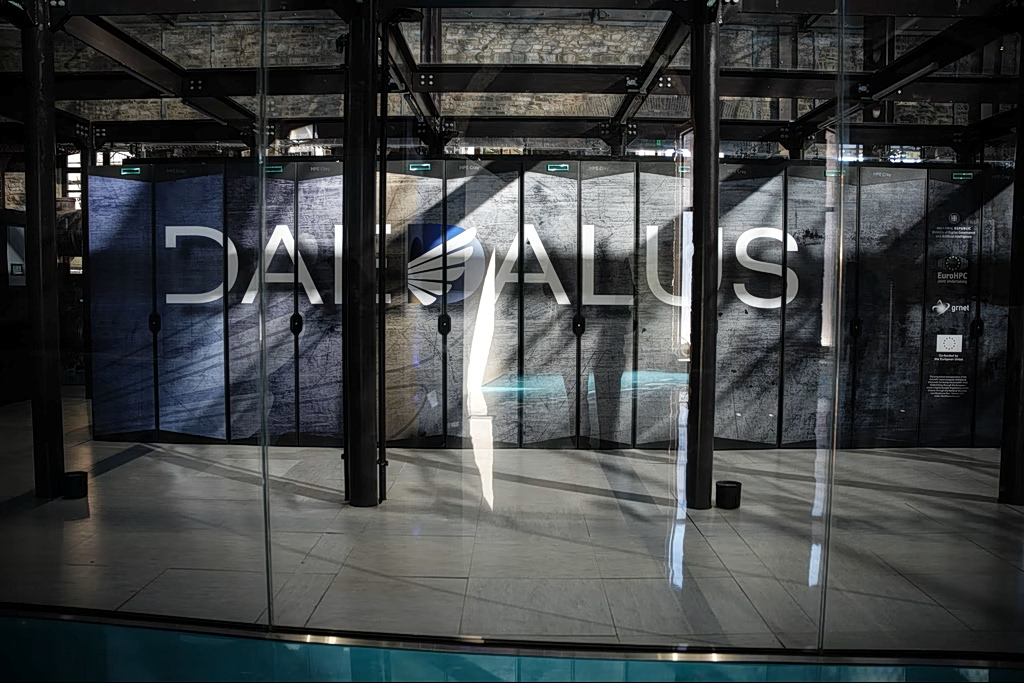
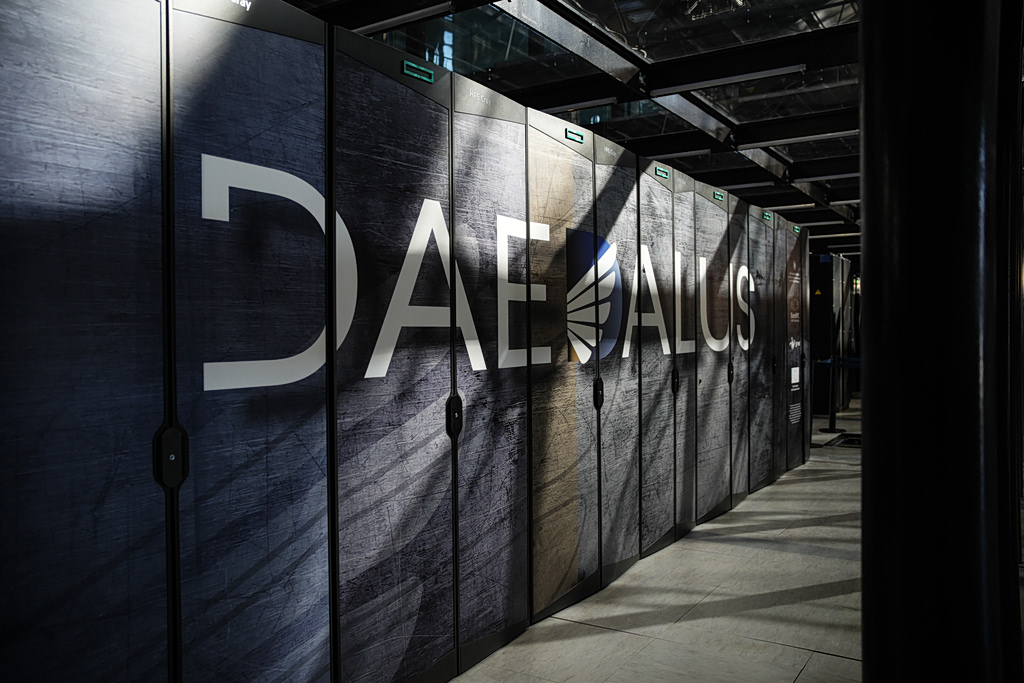
Installed at the Lavrio Technological and Cultural Park southeast of Athens, the €58.9 million system is designed to serve researchers, universities, businesses and public-sector organizations. It will also provide the computing power for Pharos, Greece’s AI Factory, which forms part of the European network of facilities supporting AI development.
With a measured performance of 85.69 petaflops, Daedalus ranks 31st in the global TOP500 list of the world’s most powerful supercomputers and 23rd in the Green500 ranking of energy-efficient systems.
The following questions and answers explain the system’s capabilities, applications, financing and significance for Greece.
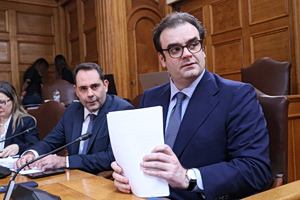
Greek Prime Minister Kyriakos Mitsotakis takes part in a discussion with journalist Timos Kouremenos during the inauguration event of the “Daedalus” supercomputer at the Lavrio Technological and Cultural Park, in Lavrio, on October 19, 2026. / Ο πρωθυπουργός Κυριάκος Μητσοτάκης συμμετέχει σε συζήτηση με τον δημοσιογράφο Τίμο Κουρεμένο κατά την εκδήλωση για τα εγκαίνια του υπερυπολογιστή «Δαίδαλος» στο Τεχνολογικό Πολιτιστικό Πάρκο Λαυρίου, στο Λαύριο, στις 19 Οκτωβρίου 2026.
Q: What is Daedalus and why is it important for Greece?
Daedalus is Greece’s new national supercomputer and the most powerful computing system the country has acquired. It is a high-performance computing (HPC) infrastructure capable of processing vast quantities of data and performing complex calculations at extremely high speeds.
It will expand Greece’s capacity in scientific research, artificial intelligence and advanced technological applications, strengthening its position in the European and international supercomputing ecosystem.
The investment is also intended to help Greece develop domestic technological expertise and reduce its dependence on computing resources located abroad.
Q: How powerful is Daedalus and where does it rank internationally?
The system has a measured computing performance of 85.69 petaflops, equivalent to approximately 85.69 quadrillion floating-point operations per second.
It ranks 31st in the global TOP500 list of the world’s most powerful supercomputers and 23rd in the Green500, which evaluates energy efficiency.
Its performance places Greece among the 14 countries with a significant presence in the international supercomputing rankings, according to the project’s presentation.
Q: When will the first users be able to access Daedalus?
Access is scheduled to begin gradually during December, following completion of the system’s technical configuration.
The National Infrastructures for Research and Technology (GRNET) will announce the relevant calls, access conditions and application instructions. The aim is to ensure an orderly and technically secure transition to operational use.
Q: Who will be able to use the system, and how will access be granted?
Daedalus will be available to the Greek and European scientific and academic communities, including universities, research centers, startups, small and medium-sized enterprises, industry and public-sector organizations.
Access will be organized through calls and procedures administered by GRNET, the European High Performance Computing Joint Undertaking (EuroHPC JU) and PHAROS, depending on the nature of each project.
Applicants will submit proposals assessed according to their scientific or technological value, computing requirements and the availability of resources. Specific eligibility criteria and deadlines will be announced when the system enters operational service.
Q: What can Daedalus do in practice? Are there specific examples?
Its applications range from health and biomedical research to climate science, energy, transportation, manufacturing and cybersecurity.
In health, researchers could train AI models using appropriately anonymized data to support the early detection of diseases and the development of personalized medicine tools.
In civil protection, the system could run complex climate simulations to improve understanding of extreme weather events and help assess wildfire risks.
Businesses could use Daedalus to simulate new products and production processes, reducing testing time and improving designs before manufacturing begins.
The system will also support generative AI applications and large language models, including tools tailored to the Greek language, with potential uses in education and culture.
Q: Will Daedalus be used exclusively for artificial intelligence?
No. It is a general-purpose supercomputer designed for scientific and technological tasks requiring exceptionally high computing power.
Although AI is one of its principal applications, the system can also support computational physics and chemistry, biology, meteorology, climate research, energy and industrial engineering.
Its ability to process large datasets and execute complex simulations makes it suitable for research across a wide range of disciplines.
Q: How does it differ from a conventional computer or a cloud service?
Daedalus is designed to tackle problems that require the simultaneous use of large numbers of processors and computing resources.
It can complete demanding calculations and simulations within practical timeframes that would take conventional systems considerably longer or be impractical to perform efficiently.
Unlike a standard computer, it is built for workloads on a much larger scale. Its role is to provide researchers and businesses with specialized computing capacity for projects that exceed the capabilities of ordinary systems.
Q: What is the relationship between Daedalus and PHAROS AI Factory?
Daedalus is the computing core of PHAROS, Greece’s AI Factory and part of the European network of AI development facilities.
While Daedalus provides the processing power, PHAROS combines it with data, technical expertise, software tools, training and specialized support to help researchers, universities, businesses and public bodies develop AI applications.
Its priority areas are health, language and culture, and sustainability.
The initiative is intended to strengthen Greece’s technological autonomy by creating the conditions for developing domestic AI models and applications.
Q: What technology does Daedalus use?
The system is based on advanced architecture from Hewlett Packard Enterprise (HPE) and uses NVIDIA GH200 accelerators designed for demanding computing workloads and AI applications.
It also employs direct liquid cooling, which removes heat from computing components efficiently and reduces the energy required for cooling.
The combination of advanced processors and specialized cooling technology is designed to support high performance while limiting energy consumption.
Q: Where is Daedalus installed, and what facilities support it?
The supercomputer is housed in GRNET’s new data center at the former electrical station in the Lavrio Technological and Cultural Park, southeast of Athens.
The historic building, a recognized monument of industrial heritage, covers approximately 1,500 square meters and has been converted into a modern high-technology facility.
The data center has an installed electrical capacity of 6.3 MVA and is designed to meet availability and reliability requirements associated with the Uptime Institute. Its operation follows GRNET’s security policies.
Q: How is the system’s energy efficiency ensured?
Energy efficiency was a central consideration in Daedalus’ design, reflected in its 23rd-place ranking in the Green500.
Its direct liquid cooling system is combined with local climatic conditions that permit free cooling for much of the year, reducing the energy needed to maintain operating temperatures.
A photovoltaic park with a capacity of two megawatts peak (MWp) at the Lavrio Technological and Cultural Park also contributes to meeting the facility’s electricity needs through self-consumption.
Q: Will the public be able to visit Daedalus?
The facility has been designed to accommodate visits, subject to the necessary security requirements.
Access to the computing equipment itself will remain controlled because of the technical demands of the installation. Information about organized visits is expected after work in the surrounding area is completed.
Q: Who manages Daedalus?
GRNET, the National Infrastructures for Research and Technology, is responsible for the system’s operation and management. The organization operates under the Ministry of Digital Governance and Artificial Intelligence within the European EuroHPC ecosystem.
Specialized personnel will monitor the infrastructure to ensure its security, availability and efficient use.
Q: How much did the project cost, and how was it financed?
The total project budget amounts to €58.9 million, including value-added tax, and was implemented by GRNET in two stages.
Hewlett Packard Enterprise undertook the supply and installation of the computing equipment, storage systems and software, as well as training services, under a contract worth €41 million, including VAT.
MainSys SA was responsible for the electromechanical infrastructure and the Lavrio data center, under a contract worth €17.9 million, including VAT.
The project was financed through Greece’s National Recovery and Resilience Plan, Greece 2.0, with resources from the European Union’s NextGenerationEU program and the EuroHPC Joint Undertaking.