 Μake us preferred on Google
 When Sam Wall was assigned “The Odyssey” in high school, he didn’t read it. Instead, he learned just enough to pass his English class.
With Christopher Nolan’s movie adaptation coming out, not being fully prepared was not an option. So Wall, now 21, picked up a translation of the epic poem. He inhaled it in a few days, and then reread it. He also read Virgil’s “The Aeneid,” which covers the story of the Trojan Horse, an element of Nolan’s film coming out Friday.
“I need to make sure that I read it, so that I know if it’s accurate or not,” Wall said.
Wall’s not alone. Readers are digging into various editions of the story so they can be ready to watch Matt Damon play Odysseus on his 10-year journey home following the Trojan War. TikTok is full of videos of readers holding up their copies of the translation by University of Pennsylvania classicist Emily Wilson, which Nolan has referenced as a source. The roughly 500-page book saw a significant increase in sales last year, according to publisher W.W. Norton.
Think of it like this: After about 3,000 years, Nolan is finally getting people to do their homework.
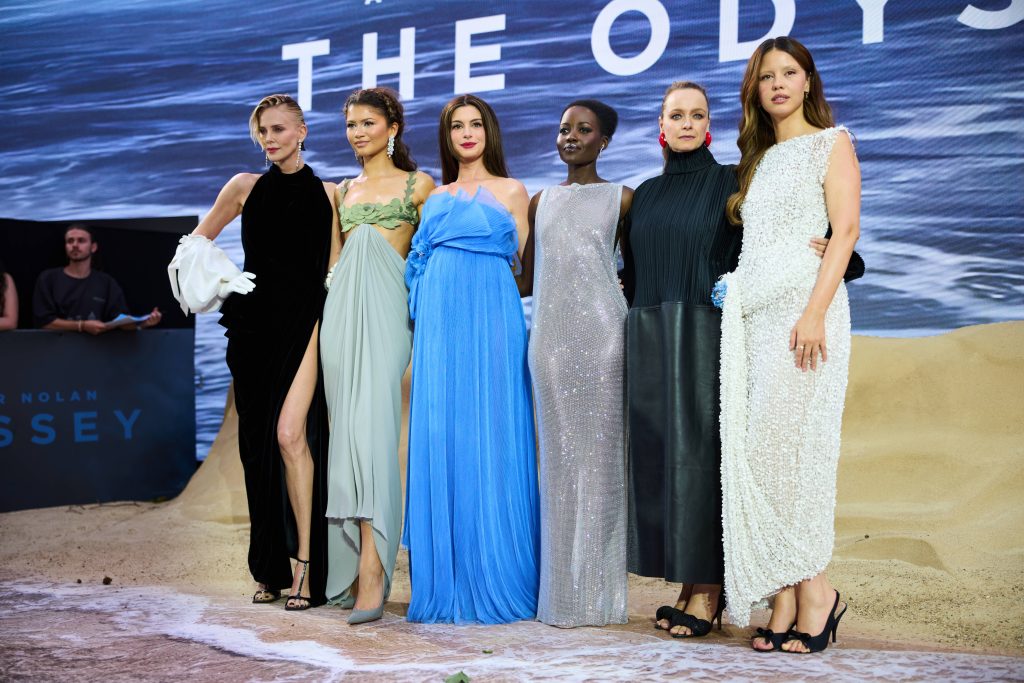
Charlize Theron, from left, Zendaya, Anne Hathaway, Lupita Nyong’o, Samantha Morton, and Mia Goth pose for photographers upon arrival at the premiere of the film ‘The Odyssey’ on Monday, July 6, 2026, in London. (Photo by Scott A Garfitt/Invision/AP)
It all has to be at least a little galling for the English teachers and Homeric scholars who have long tried to get students to appreciate the material like they do.
“It’s not like we’re trying to sell you a lemon here,” said Daniel Mendelsohn, a Bard humanities professor who has published his own translation of the poem. “It’s a Rolls-Royce, just get in it and take it for a drive and you’re going to wonder why you ever drove anything else.”
Still, Mendelsohn and other teachers will take the win.
“Frankly, anything that gets people reading or listening to Homer is fine with me,” said Lawrence Kim, a professor in Trinity University’s Department of Classical Studies.
Some movie fans are just finding out that the $250 million production isn’t an original screenplay.
When Nolan’s movie was announced, Matt Ramos, a comic book movie creator who goes by “Supes,” posted a screenshot of a search that informed him that “The Odyssey” is a “retelling of a poem written in ancient Greece more than 2,000 years ago.”
Many replied in disbelief that he had to Google the title. Cole Wojewoda, a 21-year-old film student in Virginia, related to Ramos. “It’s never been a recognizable name for me,” said Wojewoda, who wants to wait until after he sees the movie to read the poem.
Jayren Reyes also says digging through the entire 24 books of the poem wasn’t on his immediate to-do list. But the 21-year-old in Calgary says he did familiarize himself with the Wikipedia page.
Some are going all in. Duncan Rengozzi-La Barre, a marketing professional in Wales and massive Nolan fan, decided he would read “The Odyssey” in full. The 42-year-old says he was seeking that “smug feeling” of knowing source material when he sat down to watch the film on the biggest, loudest screen he could find.
“I went in completely cold,” he said. “All I knew was that it was a guy returning home. I didn’t know what he was returning home from.”
As English teachers have been trying to convince students for years, new readers are learning that “The Odyssey” is actually wildly entertaining.
Nailah Williams, a 25-year-old content creator in Atlanta, was so engaged that she said she had a physical reaction to one scene while reading her Robert Fagles translation during a July 4 cookout.
“It feels both fantastical but also very human,” she said.
Zach Musiakiewicz, 24, didn’t think “The Odyssey” was something he would ever like when he picked up a copy at a secondhand bookstore, but was pleasantly surprised.
“I really, really enjoyed it,” he said. “I enjoyed it like it was a modern, fun, fantasy adventure.”
The upshot for Benedek Kruchió, assistant professor of classics at Yale: Friends that normally want to talk about sports or something else “all of a sudden are interested in my supposed expertise.”
Write to Esther Zuckerman at esther.zuckerman@wsj.com and Connor Hart at Connor.Hart@wsj.com