LONDON—After a week of mounting political drama, the stage is set in the U.K. for months of uncertainty over who will lead the world’s fifth-biggest economy, as unpopular Prime Minister Keir Starmer embarks on a long and messy fight for his job against the left-wing mayor of Greater Manchester, Andy Burnham .
Burnham said late Thursday he planned to stand for election to parliament, opening the path for him to take on Starmer for the leadership of the ruling Labour Party. It would mark the first time a sitting Labour prime minister has been challenged while in office.
The prospect of Burnham, a darling of the Labour left who once said the U.K. needed to “get beyond this thing of being in hock to the bond market,” entering Downing Street has alarmed investors, who are now pricing in higher government spending if Starmer is booted from office.
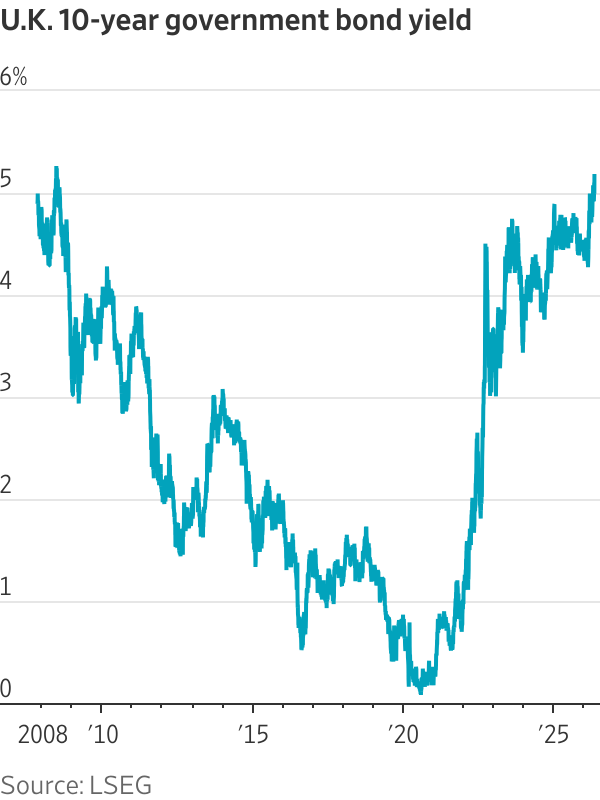
U.K. government borrowing costs climbed Friday to their highest level since the 2008-09 global financial crisis, piling pressure onto already fragile government finances. The British pound and stocks also came under pressure.
The arrival of Burnham, who has in the past said he backs nationalization of utilities and a wealth tax, and who has questioned rules constraining government spending, raises the prospect of British politics again roiling markets. Among investors, that triggers bad memories of when former Conservative Prime Minister Liz Truss sparked a market meltdown with a series of unfunded tax cuts back in 2022, before being quickly shunted from office .
“The risk is that a new, further left, prime minister pursues policies that further add to business costs, eroding profit margins and putting upward pressure on inflation,” says Andrew Wishart, an economist at Berenberg, a bank.
Starmer won in 2024 vowing to bring a period of stability to help boost the economy after an unprecedented run of turnover in the top job, with Starmer becoming the fifth prime minister in seven years. But the political uncertainty of a monthslong leadership race now will throw more sand into the wheels of an economy struggling to grow and facing higher energy and food costs due to the war in Iran.
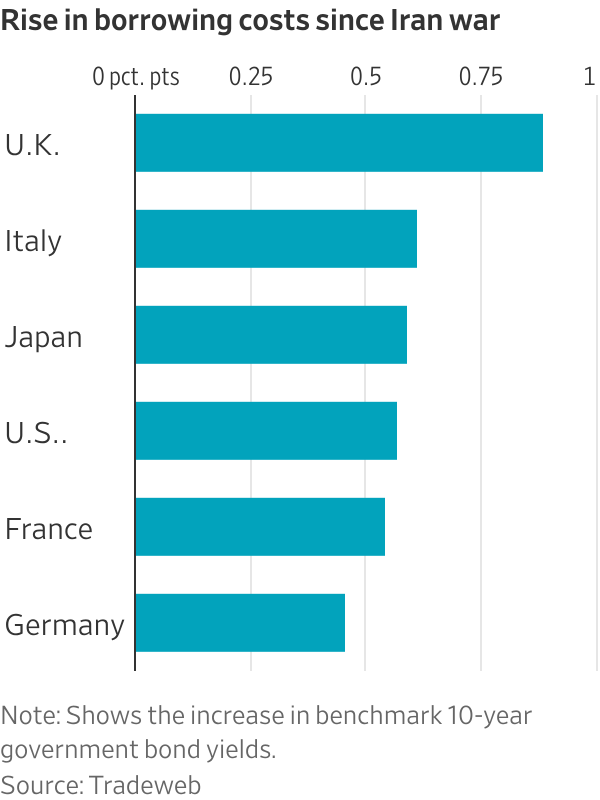
U.K. debt markets have been hit harder than other developed economies in recent months, a reflection of the economy’s outsize economic vulnerability to the war. Other factors, like the Bank of England’s effort to shrink its portfolio by selling bonds and the retreat of some traditional buyers like pension funds, have also fueled volatility, analysts say. U.K. borrowing costs have shot up by almost a full percentage point since the Iran war began, nearly double the rise seen in German bonds and a 0.6-percentage-point rise in U.S. Treasury yields.
“We do now have a history of the Liz Truss moment and…of churn in prime ministers,” said Peter Goves, head of developed market debt sovereign research at MFS Investment Management. “If you’ve got a change in leadership as frequent as every one or two years, it’s hard to discern medium-term economic implications from policy.”
Starmer and his Treasury chief, Rachel Reeves , spent the past two years trying to win back global bond investors after the Truss fiasco by sticking to strict self-imposed budget rules, which investors worry now will come under threat.
Starmer is on the ropes after Labour was crushed at recent local elections and his personal approval ratings sank to 20%. Pollster Ipsos asked Britons who should lead Labour if Starmer resigns, and 17% chose Burnham—more than triple his nearest rival, former Deputy Prime Minister Angela Rayner . Other possible candidates include Wes Streeting , who resigned as health secretary this week to pressure Starmer to stand down.
Burnham has in the past complained that Britain’s fiscal rules—which force the government to try to reduce debt as a percentage of gross domestic product within five years—act as a straitjacket. In past speeches, the 56-year-old has set out a vision for a more active state, including the mass construction of public housing. Recently he has also suggested that borrowing for military spending should be counted outside the government’s fiscal rules.
Analysts say the room for fiscal maneuver in the U.K. is tight. The government’s debt-to-GDP ratio stands at 94%, which while lower than several European peers, has shot up at a much faster rate as the state absorbed the twin shocks of the 2008 financial crisis and Covid-19. This year the U.K. government is expected to spend over 8% of its budget simply paying off the equivalent of about $150 billion in interest charges on its debt, nearly double its defense budget. The recent climb in borrowing costs will add to interest costs.
zjtmath / Shutterstock.com
“If debt levels in the U.K. are already close to 100%, it means that the government needs to continuously borrow,” said Mohit Kumar, chief European economist at Jefferies in London. “So as rates go higher, the interest rate expense of the government is also higher…and that almost becomes a spiral.”
The U.K. doesn’t benefit from the kind of built-in demand for its currency and debt that the U.S. enjoys, with the dollar’s reserve status attracting huge investment from abroad.
Burnham may try to convince markets that he will ensure his plans add up. “They’re aware that there is a sensitivity in the U.K. bond market given the state of public finances,” said Goves. “So it could be the case that Burnham comes out and says, ‘I’m a sensible guy, fiscally, I’m not going to do anything unfunded.’”
To replace Starmer, Burnham must first win a special election sometime this summer in Makerfield, a northern English district in Greater Manchester, to become a lawmaker. While the district has traditionally been a safe Labour seat, he will have to contend with the rise of the anti-immigration Reform UK party, which is leading national polls.
If he wins, he then needs the support of 20% of Labour lawmakers—81 of them by current totals—to trigger a leadership challenge against the prime minister. Starmer could at that point quit, but he could also try to duke it out with Burnham. The Labour Party’s 300,000 members, as well as union members, would choose a winner. The process could drag on for months.