The Alliance Fairfax, a towering black and white car-carrier ship that had been stranded in the Persian Gulf for over two months, was finally making a break for it.
“You are all set to go,” a U.S. military officer radioed as the ship glided through the Strait of Hormuz on Monday and swung around the peninsula at the northern end of Oman. “Safe travels.”
Soon after, Iran launched a barrage of missiles and drones at commercial ships, at the U.S. Navy—and at one of America’s allies, the United Arab Emirates, where an oil transit hub was set ablaze. U.S. helicopters sank Iranian speedboats, and Iranian drones hit a civilian ship.
The intervening hours included the most serious escalation in the conflict since President Trump declared a cease-fire in the war in April.
Then, almost as quickly as it started, Trump directed the U.S. operation to guide ships through the strait to be put on pause. Only two vessels are known to have made it through when the president halted operations Tuesday, roughly 36 hours after the project began. Ship traffic, already a trickle, again ground to a halt.
The short-lived exercise, known as “Project Freedom,” exposed the limits of Trump’s ability to maneuver in the region. Saudi Arabia and Kuwait, spooked by fear of an escalation and as Washington played down Iran’s attacks, withdrew permission for the U.S. military to use bases and airspace critical to the mission, The Wall Street Journal reported Thursday. Phone calls between Trump and Saudi Crown Prince Mohammed bin Salman led to a restoration of permission , according to Saudi and U.S. officials.
Pentagon officials said they could restart the operation as soon as later this week. The White House denied there was ever a restriction or ban on U.S. aircraft.
The mission showed that even small tactical successes can morph into broader strategic challenges, military analysts said. The U.S. military extricated a pair of vessels but triggered an escalation from Iran that reinforced its grip on the world’s most important energy shipping lane.
The origins of the program go back to the early weeks of the U.S.-Israeli bombing campaign, when Trump first suggested that the Navy would escort ships through the strait “when the time comes.”
The U.S. military began quietly laying the groundwork for an operation to roll back Iran’s influence over the strait in April, sending uncrewed sea drones into the area to scan for mines to help eventually establish a new safe shipping lane along the southern edge of the strait, according to defense officials. The U.S. also sent a pair of destroyers into the strait in an initial run in mid-April.
Providing a military shield for civilian ships could increase the pressure on Tehran in the negotiations while rolling back its efforts to institutionalize its grip—including by imposing tolls—on the strait.
The chairman of the Joint Chiefs of Staff, Gen. Dan Caine , and the head of U.S. Central Command, Adm. Brad Cooper , briefed the White House on May 1 on a range of military options, including for how to guide ships through the strait.
Trump announced the impending mission in a social-media post on May 3, framing the operation as a “humanitarian gesture” and an effort to get stranded crews out of the gulf, while warning Iran not to interfere.
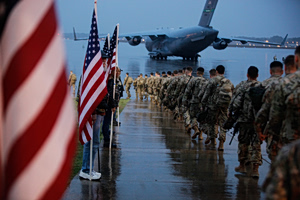
Trump had settled on a defensive mission involving guided-missile destroyers and more than a hundred aircraft to provide cover, according to U.S. officials. Sending more ships would have put more servicemembers at risk while taking away resources from the Navy’s other major mission in the area: a blockade of Iranian ports designed to cut off the Iranian regime from oil revenue.
By contrast, a U.S. operation that escorted ships during the so-called Tanker War with Iran during the 1980s saw the U.S. station warships in a string of “lily pads” across the Persian Gulf, along with patrolling the Strait of Hormuz itself and providing air support.
“They were hoping to get by on the cheap by essentially having these warships go out and show that there was a clear channel,” said Bryan Clark , a former Pentagon official focused on Navy operations and now a senior fellow with the Hudson Institute. “I think it pretty quickly was clear that it was not safe enough.”
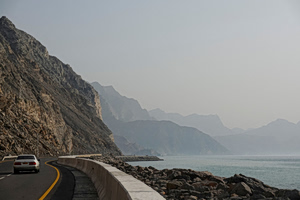
A brief notice was issued to mariners instructing them to use a new safe corridor that hugged close to the coastline of Oman, on the southern side of the strait, effectively splitting the strait into two competing shipping lanes.
Iran in April instructed ships to use a new corridor along its coastline, making a hairpin turn on the northern side of the passage. The normal channel used before the war was now unsafe, the Navy warned, because of mines left by Iran.
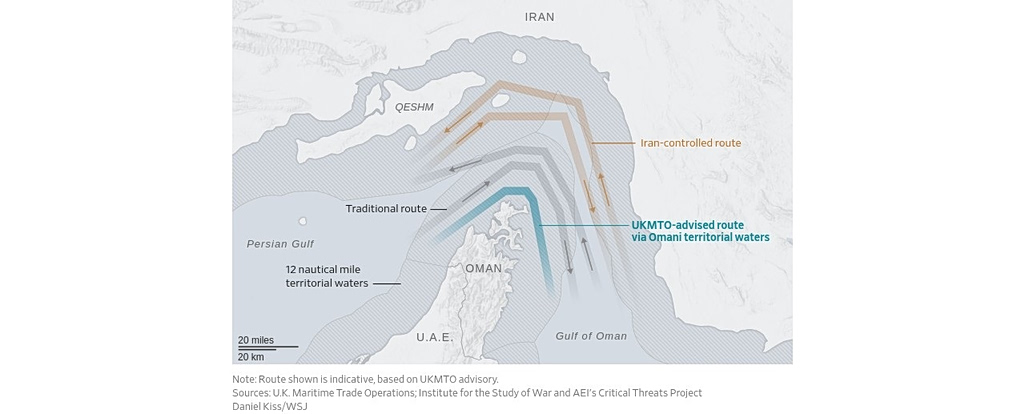
The companies involved in the initial operation were racing for specifics beyond a one-page notice issued by the Navy. Denmark’s A.P. Moller-Maersk was offered a window of several hours to move the Alliance Fairfax, a U.S.-flagged car carrier, according to company officials.
The operation would use the new “enhanced security area” through Omani waters. The lane was about 500-feet wide, just enough for a supertanker to squeeze through. That means that only one ship could get out at a time.
Maersk has a history of moving troops and weapons for the U.S. military dating to the Vietnam War, and Maersk officials said the company felt safe when it was told that its ships were under the protection of U.S. Navy forces.
When the time came, America’s forces radioed the ship, guiding it on its journey.
The U.S. scrambled a large force in the air, including Apache and Sea Hawk helicopters, important tools to counter the threat of Iran’s “mosquito fleet” of small, fast attack boats. In the wider region, the U.S. also used drones and had numerous fighter aircraft and other warships supporting the operation, Adm. Cooper told reporters on Monday.
The plan, military officials and analysts said, was for the destroyers to provide an antimissile umbrella, while U.S. helicopters would protect against Iranian attack boats.
“Hold your course, no turns please. You are not under threat of being attacked,” an officer from a U.S. warship radioed to the Alliance Fairfax, according to recordings reviewed by the Journal. “Aye, we are slow and holding our course,” an officer on the Alliance Fairfax responded.
“Let us know when we can make our way. Can’t wait to get out of here,” the officer said.
It took around three hours for the ferry to clear the strait.
The Iranians then sent a squadron of small attack boats. The transit time across the 20-mile-wide strait gave U.S. helicopters time to respond.
“When the small boats came out, their natural enemy is the helicopter,” said Steven Wills , a former active-duty Navy officer and now a navalist for the Center for Maritime Strategy in Washington.
Though the U.S. launched a successful defense of the ships involved in the initiative, Iran launched a wider retaliation in the gulf that soon threatened to drag the region back into a shooting war.
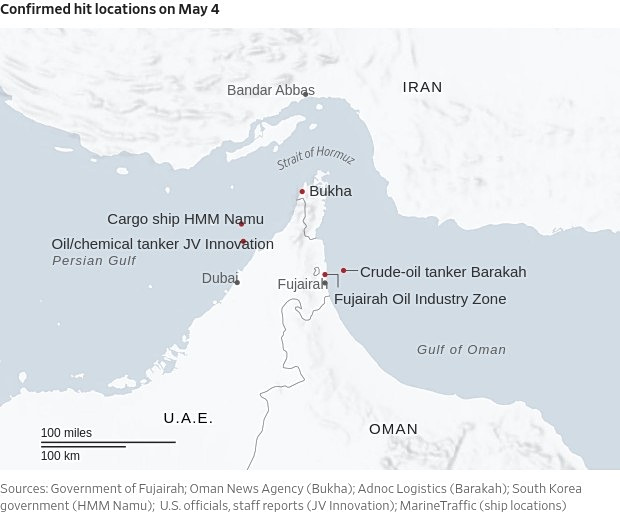
This included ships that weren’t involved in Project Freedom. Around noon, a conversation in Chinese crackled to life over the marine VHF radio. “We are a Chinese vessel. We were struck by a missile at 26°01.1, 55°48.2. The deck is on fire,” according to nearby crew members and a recording reviewed by the Journal.
“Brother, what’s your location? Are you a tanker or cargo?” an unidentified Chinese crew member asked in Chinese over the radio.
Quickly, other seafarers tuned in to the channel figured out that the struck vessel was JV Innovation, a Chinese oil tanker. It was loaded with 38 kilotonnes of petrochemical products from Jubail, Saudi Arabia, according to the financial-data provider LSEG.
“We are still putting out the fire on the deck, but there are no visible flames anymore,” said the captain over the marine VHF radio.
Another ship, the South Korean-owned HMM Namu, was struck by an explosive late Monday. A third ship, a containership called the San Antonio owned by the French company CMA CGM, was attacked a day later, injuring crew and damaging the ship, the company said.
On Tuesday, a second U.S.-flagged vessel, the CS Anthem, a product tanker operated by Crowley Maritime, transited the strait using the U.S. Navy corridor. It would be the last known ship to cross.
Early on the morning of May 6, Trump said on social media that Project Freedom had been paused, citing what he said was progress in the negotiations with Iran and a request from Pakistan, which is mediating talks with Iran.
Write to Jared Malsin at jared.malsin@wsj.com , Costas Paris at costas.paris@wsj.com , Shelby Holliday at shelby.holliday@wsj.com and Rebecca Feng at rebecca.feng@wsj.com