 Μake us preferred on Google
 “I am running for… my friend, my mother, my cousin, my sister, my teacher, my wife, myself; for all of us; for those who are not here with us today.”
Before the race begins, every participant in Greece’s annual Race for the Cure is asked a simple but deeply personal question: “Who are you running for?”
The answers are written by hand on stickers and stuck to the backs of T-shirts. Names of mothers, sisters, friends, wives, and teachers. Names of people still fighting, of those who have survived, and of women who are no longer here to run alongside them.
Every autumn, Athens turns pink as thousands of people take to the streets for the Greece Race for the Cure, transforming what began as a small gathering nearly two decades ago into one of the largest breast cancer awareness events in Europe.
TO BHMA International Edition sits down with Paraskevi Michalopoulou, President of the Board of Directors of the Hellenic Association of Women with Breast Cancer “Alma Zois”, to discuss the power of this celebration of life, love, and sharing.
“The Greece Race for the Cure is far more than a race or a walk. It’s a conscious choice to stand by one another,” says Michalopoulou. “Participation symbolizes strength, solidarity, hope, and the power of togetherness. It’s a way to send a powerful message that no one walks this path alone.”
No one is alone
The Greece Race for the Cure came to life as an initiative of Alma Zois (Leap of Life), an organization made up of women with personal experience of breast cancer.
“They saw the event as much more than a race,” Michalopoulou explains. “They transformed it into a space of awareness, solidarity, memory, and support. They turned a difficult subject into a collective, positive experience.”
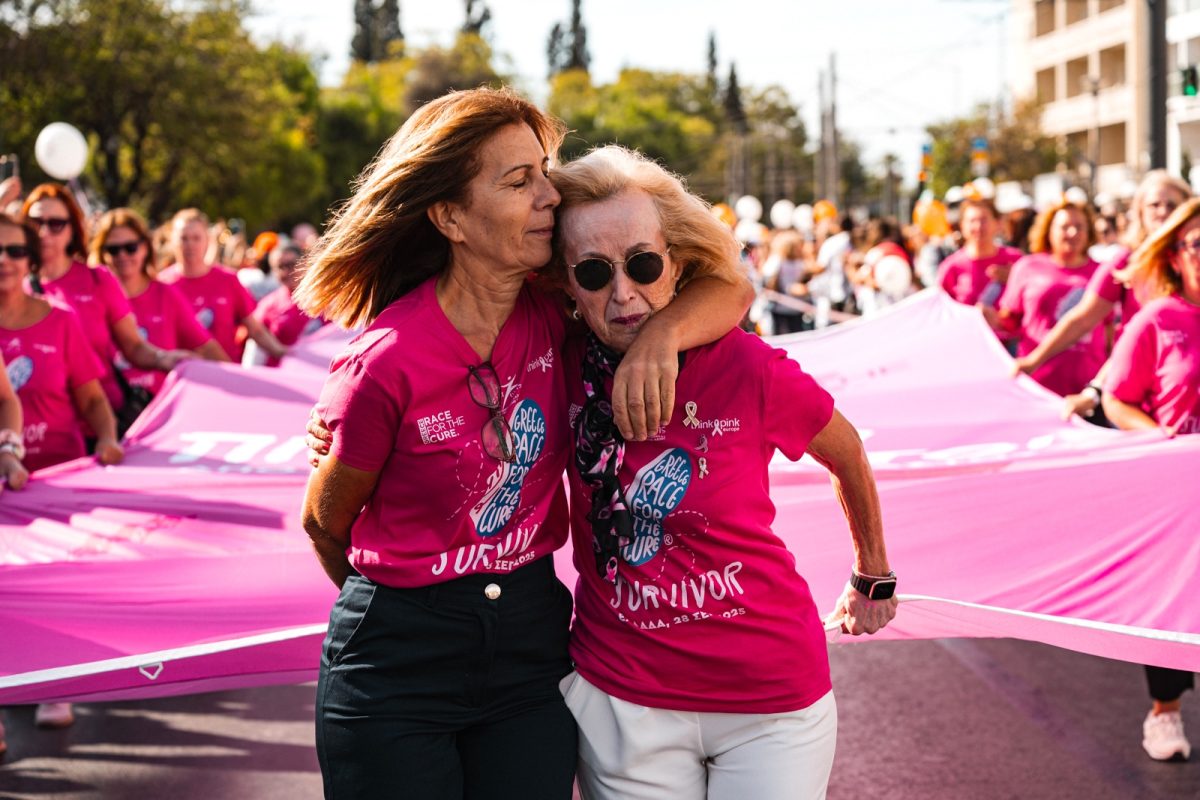
Anyone who has participated understands what she means. There is a tangible contrast between the seriousness of the cause and the atmosphere of the day. Music, movement, laughter and colour. Friends arrive together. Families walk side by side. Survivors in pink T-shirts stand at the starting line. It certainly feels like a celebration. And that, perhaps, is precisely the point.
“Breast cancer is often associated with fear, anxiety, and loss,” Michalopoulou explains. “The Race creates a different kind of symbolism. The presence of women who have battled the disease, their families, and thousands of people makes it clear that illness should not be faced in silence and isolation. Instead, we run and walk together, talk about it, and spread the word.”
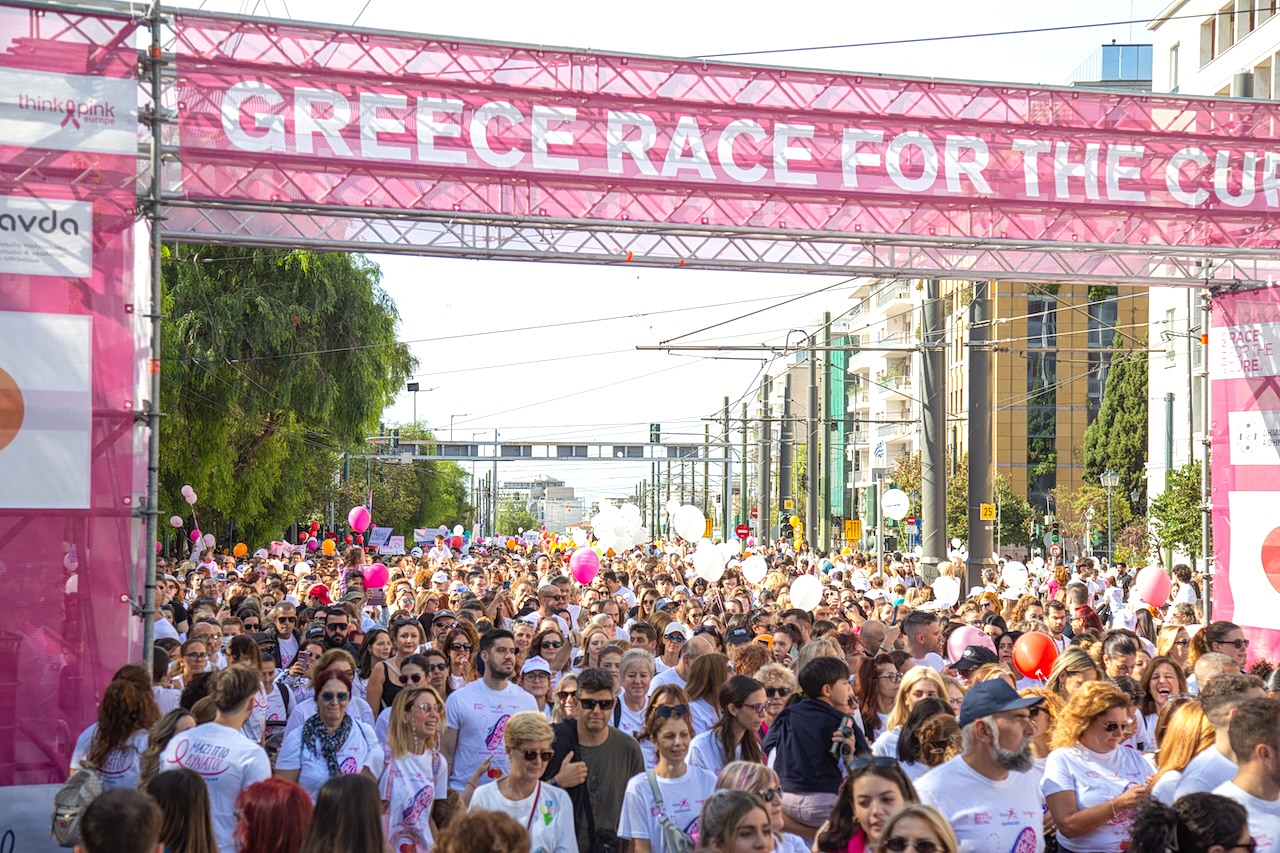
Greece Race for the Cure: for some it is a celebration of survival. For others, a tribute to someone they have lost. And for many, it is simply a reminder that no one should have to face breast cancer alone. RACE FOR THE CURE
The annual event is open to women, men and children of all ages. The message is deliberately inclusive. “Breast cancer is an issue that concerns us all,” Michalopoulou tells TO BHMA International Edition. “Even if we have not personally experienced the disease, it could affect someone we love.”
Since the first time it was run in 2009, by around 5,000 people, the Greece Race for the Cure has grown into a major annual show of solidarity. Now in its 18th year, it is the country’s largest social sporting happening. More than 60,000 people took part in the 2025 edition—a record turnout that placed Greece second among Race for the Cure events in Europe. Across the wider European movement, nearly 300,000 people registered in 2025.
The Greece event includes a 5km run, a 2km walk, and the option to participate virtually from anywhere in the country.
From Dallas to Athens
The story of Race for the Cure began in Dallas, Texas, in 1983. Nancy G. Brinker organized the first race in honor of her sister Susan G. Komen, who had died of breast cancer in 1980 at age 36. The inaugural event was named the Susan G. Komen Race for the Cure. A year earlier, Brinker had set up the Susan G. Komen Breast Cancer Foundation, keeping a promise to her sister to end the suffering, social stigma, and silence surrounding the disease. The first race attracted a few hundred participants, only to grow into a worldwide movement bringing together survivors, patients, families, friends, companies, schools, sports groups, and communities.
In Europe, Race has become the continent’s largest sporting event dedicated to women’s health, combining fundraising with awareness, patient and survivor support, research, education and advocacy.
Changing lives
Beyond raising awareness, the Greece Race for the Cure secures funding through participation fees and donations. These funds are channeled into support programs run by Alma Zois, including awareness initiatives, psychosocial support and empowerment for breast cancer patients, support for caregivers and families, and public education about prevention and early diagnosis, explains Michalopoulou.
The impact continues long after participants cross the finish line. But Michalopoulou is careful not to separate fundraising from the wider social impact of the event.
“Everyone participates in the race for their own personal reason,” she says. “Some come to support a loved one, others to honor the memory of a woman they have lost; some have experienced the disease themselves, while others simply believe that no one should face it alone.”
“All these different paths converge at the same point, creating something far greater than a race: a powerful collective statement that we are here for one another.”
That, she says, is the true power of the Greece Race for the Cure.
Changing the conversation
There is another kind of impact that cannot easily be measured in registration figures or fundraising totals: the power of word of mouth. Thousands of people participate, talk about breast cancer, and bring these discussions home to their families, workplaces, schools, and communities. Prevention and early detection become part of everyday conversation.
For Michalopoulou, this is crucial. A single awareness talk can encourage a woman to seek medical advice and discover an abnormality early. A conversation may lead someone to look for information they would not otherwise have sought. A patient may find the support she needs at a moment of fear or uncertainty.
“Perhaps that is the event’s greatest value: that a single day of participation can generate initiatives and support that continue throughout the year.”
Every participant matters
One of the most powerful sights at the Race is seeing men and children turn out in force. Breast cancer may be predominantly associated with women, but its impact extends far beyond the person diagnosed, Michalopoulou explains.
“It affects families, friends, colleagues, and caregivers; everyone who stands by someone else during a difficult and demanding journey.”
“That is why participation matters even for those without a personal connection to the disease. By showing up, they are effectively saying: I’m here, too.”
Over time, that collective presence helps build a stronger culture of prevention, awareness and care, and a society more willing to speak openly about breast cancer.
“It is crucial that no one feels alone on this journey,” Michalopoulou says. “The burden of a difficult experience can feel a little lighter when shared.”
The work that remains
Nearly two decades after the first Greece Race for the Cure, there has been progress in prevention and early diagnosis. Michalopoulou points to organized screening programs such as the “Fofi Gennimata” initiative, which provides free digital mammograms and follow-up ultrasounds to women aged 45 to 74, as well as the development of certified Breast Centers in seven public hospitals as important steps forward.
But she stresses that access must be equal, regardless of income, awareness or where someone lives.
“Inequalities persist not only regarding participation in screening but throughout the entire patient journey: from the initial discovery, early diagnosis and the start of treatment through to the post-therapy period,” she says.
Psychosocial support, rehabilitation, returning to work, quality of life—all require continued investment. Younger women diagnosed with breast cancer face additional questions surrounding fertility, family, employment and life planning, while women living with metastatic breast cancer face a different, long-term journey requiring continuous specialized support.
Behind all these challenges lies the ultimate goal: reducing breast cancer mortality through prevention, early diagnosis, equitable access to modern treatment, and comprehensive care.
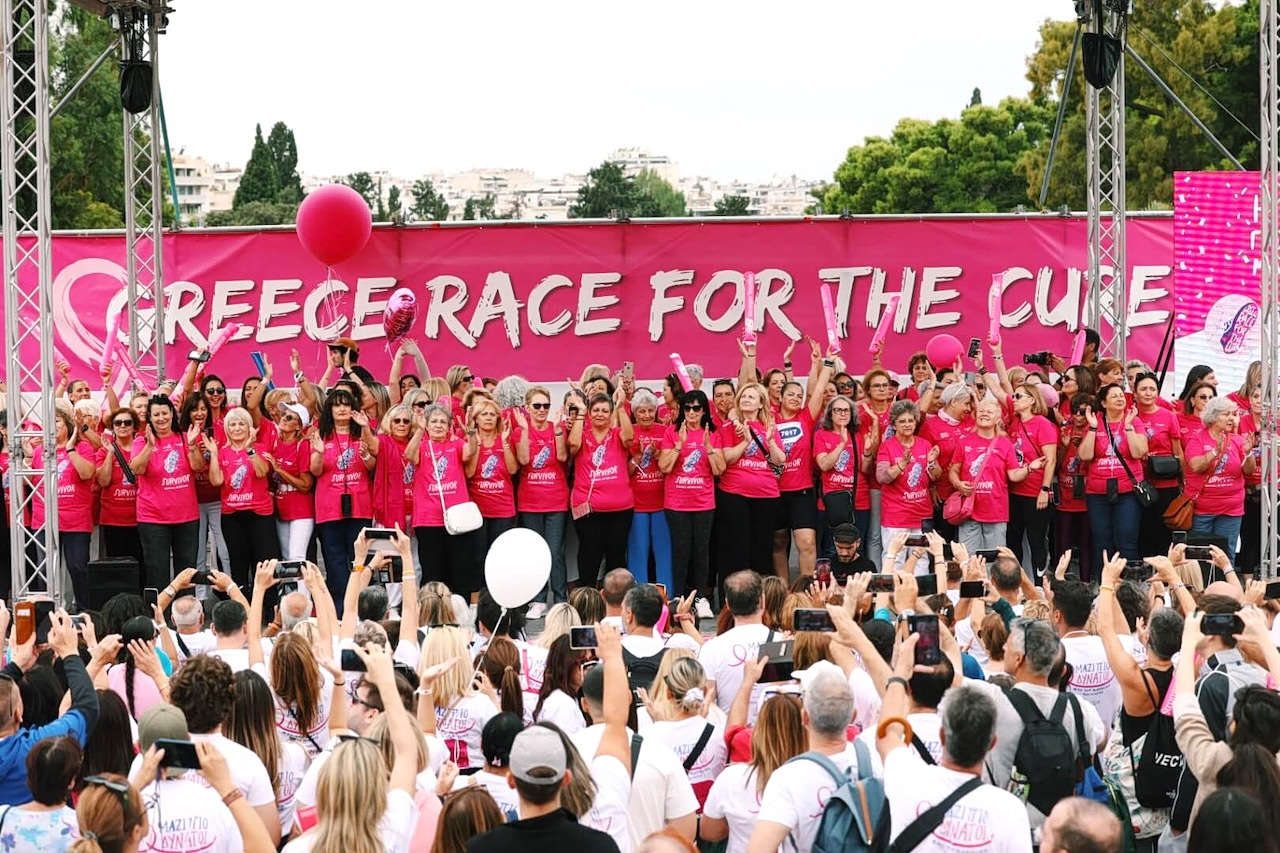
Every year in Athens, the roads turn pink as people of all ages and from all walks of life come together to walk or run, and talk openly about breast cancer. RACE FOR THE CURE
The image that says it all
Michalopoulou has taken part in many Race for the Cure events. Asked which moment has stayed with her most, she does not mention the size of the crowds or the fundraising figures. She remembers the women at the starting line, survivors wearing their pink T-shirts, standing together and holding hands.
“It is a moving, powerful image, and one that’s full of life,” she says. “Seeing them, you feel a strength and receive a silent yet incredibly powerful message: ‘We are here for one another. We are in this together.’”
This image explains better than any statistic what the Greece Race for the Cure is all about. The thousands of participants are real people, families and friends with battles, losses, hopes and fears. Every single sticker on the back of a T-shirt tells a different story. Yet on the streets of Athens, those stories come together to create something far greater.
For the past six years, I have taken part in the Race myself, and the positive energy flowing through the streets is difficult to capture in words. I asked Michalopoulou what she would want those who show up on Sunday to take home with them.
“To feel the strength they have offered fellow human beings who are facing hardship. I want them to feel that their presence and support have a real impact.”
If each of us goes home having taken just one of the Race’s many messages to heart, and then shares it with someone else, its power can endure far beyond that single day. It will live on in the conversations we have, the choices we make, the support we offer and, most importantly, in the hearts of those facing an uphill battle.
You are not alone.
* This year’s Greece Race for the Cure events start on October 3 at the Pedion tou Areos Park. The race takes place on Sunday, October 4. Alter Media Group will be participating. You can also support Alma Zois and Race for the Cure by participating as a volunteer or by making a donation.