 Μake us preferred on Google
 “The return of the exile”
My old friend, what are you looking for?
After years abroad you’ve come back
with images you’ve nourished
under foreign skies
far from your own country.
— George Seferis
Summer has drawn to a close, and most people have returned to their home base and are trying to settle back into their daily routine, as autumn quietly but unmistakably makes its presence felt. For many, this is a season of sweet melancholy, as everyone looks back fondly on beautiful Greek destinations, carefree sun-filled days with friends, family gatherings on some island shore, or late-night celebrations under the enchanting moon of the Greek summer. Once the holidays end, everyone soon falls back into their schedule. But the process of readjusting to the unforgiving daily grind is a far harder transition for diaspora Greeks.
More than just a holiday
Holidays are rarely just about rest, Danai Siamou-Kaarakainen, a clinical psychologist and psychotherapist who lives in Finland and specializes in migration psychology, tells TO BHMA International Edition. Psychologically, they usually represent a temporary escape from the demands of everyday life, inviting us to “pause” our “productive mode” to reconnect with parts of ourselves that don’t get much room during the rest of the year: a sense of carefreeness, connection, communication with ourselves, and a sense of freedom.
For someone living abroad, however, a holiday back in their home country often carries even greater emotional weight, Siamou says. “Returning isn’t simply going somewhere to relax. It means returning to people, smells, language, food, places, and versions of oneself that are tied to one’s own history.”
Expectations when embarking on a holiday usually include rest, having a wonderful time, and recharging our batteries. But for those returning to Greece from abroad, the experience can also involve long journeys, family obligations, friends they need to fit in, people who want to see them, and children who have to adjust, the psychologist explains. “Someone may return to their country of residence feeling they had a wonderful time, while at the same time feeling completely drained. The two don’t necessarily cancel each other out.”
For a diaspora Greek, however, the holiday often carries a deeper expectation: that of reconnection, both with people and with a sense of self.

Danai Siamou-Kaarakainen is a clinical psychologist and psychotherapist.
“When you live abroad, a large part of your daily life requires you to adapt: to another language, another culture, other social codes. When you return to Greece, there can be a sense that you no longer need to explain so much, or that your brain doesn’t have to constantly operate on multiple levels. At the same time, there’s something more symbolic at play: the need to confirm that you still belong. That your relationships are still there, that there’s still a place for you, and that the home you left hasn’t disappeared just because you left,” Siamou says.
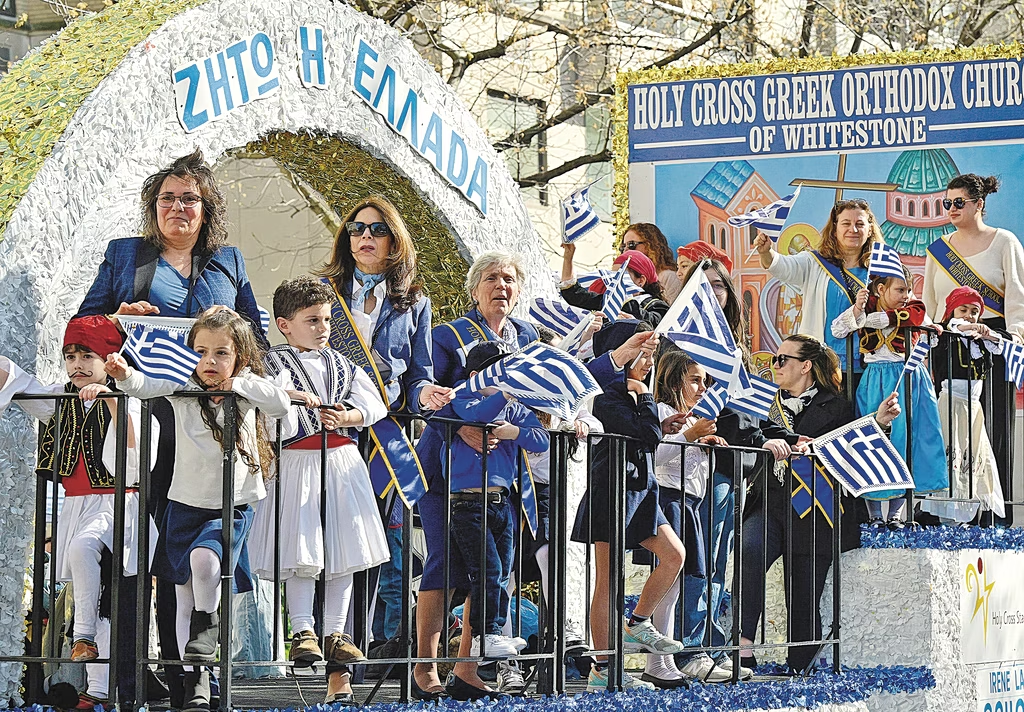
For many people, the village or the neighborhood where they grew up functions as a small anchor of identity—and this becomes even more important once children are involved. This is because, according to Siamou, diaspora parents don’t return only for themselves. “They want their children to meet their grandparents, to know the village, the language, the way of life. They’re essentially trying to build a lived, experiential relationship with a cultural identity that might otherwise exist only through stories.”
The weight of limited time
Though holidays back in Greece can bring moments of great joy and lightness for the diaspora, they also carry an invisible, silent weight: when time is limited, every moment gains extra significance. “You know that a meal with your parents isn’t just a meal, when you’re counting down the few days left before you leave again. Sometimes what I’d call ‘anticipatory grief’ even appears: the visit hasn’t ended yet, but you’re already saddened because you know it will,” the psychologist explains.
Returning to a Greece that has changed
But what happens when someone returns to a Greece that has changed, when they have changed too?
According to Siamou, this is one of the hardest parts of the migration experience, as people tend to hold on to the memory of the past as it was when they left. “But the country carries on without us. Friends change, parents grow older, neighborhoods change—and of course we change too. At some point you may realize that you’re returning to the place you call home, but neither it nor you are quite the same,” she says, stressing that it may create a feeling of ambiguous loss: we miss something that still exists, but no longer in the form we remember it.
Second and third generations: ‘how Greek am I, really?’
Siamou also explains that second- and third-generation Greeks experience these returns differently, because their relationship with Greece has been shaped differently. For a first-generation person, Greece may be the place of their childhood and previous life. For a second- or third-generation child, it may be more a place of family and cultural identity, or even the place their parents feel nostalgic for.
So the question can arise: “How Greek am I, really?” In their country abroad they may be seen as Greek, yet when they come to Greece they may be treated as foreigners. This in-between position can be very rich culturally, but also complex, or even lonely, in terms of our sense of belonging. This is why experiencing local festivals (panigyria), family gatherings, and customs is extremely important for second- and third-generation Greeks—because identity isn’t transmitted only through words, it’s transmitted experientially, the psychologist emphasizes.
“Watching this through my own child, a panigyri, a summer evening in the village square, grandma cooking, cousins playing together, all of this creates connective memories. Especially for diaspora children, these experiences can change Greece from something that isn’t really theirs, that their parents tell them they belong to, into something they’ve actually lived,” she says.
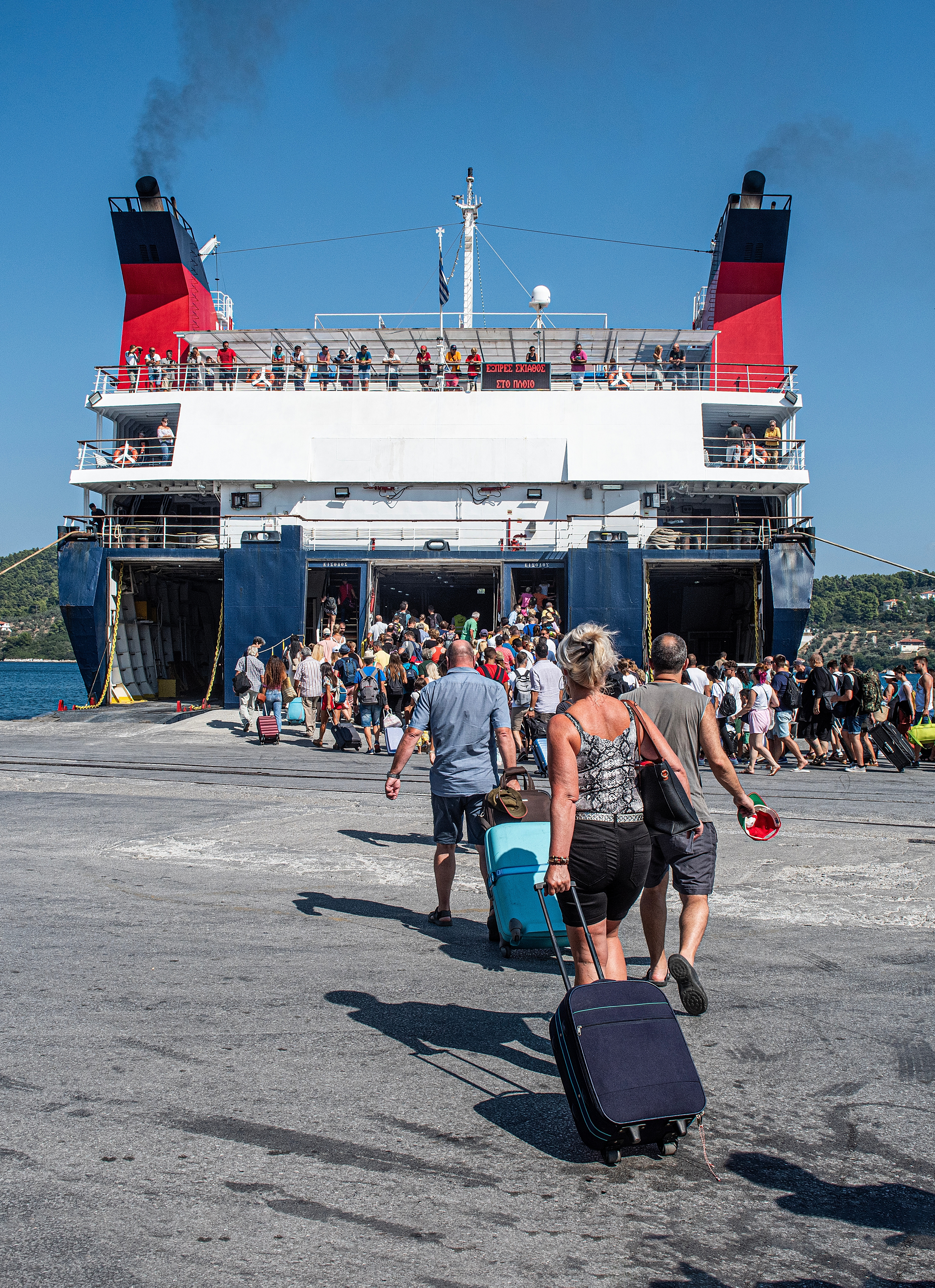
Travelers boarding a ferry at a harbor on Skiathos, Greece.
The difficult goodbye
When the time comes to depart, a complex mix of feelings—sadness, guilt, nostalgia, anxiety, but also sometimes relief—dominates. “Something I’ve noticed strongly in sessions after the holidays is a sense of imbalance: it can take days, even weeks, to readjust to your old routine and to the different rules of your country of residence,” Siamou says.
For many people, she continues, reintegration into daily life can be difficult because the transition is abrupt. One day you might be at a large family table, and two days later you’re alone again in your home in another country. The language around you changes, the weather, the sounds, the everyday social rhythm. The nervous system needs time to catch up with that transition. And of course there’s the separation itself. Especially as parents get older, the goodbye can carry a very different weight.
People living abroad tend to experience the so-called “post-holiday blues” more intensely than others, without this necessarily indicating any psychological disorder. According to Siamou, it’s natural that after a period of intense connection and a different pace of life, readjustment simply takes time. “For diaspora people, there can be an added dimension: it’s not just the holiday ending, it’s that a small separation has happened all over again. That’s why many of us grieve not only the summer, but also the closeness we had for a little while which we are now losing again.”
Learning to live with contradictions
Finally, Siamou advises Greeks living abroad to let go of the expectation that everything will go perfectly during their holidays in Greece, and above all, of the idea that they must fit everyone and everything into the limited time available to them. “I think the most important thing is to allow ourselves to experience contradictory feelings without constantly trying to resolve them. I can feel happy to be back and tired at the same time. I can love Greece and not want to live here. I can love my life abroad and still cry when I leave.
“There is room in the migration experience for multiple ‘ands’ in places where we often try to force a single ‘or’.”
Summing up in one phrase what the Greek summer represents for a member of the diaspora, Siamou cites the poem “The Return of the Exile” by George Seferis, in which the Greek Nobel laureate speaks about an old friend who has come back after years away, bringing images with him that were formed under foreign skies, far from his homeland.
“For me, those lines capture exactly the Greek summer for a diaspora person, because they speak precisely to the paradox of returning and discovering that neither the place is quite the same anymore, nor are you the same person.”