In the early hours of Jan. 3, energy magnate Harry Sargeant III was in bed at his waterfront Florida mansion, struggling to fall to sleep. He had uncharacteristically forgotten to turn his phone off, and was startled when text messages and news reports began flooding in of a surprise U.S. military raid in Venezuela.
Following the action in real time, the 68-year-old former Top Gun pilot—and sometime golfing partner of Donald Trump’s—alternated between feeling hopeful and fearful. As perhaps the only U.S. businessman who could shuttle between Mar-a-Lago and the Miraflores presidential palace in Caracas, few Americans had worked harder and longer than Sargeant to pry open the Venezuela market.
And with stakes in companies that could potentially produce hundreds of thousands of barrels of crude a day, as well refurbish the country’s largest refinery, arguably no one had more at stake financially than Sargeant.
Sargeant was close enough to Nicolás Maduro that the strongman called him abuelo, Spanish for grandfather. But Sargeant of late had been pushing Trump officials to act decisively, even if that meant removing Maduro from power.
“Work with the guy or don’t. But take a decision that lets Americans get back down there and get to work so the Chinese don’t have the place to themselves,” Sargeant says he told Trump officials.
When the dust settled, Maduro was ousted, swept away to New York to face narcoterrorism charges. But the rest of the regime that had ruled the country for more than two decades with an iron fist remained intact , and Trump has pledged to kick-start the country’s oil production to fix an economy whose epic decline over the last decade had stoked record migration.
Sargeant is now in position to be the latest of the president’s allies to reap a windfall based on his second-term policies and actions. He is also deeply unpopular within the Venezuelan political opposition, much of which considers him an apologist for the oppressive regime. Thor Halvorssen, a Venezuelan activist, called Sargeant “the American supervillain in Venezuela’s regime story” who gives priority to his personal profit above all else.
Trump is pressing U.S. firms to move in fast as his aides work to loosen the sanctions restrictions that were imposed on Venezuela during his first administration.
Many U.S. companies are nonetheless proceeding cautiously, wary of investing huge sums until the country’s politics are stabilized and a legal framework is in place for foreign companies. During a Jan. 9 White House meeting, Exxon CEO Darren Woods called the country “uninvestable” until those conditions are met.
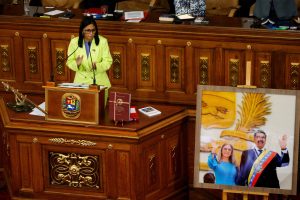
Sargeant, though, isn’t waiting. He met in person last week in Caracas with Maduro’s longtime deputy and economic manager Delcy Rodriguez , to discuss plans to get his businesses up and running.
“This is the greatest investment opportunity since the collapse of the Soviet Union,” Sargeant said in an interview from his mansion in Gulf Stream, an exclusive neighborhood on Florida’s east coast known for its Vanderbilt-family estates . “This is what I’ve been after all along.”
Sargeant is a complicated and at times controversial figure to emerge as the standard-bearer for U.S. business in Venezuela. He previously was accused of overbilling the U.S. military in Iraq. Sargeant denied the allegations and in 2018, a Defense Department report cleared him and awarded his company a $40 million payment for its work.
Mohammed Al-Saleh, a brother-in-law of Jordan’s king, separately obtained a $28.8 million judgment against Sargeant for allegedly being cut out of the Iraq contract. As part of ensuing litigation over the award, Sargeant accused his brother, Daniel, of engaging in a conspiracy against him that involved the use of information from a private email account that included videos and photographs of “intimate activity and private consensual relations” involving Sargeant, according to court filings.
Sargeant had been involved in a lengthy legal dispute with members of his family, including his father and brothers, over control of various parts of the family’s shipping and energy empire. That business, Sargeant Marine, in 2020 agreed to pay a criminal fine of $16.6 million to settle federal charges that it paid bribes to foreign officials in three South American countries, including Venezuela, between 2010 and 2018. Sargeant said he hasn’t had involvement in the company’s operations since 2011. The family lawsuits were settled in 2015.
Sargeant also for a time helped bankroll Rudy Giuliani associate Lev Parnas , who was involved with peddling the Biden-Ukraine conspiracy and was later convicted of illegal donations to Trump’s 2020 presidential campaign.
Sargeant once served as finance chairman of the Florida GOP and has been a regular political donor over the years, primarily to Republicans. Last year he contributed $200,000 to support Florida gubernatorial candidate Byron Donalds, currently a Republican House member. Ahead of the 2020 presidential election Sargeant’s wife donated $285,000 to a committee backing Trump.
Despite his ties to Trump, even Sargeant says he doesn’t fully know what to expect in Venezuela going forward, in part because at times he has clashed with factions in the White House.
Sargeant has discussed with administration officials, including Energy Secretary Chris Wright and Interior Secretary Doug Burgum, his concerns that the U.S. isn’t moving fast enough to let American producers move back into the country.
Wright said in a late January interview that he has heard those concerns from a number of oilmen.
“I got three of those texts today,” he said. Wright, who is leading a delegation of American oil executives to Venezuela this week, said the administration is working on the issue “seven days a week.”
If all goes to plan, the windfall promises to be massive for Sargeant, who is eyeing a host of prospects across Venezuela’s oil and gas sector.
Sargeant’s visit to Caracas last week—his first in several months—was aimed at restarting shipments of asphalt, which he has been exporting from the country for decades through Global Oil Management Group, the resources conglomerate he founded and where he serves as chairman.
Through side investments he also has a minority stake in North American Blue Energy Partners, a company that has the rights to at least four oil fields that are aiming to more than double production in the coming years to nearly 400,000 barrels of crude a day. He has another stake in a company that is helping Venezuela refurbish its largest refinery, Amuay, which was the site of an explosion in 2012 that killed more than 40 people and had become a symbol of neglect and mismanagement of a once-prestigious oil industry.
And Sargeant is looking into a project to capture and package natural gas from crude pumping facilities in eastern Venezuela that could be used for national power generation while reducing carbon emissions. For years, the government had burned that gas off into the sky because it lacked the money and technology to use it.
“Harry stands to do very well but he’s certainly earned it by never giving up,” said former Florida Gov. Charlie Crist, who was a fraternity brother of Sargeant’s at Florida State University. Crist stressed that opening up Venezuela will help Americans with more resources, pointing to gasoline prices. “A lot of us are going to benefit from his hard work and tenacity.”
But Sargeant says he’s not popping the Champagne yet. While he sees Rodriguez as a savvy and pragmatic technocrat who is interested in making the changes to attract overseas investors, there remains a complex web of U.S. sanctions that need to be unwound for companies to return. Rodriguez and many of her aides are blacklisted by the U.S. Treasury and Washington still deems the government in Caracas to be illegitimate.
Political analysts are cautious over Rodriguez’s ability to keep the various factions of her ruling regime satisfied and united. Much of it depends on how long her tenuous detente lasts with the U.S., which is tightly controlling her government’s oil revenues, and whether she can tame the expectations of a Venezuelan population clamoring for a return to democracy.
Sargeant has navigated cycles of political instability in Venezuela, where he began working shortly after leaving the U.S. Marine Corps in the late 1980s, hunting for sources of asphalt for his late father’s shipping business. By 2004, he had a falling-out with the government led by the late socialist firebrand Hugo Chávez, whose oil czar, Sargeant said, tried shaking him down for a bribe.
Sargeant said he refused to pay. For almost 10 years, he said he was blacklisted by Chavez’s oil managers, who barred him from directly buying supplies from state energy monopoly PdVSA, forcing him to work through government-allied intermediaries to acquire asphalt.
Over the years, he’s seen the country transition from a democratic, but crime-ridden society to an authoritarian state under Maduro where human rights abuses are rampant but once-soaring murder and kidnapping rates have plummeted.
These days, he can walk to coffee shops and McDonalds from the swanky, $500-a-night hotel he usually stays at, Cayena, in Caracas’ La Castellana neighborhood, a popular haunt for businessmen and diplomats.
Sargeant over the years strove to convince U.S. policymakers that the best way to ensure energy security, stem the outflow of migrants and curb China was by working with Venezuelan authorities. His message to successive U.S. governments: Maduro’s a crook, not a national security threat.
After Trump won office in 2016, Sargeant began rekindling his relationship with Venezuela. At the time, he had been shopping for crude suppliers for a refinery he was planning to construct in Perth Amboy in his home state of New Jersey. Maduro, meanwhile, was struggling to keep the national economy from falling apart amid an exodus of foreign investors.
Sargeant held meetings with General Manuel Quevedo, a military honcho who Maduro had put in charge of his fledgling oil industry. When Maduro learned that a gringo was engaging with his energy minister, he called Sargeant into the Miraflores presidential palace. Sargeant said he rarely made plans to see Maduro during his business trips, but the Venezuelan leader would ask him to stay an extra day to talk.
The two hit it off. They talked about American politics, which Maduro had a deep interest in. Sargeant explained to the Venezuelan leader the corruption and inefficiencies that kept the industry from growing. Both blamed much of the problems on Chavez’s former oil czar, Rafael Ramirez, who Maduro had pushed out of government and into exile in Europe.
Maduro later approved the rights to two oil fields for Sargeant under a new model whereby the leftist government began granting private companies greater operational and financial control of projects. But the American’s plans were upended in 2019 when the Trump administration began a pressure campaign to oust Maduro. Punishing economic sanctions banned Sargeant and all other Americans from doing business in Venezuela.
After Biden won the presidency, Sargeant tried to encourage rapprochement between the new administration and Maduro, with mixed results.
Sargeant served as a go-between for the two governments, conveying messages as well as shopping for business opportunities. In early 2024, he took several American oil executives down to Caracas to explore investments.
Throughout, Sargeant argued that Maduro was the man to work with, even after he was accused of rigging the July 2024 election. With Maduro controlling the armed forces and all the levers of powers, Venezuela’s opposition forces led by Maria Corina Machado, as Sargeant saw it, would struggle to govern the country. Hasty regime change could lead to a messy transition, he warned.
After Venezuela’s contested election, hopes that team Biden could thaw relations with Caracas faded, and the U.S. reapplied economic sanctions. Maduro stopped accepting Venezuelan deportees from the U.S. and started arresting American citizens to gain leverage with Washington.
Around the same time, Sargeant and other businessmen, including major debt investors, turned their attention to Richard Grenell, the Trump confidant who was rumored to be on the shortlist for Secretary of State if Trump won the 2024 election.
Unlike hawkish Secretary of State Marco Rubio, Grenell had no personal ties to Latin America or long-held grudges against the leftist authoritarians in the region. He had publicly signaled he was open to a diplomatic solution.
Sargeant was among businessmen pushing for a deal that would include Maduro accepting deportees and paving the way for U.S. energy companies to flock back to Venezuela. Sargeant sought to display the perks of reopening Venezuela.
In November 2024, after Trump’s electoral victory, a shipment of Venezuelan asphalt sourced by Sargeant’s Global Oil Terminals landed at the Port of Palm Beach, just a few miles from Trump’s Florida residence. It was the first asphalt delivery from Venezuela to the port since Trump’s first administration imposed oil sanctions in early 2019.
After Trump began his second term, Sargeant brokered a meeting in Caracas between Maduro and Grenell. It ended with Maduro freeing several Americans from Venezuelan detention and sending them back home with Grenell as a goodwill gesture.
Sargeant’s backing of Maduro earned him enemies in the South Florida Latin community. Weeks after the prisoner release, a Venezuelan opposition activist group took out an ad in Politico that slammed Sargeant and Chevron, the largest U.S. company working in Venezuela, as facilitators for a brutal dictatorship.
While Grenell’s diplomatic efforts continued for the first few months of Trump’s administration, Sargeant saw his luck wither as Rubio took control of Venezuela policy.
In the spring, the Trump administration scrapped the licenses that Sargeant and several other American companies had received under Biden that gave them an exemption from U.S. sanctions to work in Venezuela. The Trump administration later reinstated Chevron’s licenses.
By August, Sargeant was keeping his distance from Caracas as Trump officials moved on a massive military buildup in the Caribbean, partly aimed at containing drug flows out of Venezuela that the U.S. alleged helped finance the Maduro regime. He was also losing patience with a policy that seemed constantly in flux and expressed frustration to colleagues over the U.S.’s insistence that Venezuela was a major drug hub.
Sargeant’s influence with the Trump administration remains unclear. He wasn’t invited to the White House meeting between Trump and top American oil executives, and a person familiar with the matter said Sargeant doesn’t have significant sway with the administration regarding its Venezuela policies. Some in the White House viewed Sargeant’s work with Grenell to appease Maduro as counterproductive, believing it might have delayed efforts to remove him.
Still, Sargent says Trump’s latest policy shifts present “a defining moment where we have energy security not just for America, but for the whole hemisphere.”
By fixing the economy first, Sargeant notes, Venezuela has a chance to calm a political stalemate that has left both the ruling Socialist Party and its foes entrenched for years.
Sargeant says he’s not sure how much his lobbying efforts influenced Trump’s turn on Venezuela. “I’d be naive to say I didn’t move the meter,” he said. “I don’t think I was the determining factor in this, but it helped move the meter.”
But he said he’s encouraged by the new U.S. policy.
“Let’s get back to work.”
Write to Scott Patterson at scott.patterson@wsj.com , Kejal Vyas at kejal.vyas@wsj.com and Alex Leary at alex.leary@wsj.com