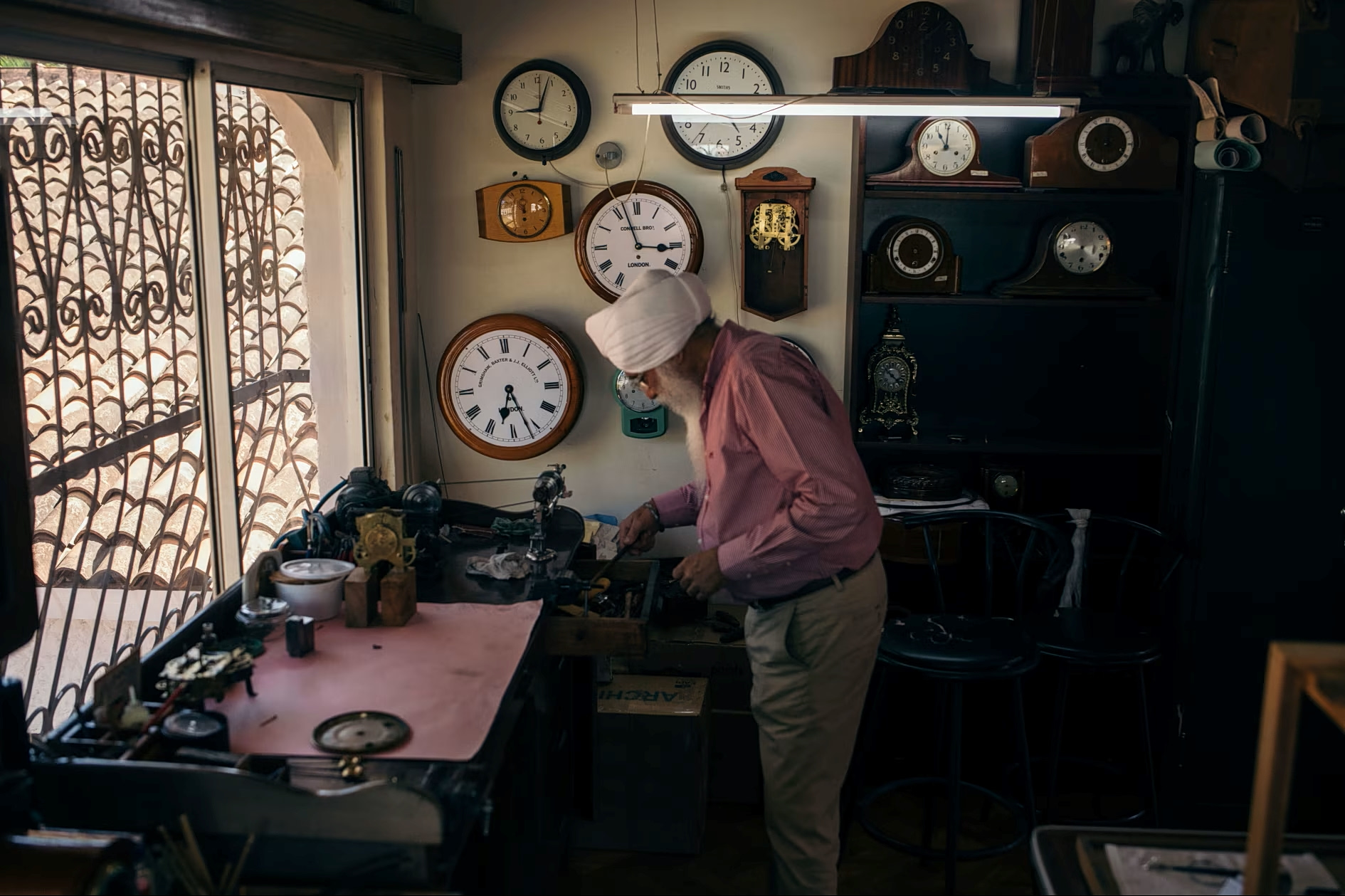
NAIROBI, Kenya—Ravinder Singh’s great-great-grandfather Ram Singh was a watchmaker. So too his great-grandfather, grandfather and father—watchmakers all.
Up a spiral staircase in his Nairobi workshop, surrounded by springs and stems, minute hands and hour chimes, Ravinder maintains a family tradition that spans two anti-colonial uprisings, three continents and five generations.
Now 74, with a white beard and whiter turban, Ravinder is facing the possibility that he might be the last in that line. His sons, grown up with sons of their own, don’t have time to repair clocks and watches. “They have busy lives,” he says.
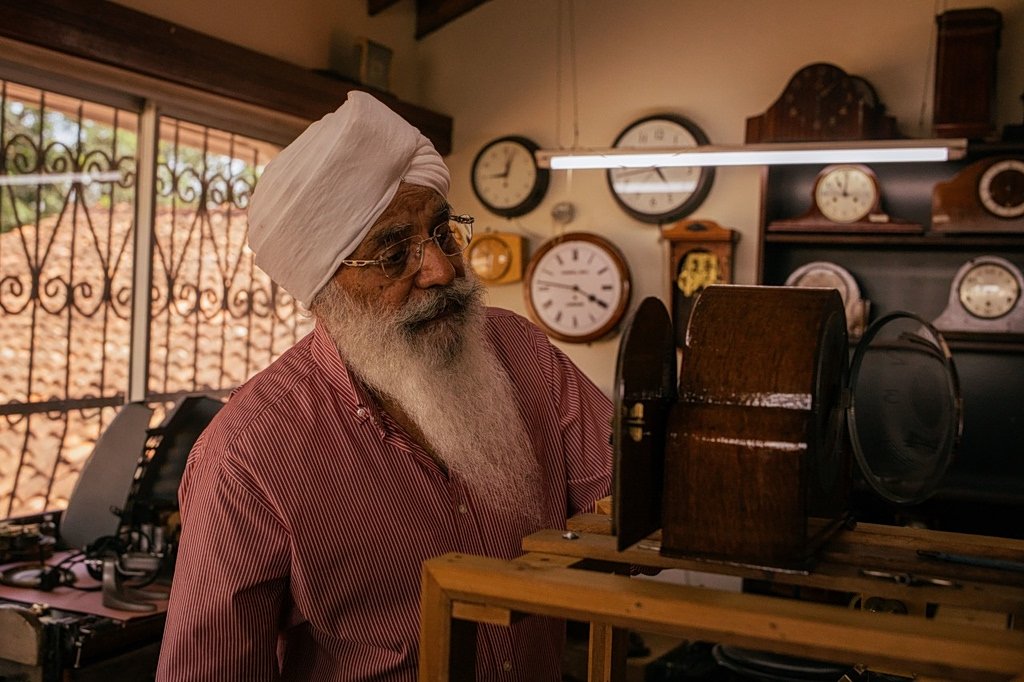
Ravinder learned watchmaking from his father, Vasdev.
Photography by Kang-Chun Cheng for WSJ
That leaves Ravinder, who makes a living from his construction company, spending weekends sequestered in his workshop. It is painstaking, dismantling delicate gear assemblies, then searching hundreds of century-old envelopes for the tiny parts that will bring them back to life.
Each spring, winder, chime and tool is a piece of Swiss perfection purchased by his father, Vasdev Singh, the first in the family to move from India to East Africa.
The family history is enmeshed with the British Empire. The Singhs sold clocks and watches to the colonials while secretly rebelling against British rule.
In the first part of the 1800s, Ram Singh, Ravinder’s great-great-grandfather, farmed wheat and rice outside of Lahore, now in Pakistan but then part of British India. He took up watchmaking as a hobby but advised Nehal, his son, that it would make a good business.
Nehal opened a watch shop in Lahore, and his son, Jewan, followed suit.
In 1922, Jewan Singh & Sons was appointed watchmaker to the governor of the Punjab, His Excellency Sir Edward Maclagan, knight commander of the Most Exalted Order of the Star of India.
But Jewan concealed an anti-colonial streak and Sikh activists gathered to talk rebellion at a retreat he built on the Ravi River, which zigzags across what is now the restive border between Pakistan and India.
Jewan’s son, Vasdev, was born in 1900. He caught independence fever and, at the age of 13, stole off to Tehran to acquire weapons he imagined would spark an uprising against the British. “I’m here to buy arms,” Vasdev told an older Sikh gentleman who noticed him at the train station on arrival, according to family lore.
The older man boxed his ears and dispatched him back to the family in Lahore, the legend goes.
Jewan was worried enough about his son’s impulsive politics, however, to ship Vasdev to East Africa in 1914 with an uncle, Bishan Singh, also a watchmaker, who was headed that way.
Waves of Indians migrated to East Africa around that time, as teachers, clerks, merchants and indentured workers. Between 1896 and 1901 alone, 32,000 Indian laborers were brought to Britain’s East African Protectorate to build a rail line connecting the port of Mombasa to Uganda, according to an official history published by the East African Railways and Harbours Corporation in 1949.
Vasdev had already studied watchmaking under his father, but he taught himself to read and write.
In Nairobi, the boy was permitted to carry his uncle’s toolbox—though it was years before he was allowed to use the tools.
Eventually Vasdev opened his own watch and jewelry store in downtown Nairobi, a one-story building on Government Road with a stone-and-glass facade and corrugated-metal roof. Crowds lined the street in front of the store when Britain’s Princess Margaret, Queen Elizabeth II’s sister, visited in 1956.
The shop, a Rolex dealer, was popular with white colonials. Vasdev’s politics ranged far left, however, and his customers were unaware that while he fixed their timepieces, he also secretly financed Mau Mau insurgents who fought the British in a bloody conflict in the 1950s .
He funded trade unionist Makhan Singh’s printing press, which churned out pro-independence leaflets. Makhan spent 11 years behind bars for his activism. Jomo Kenyatta, the first president of postcolonial Kenya, and other independence leaders gathered at Vasdev’s shop to map out strategy.
A senior Sikh policeman, putatively working for the colonial government, protected Vasdev from arrest. “We were all related,” says Ravinder. Many Sikh men traditionally bear the surname Singh, or lion in Punjabi, while by tradition Sikh women are Kaurs, princesses.
Vasdev had two wives, Harbans Kaur, known as Big Mother, and Satwant Kaur, Small Mother. The family was such a cohesive unit that Ravinder was 10 before he learned which one was his biological mother. It was Small Mother.
After independence in 1963, Vasdev grew disillusioned with Kenyatta, who proved far less socialist than Vasdev had hoped. Five years after independence, Vasdev closed up shop and emigrated to London.
“He couldn’t take the nonsense,” recalls Ravinder, who had learned watchmaking at his father’s knee after school in Nairobi.
When Ravinder was 24, Small Mother decided it was time for him to marry.
She picked Gita Kaur, whose grandmother had kept Gita virtually cloistered in the family house in Nairobi until she was 19. Gita’s family sent her photo to Ravinder’s family.
Ravinder wasn’t impressed.
So her aunt and uncle tried to salvage the matchmaking with a chaperoned Chinese dinner. Gita had never been to a restaurant and was too shy to look Ravinder in the eye. She spilled Coke on her sari and figured her clumsiness would doom the engagement.
The next morning, though, Small Mother sat at Ravinder’s bedside and declared the match final. “It is a very good family,” he recalls her saying. His elder brother pressed Gita’s case, too, while Ravinder, in a panic, pleaded for time to think.
Next year, Ravinder and Gita will have been married for half a century, the trepidations of youth dispelled by time.
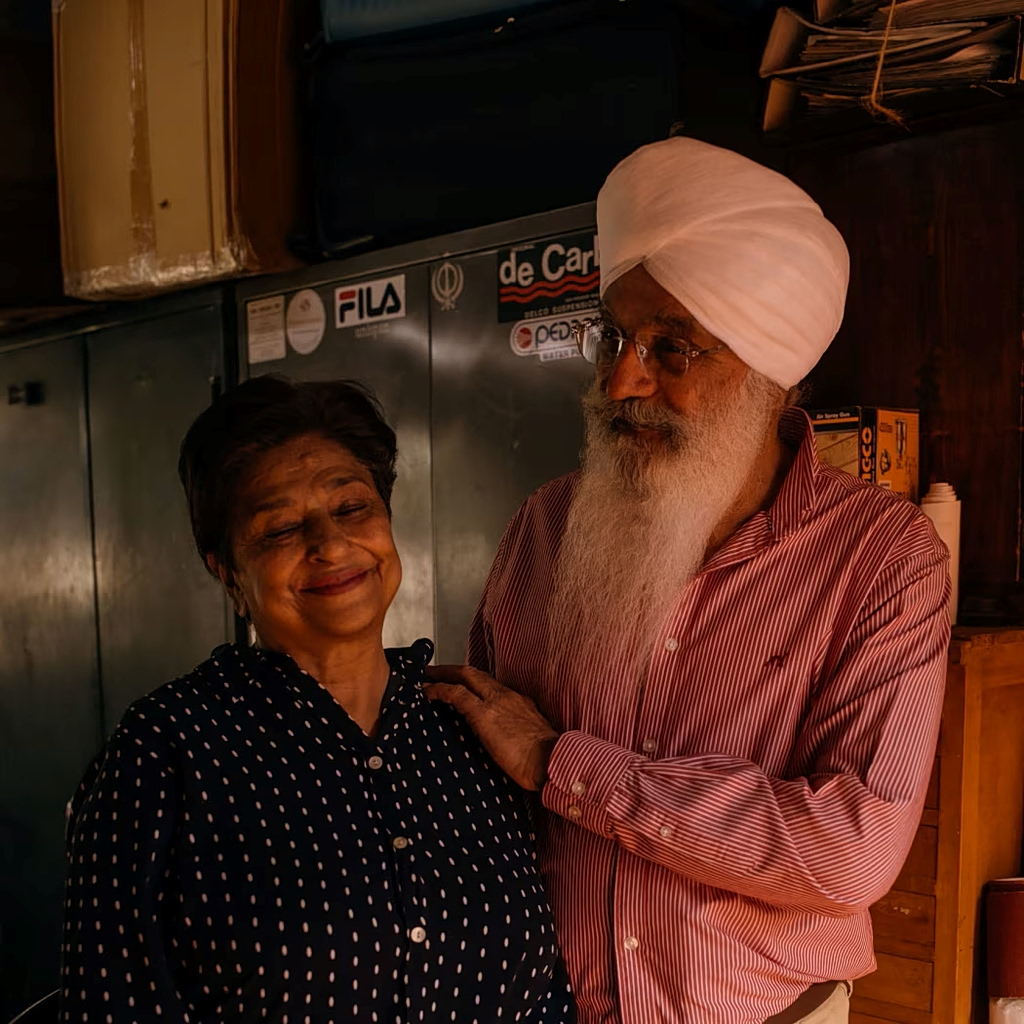
Ravinder with his wife, Gita. Photography by Kang-Chun Cheng for WSJ
And what does Gita, 68, think of her husband’s watchmaking hobby? “It calms him down,” she says. “I know he’s upstairs when I need him.”
Ravinder usually works on his timepieces alone, the only sound the tapping of an elegant hammer and the metronomic ticking of clocks.
“It keeps me occupied,” he says. “I won’t grow old.”
But he is growing old, and wonders what will become of the line of Singh watchmakers once he’s gone.
His best hope is his 18-year-old grandson, Harnek Singh. He started hanging around his grandfather’s workshop when he was 7 or 8, and already has five watches in his collection. He plans to study mechanical engineering and says it would be a “dream opportunity” to work for Rolex or Patek Philippe.
Ravinder remains hopeful that one of his children or grandchildren will carry on the family tradition.
“After all,” he says, looking around his cluttered workshop, “what are they going to do with all this stuff?”
Write to Michael M. Phillips at Michael.Phillips@wsj.com