 Μake us preferred on Google
 President Trump has ordered the withdrawal of 5,000 U.S. troops from Germany, escalating his clash with Berlin and NATO allies over their reluctance to support the war in Iran, officials said Friday.
The Pentagon has previously said that its longer-term goal is to have Europe take the lead on its own conventional defense and to gradually reduce the American military presence on the continent.
But the timing of the administration’s announcement took European nations and even some U.S. military officials by surprise, according to people familiar with some of the planning.
It came days after German Chancellor Friedrich Merz criticized Trump’s handling of the war in Iran, saying that Iran’s leadership was “humiliating” the U.S. and that he didn’t see a U.S. exit strategy. A senior U.S. defense official said the comments were inappropriate and unhelpful, and that Trump “is rightly reacting to these counterproductive remarks.”
The announcement also comes as the U.S. seeks to build an international coalition to reopen the Strait of Hormuz. Trump has previously called on European countries to do more to facilitate the movement of ships through the narrow waterway, which Iran has blocked since the start of the war with attacks and demands.
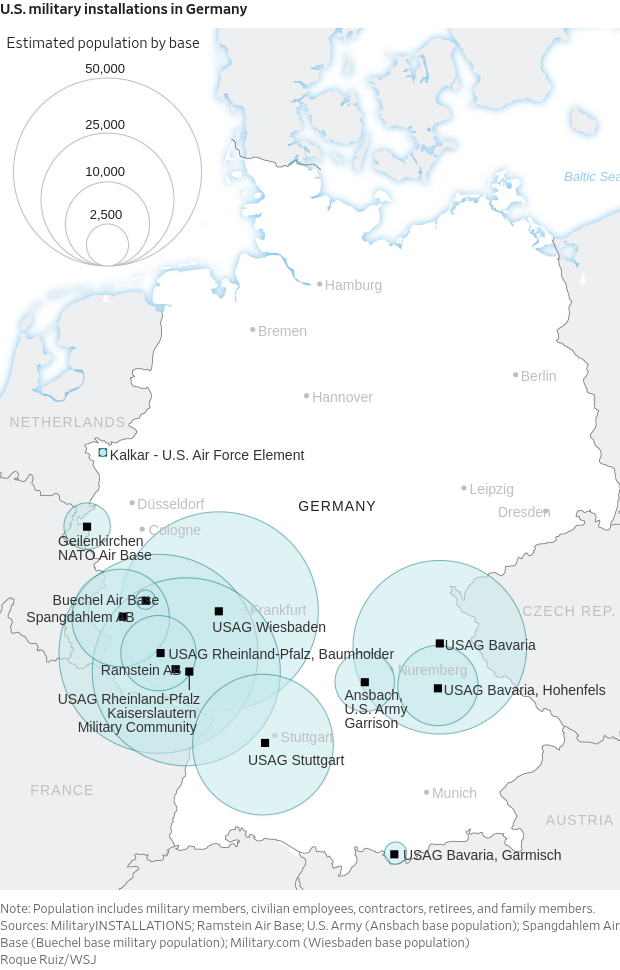
With more than 36,000 U.S. troops in the country, Germany is the biggest American military hub in Europe and has been used by the U.S. to project power in the Middle East. Bases in the country have served as key logistics hubs and fueling stops for Operation Epic Fury, as the U.S. military campaign against Iran is known.
“This decision follows a thorough review of the Department’s force posture in Europe,” said Sean Parnell, the chief Pentagon spokesman. “We expect the withdrawal to be completed over the next six to twelve months.”
Senior defense officials said the decision would result in the removal of an Army brigade. It will also reverse a Biden administration decision to deploy a battalion with long-range conventional missiles to Germany later this year. That deployment had been announced by the U.S. and Germany at the 2024 North Atlantic Treaty Organization summit in Washington.
While Germany hailed the step at the time as a demonstration of the U.S. commitment to the alliance, the move was sharply criticized by Russian President Vladimir Putin as reminiscent of the Cold War.
The cuts would bring U.S. troop levels in Europe back to where they were in 2022 before Russia’s invasion of Ukraine. The announcement follows on the heels of the Trump administration’s decision last year to remove an American combat brigade from Romania .
Trump has also threatened to withdraw troops from Spain and Italy. He has complained that Spain isn’t spending enough on its military and has been angered by the country’s refusal to allow its bases to be used for the American military campaign against Iran.
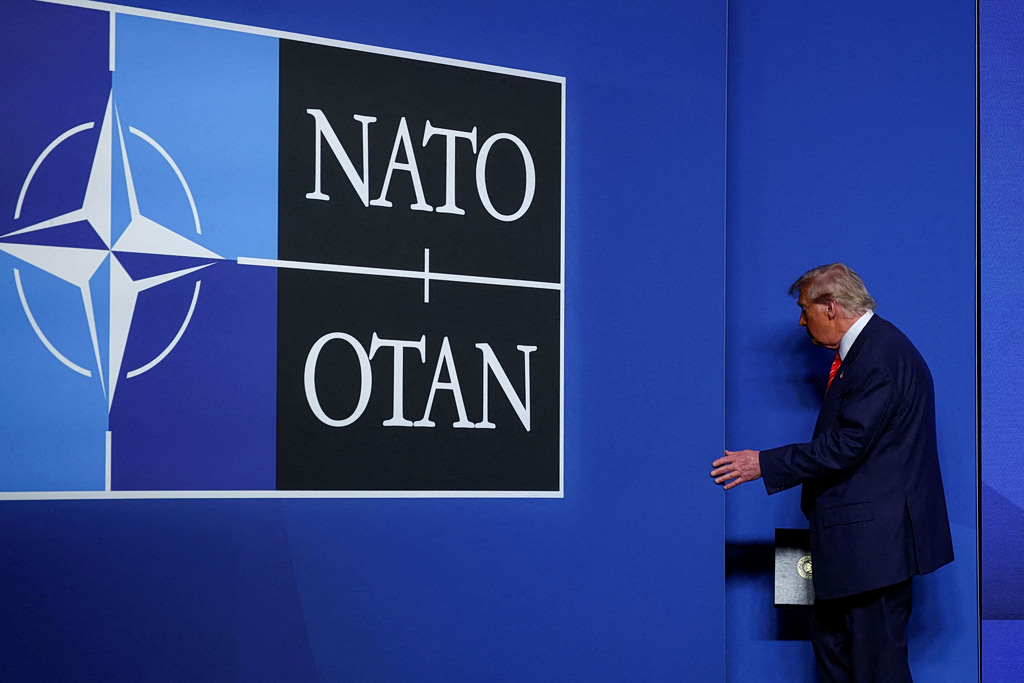
FILE PHOTO: U.S. President Donald Trump leaves a press conference at a NATO summit in The Hague, Netherlands June 25, 2025. REUTERS/Yves Herman
Germany, in contrast to Spain, has been praised by U.S. officials for stepping up its military spending. German officials, who have sought to tamp down trans-Atlantic tensions with the U.S. following Merz’s initial comments, said that they didn’t expect major installations in Ramstein and Stuttgart to be affected by the U.S. troop cuts.
“We are prepared for it. We are discussing the matter closely and in a spirit of trust within all NATO bodies,” Foreign Minister Johann Wadephul said on Thursday, adding that he expected the U.S. to make decisions “in a way that is appropriate among allies and partners.”
Last month, The Wall Street Journal reported that the White House was considering a plan to punish some NATO members who Trump deemed unhelpful to the U.S. and Israel during the Iran war.
Rep. Don Bacon , a Nebraska Republican and a retired Air Force brigadier general, said the decision undermines U.S. efforts to strengthen relationships with allies. “I think it weakens NATO. Russia likes it. It seems like a knee-jerk reaction,” he said.
Germany hosts major U.S. infrastructure including Ramstein Air Base, U.S. European Command, and U.S. Africa Command headquarters, as well as Landstuhl Regional Medical Center, the largest American military hospital outside the U.S., which has treated casualties from the conflict with Iran.
In 2020, the first Trump administration developed plans to take nearly 12,000 troops out of Germany, which the Pentagon framed as a strategic repositioning and Trump as a penalty for Germany being “delinquent” in its military spending. The following year, President Joe Biden halted the withdrawal, and Germany had boosted its military spending since then.
Despite the public trans-Atlantic tensions, Britain has allowed the U.S. to launch bomber missions against targets in Iran from its territory,
While U.S. officials said they were still working out details, they said that the larger aim wasn’t to reposition forces within Europe but to allocate them to the Western Hemisphere and the Indo-Pacific.
The U.S. has about 85,000 troops in Europe, including the USS Gerald R. Ford battlegroup, which has been in the Mediterranean.
Write to Shelby Holliday at shelby.holliday@wsj.com , Michael R. Gordon at michael.gordon@wsj.com and Vera Bergengruen at vera.bergengruen@wsj.com