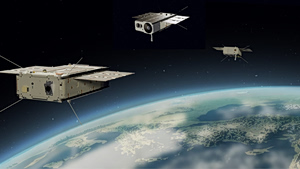

WASHINGTON—The Trump administration covertly sent thousands of Starlink terminals into Iran after the regime’s brutal crackdown on demonstrations last month, U.S. officials said, an effort to keep dissidents online following Tehran’s stifling of internet access.
After Iranian authorities smothered mounting unrest in January by killing thousands of protesters and severely cutting internet connectivity, the U.S. smuggled roughly 6,000 of the satellite-internet kits into the country, the first time the U.S. has directly sent Starlink into Iran.
The State Department had purchased nearly 7,000 Starlink terminals in earlier months—with most bought in January— to help antiregime activists circumvent internet shut-offs in Iran, officials said. The purchase came after senior Trump administration appointees decided to divert some funds from other internet-freedom initiatives inside Iran to the purchasing of Starlink terminals instead.
President Trump was aware of the deliveries, officials said, but they didn’t know if he or someone else directly approved of the plan.
Tehran has repeatedly accused Washington, without evidence, of playing a role in fomenting popular dissent and organizing last month’s nationwide demonstrations in the country of 90 million people. Iranians were protesting years of economic mismanagement, a weakening currency and hard-line rule.
The U.S. has denied any connection to the uprising, though the Starlink operation shows the Trump administration has done more to support antiregime efforts than has been previously known.
The White House declined to comment.
As protests swept Iran, Trump encouraged Iranians to continue demonstrating against the regime, promising them “help is on its way.” Analysts said more Iranians took to the streets expecting Washington’s support in the form of airstrikes on government and military targets. No such attack came.
The U.S. and Iran have since been locked in high-stakes talks over dismantling Iran’s nuclear program. Tehran is reluctant to end any nuclear enrichment , insisting it is necessary for civilian purposes, while Washington aims to close any pathway that could allow Iran to acquire a nuclear weapon. Any failure to reach a deal could see Trump authorize an attack on Iran with a carrier strike group, warships and jet fighters that the U.S. deployed to the Middle East after Tehran crushed the demonstrations.
Trump and Israeli Prime Minister Benjamin Netanyahu met Wednesday in Washington to discuss how to engage Iran. In a Truth Social post, Trump said he preferred to resolve the nuclear problem with Tehran diplomatically. “If it cannot, we will just have to see what the outcome will be,” he wrote.
Owning one of Elon Musk’s Starlink terminals is illegal in Iran and risks a multiyear prison sentence; the repressive regime limits access to independent and foreign media. But tens of thousands of Iranians possess the satellite terminals, analysts and activists say, using them to maintain contact with like-minded citizens and share information outside the control of government firewalls and censors. Iranian authorities search suspected people’s homes and roofs for evidence that they use Starlink, they added.
Trump and Musk spoke in January about ensuring Iranians could use Starlink to access the internet during protests, the White House confirmed at the time.
The administration’s decision to procure Starlink systems came against the backdrop of internal debates over whether diverting funds to Starlink would undercut other important U.S. programs that fund internet access in Iran.
For months, senior officials pushed Starlink as the best way to support antiregime movements inside Iran, alongside or instead of virtual private networks, known more commonly as VPNs. Mora Namdar, who until December led the State Department’s Middle East bureau, in August sent a memo to Secretary of State Marco Rubio urging the acquisition of Starlink expressly for delivery to Iran. While her bureau “has funded a variety of VPNs and other internet freedom technologies, it is useless when the internet is shut down,” she wrote.
Namdar has long been an advocate for empowering Iranians to overthrow the regime. “The question has always been ‘when’ and not ‘if’ the Islamic theocracy in Iran would meet its end,” she wrote in Newsweek during another set of Iranian protests in 2022. The U.S., she continued, should “support the aspirations of the Iranian people for a secular democracy.”
Namdar is now the assistant secretary for consular affairs, though officials say she continues to engage on Iran-related policy.
Internet-freedom experts and other U.S. officials have advocated for fully funding VPNs because they would better protect Iranian dissidents. They argued for funding both Starlink and VPNs, but warned against curbing VPN funds. Operating Starlink without VPNs, they said, would make it easier for Iranian authorities to geolocate the user, adding that VPNs are also more accessible and cost-effective for a broader base of people.
Some 30 million Iranians used U.S.-funded VPNs during the country’s widespread protests in 2022, according to internal State Department data. State Department officials also estimate that around 20% of Iranians were still able to get limited internet access with U.S.-funded VPN services during the 12-day war in June 2025, when the Iranian government issued a nearly full-scale internet blackout following U.S. and Israeli strikes.
Some VPN companies dependent on U.S. funding said they are struggling to provide their service to Iranians, among others. Psiphon, a technology company that provides uncensored internet access to users, now receives about $5.9 million in U.S. funding, compared with $18.5 million in 2024. Michael Hull, Psiphon’s president, said in an interview his company is now straining to meet the research, development and operational costs to help Iranians stay on a freer internet. “We’re running out of time here,” he said.
Hull said Psiphon had about 18.4 million active Iranian users in January, the same month Tehran shut off the internet, though the company detected only 1,500 people operating Psiphon with Starlink when the regime cut off nearly all online access.
When the State Department redirected VPN funds to acquiring Starlink, it allowed funding to lapse for two of five VPN providers for Iran, two U.S. officials said. Three continued with limited support from remaining U.S. funds, they said.
A State Department official said the department supports a range of tools, including VPNs and other technology, to help Iranians stay online through internet restrictions and blackouts. The official said the administration is expanding these capabilities and working with other international partners to share the cost of that expansion.
Kari Lake , deputy CEO of the U.S. Agency for Global Media, a government agency that provides non-censored news and information to foreigners in repressive regimes, has favored Starlink over VPN support, officials said, and offered to use some of her agency’s funds to help with purchasing terminals. In a statement, Lake said her agency spends millions of dollars on VPNs and “is dedicated to utilizing every method possible to get information to the brave people of Iran. That has been my goal from Day 1.”
U.S. officials have long discussed the feasibility of sending Starlink terminals into Iran, with some arguing it was the most dangerous option to secure internet connectivity in the country. Concerns about the risks of the operation, both to U.S. officials delivering the terminals and Iranians receiving them—and the potential for pro-regime figures to gain access—weren’t deemed troubling enough to scuttle the purchases and delivery, officials said.
A handful of American civil-society groups also help Iranians acquire Starlink, officials said.